Binary Tree in C#: Use Cases, Performance Comparison, and Alternatives
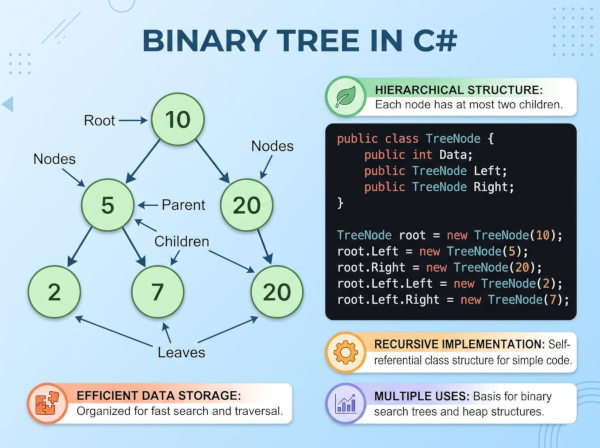
A binary tree is a hierarchical data structure where each node can have at most two child nodes, commonly called the left child and right child.
A binary tree organizes data in a parent-child relationship instead of storing items sequentially like arrays or lists. Each node contains a value and references to its child nodes, which allows efficient searching, insertion, and hierarchical data representation. Binary trees are widely used in databases, compilers, search engines, operating systems, and memory management systems because they provide fast access patterns for sorted or structured data. Different variations such as Binary Search Trees (BST), AVL Trees, and Red-Black Trees improve balancing and performance for large-scale systems.
Why Do We Need Binary Trees?
Binary trees help developers organize and retrieve data efficiently when relationships between elements matter. Unlike arrays or linked lists, binary trees reduce the number of comparisons required for searching large datasets by dividing data into smaller branches. This structure improves performance for operations such as search, insert, delete, and sorting.
Another important advantage is hierarchical representation. Many real-world systems naturally fit into a tree structure, including file systems, organizational charts, syntax parsers, and decision engines. A binary tree allows developers to model these relationships clearly and process them efficiently.
Binary trees also support recursive algorithms very naturally. Operations like traversals, balancing, searching, and path calculations become simpler because each subtree behaves like a smaller version of the whole tree. This recursive nature makes binary trees powerful for algorithm design.
Structure of a Binary Tree
A binary tree node usually contains:
• A value
• A reference to the left child
• A reference to the right child
Example structure:
public class TreeNode
{
public int Value { get; set; }
public TreeNode Left { get; set; }
public TreeNode Right { get; set; }
public TreeNode(int value)
{
Value = value;
}
}
In this structure, every node can connect to two other nodes. The left subtree typically contains smaller values and the right subtree contains larger values in Binary Search Trees.
How to Implement a Binary Tree in C#?
Basic Binary Search Tree (BST) Implementation
The following example shows a practical Binary Search Tree implementation in C#.
using System;
public class TreeNode
{
public int Value;
public TreeNode Left;
public TreeNode Right;
public TreeNode(int value)
{
Value = value;
}
}
public class BinarySearchTree
{
public TreeNode Root;
public void Insert(int value)
{
Root = InsertRecursive(Root, value);
}
private TreeNode InsertRecursive(TreeNode node, int value)
{
if (node == null)
return new TreeNode(value);
if (value < node.Value)
node.Left = InsertRecursive(node.Left, value);
else if (value > node.Value)
node.Right = InsertRecursive(node.Right, value);
return node;
}
public bool Search(int value)
{
return SearchRecursive(Root, value);
}
private bool SearchRecursive(TreeNode node, int value)
{
if (node == null)
return false;
if (node.Value == value)
return true;
if (value < node.Value)
return SearchRecursive(node.Left, value);
return SearchRecursive(node.Right, value);
}
public void InOrderTraversal(TreeNode node)
{
if (node == null)
return;
InOrderTraversal(node.Left);
Console.WriteLine(node.Value);
InOrderTraversal(node.Right);
}
}
class Program
{
static void Main()
{
BinarySearchTree bst = new BinarySearchTree();
bst.Insert(50);
bst.Insert(30);
bst.Insert(70);
bst.Insert(20);
bst.Insert(40);
Console.WriteLine("Search 40: " + bst.Search(40));
Console.WriteLine("Sorted Traversal:");
bst.InOrderTraversal(bst.Root);
}
}
This implementation demonstrates insertion, searching, and traversal operations. The tree automatically organizes values into sorted order, which makes searching much faster than scanning a normal list sequentially.
Binary Tree Traversal Types
Traversal means visiting nodes in a specific order.
In-Order Traversal
In-order traversal visits the left subtree first, then the current node, and finally the right subtree. In Binary Search Trees, this traversal produces sorted output automatically. Databases and indexing systems often use this behavior for ordered data retrieval.
Pre-Order Traversal
Pre-order traversal processes the current node before its children. This approach is useful when copying trees, serializing hierarchical structures, or generating prefix expressions in compilers. It preserves the parent-child relationship efficiently.
Post-Order Traversal
Post-order traversal visits child nodes before the parent node. This is commonly used for deleting trees, releasing memory safely, and evaluating expression trees. Dependency systems also benefit from this traversal order.
Best Binary Tree Use Cases
1. Database Indexing Systems
Database engines use tree structures to accelerate record searching and sorting. Instead of scanning millions of rows sequentially, indexed trees allow the database to navigate quickly through branches and find records efficiently. Balanced tree variants such as B-Trees and B+ Trees are especially important for reducing disk access operations.
Example Concept
bst.Insert(1001);
bst.Insert(1002);
bst.Insert(1003);
bool exists = bst.Search(1002);
This mechanism helps databases retrieve rows much faster than linear searches.
2. File System Hierarchies
Operating systems organize folders and files using tree-like structures because directories naturally form parent-child relationships. A binary tree can represent file paths, nested directories, and search operations efficiently. This structure helps systems quickly navigate large storage hierarchies.
Example Concept
public class FileNode
{
public string Name;
public FileNode LeftFolder;
public FileNode RightFolder;
}
This organization improves lookup speed when navigating complex directory structures.
3. Expression Parsing in Compilers
Compilers use binary trees to represent mathematical and logical expressions internally. Each operator becomes a parent node while operands become child nodes. This structure allows the compiler to evaluate precedence rules and generate executable instructions correctly.
Example Concept
public class ExpressionNode
{
public string Operator;
public ExpressionNode Left;
public ExpressionNode Right;
}
For example, the expression (5 + 3) * 2 can be represented as a tree where multiplication is the root node and addition becomes a subtree.
Binary Tree Performance Comparison
Time Complexity Overview
| Operation | Binary Search Tree (Average) | Binary Search Tree (Worst) | Balanced Trees (AVL / Red-Black) |
|---|---|---|---|
| Search | O(log n) | O(n) | O(log n) |
| Insert | O(log n) | O(n) | O(log n) |
| Delete | O(log n) | O(n) | O(log n) |
| Traversal | O(n) | O(n) | O(n) |
Why Balanced Trees Matter?
A normal Binary Search Tree can become unbalanced if data is inserted in sorted order. For example, inserting 10, 20, 30, 40 sequentially creates a structure similar to a linked list rather than a balanced tree. This degrades performance from O(log n) to O(n).
Balanced trees such as AVL Trees and Red-Black Trees automatically reorganize nodes after insertions and deletions. This balancing mechanism ensures search operations remain fast even with very large datasets.
Alternatives to Binary Trees
Hash Tables
Hash tables provide extremely fast average lookup times using key-value mapping. Unlike binary trees, they do not maintain sorted order, but they are excellent for caching systems, session storage, and dictionary-style access patterns. Applications requiring constant-time lookups often prefer hash tables over trees.
B-Trees
B-Trees are optimized for storage systems and databases where minimizing disk reads is critical. Instead of allowing only two children per node, B-Trees store many keys and children inside each node. This dramatically reduces traversal depth and improves performance for large persistent datasets.
Graph Data Structures
Graphs are better suited for systems where relationships are many-to-many rather than hierarchical. Social networks, routing engines, and recommendation systems often use graphs because nodes may connect in multiple directions. Binary trees are too restrictive for these relationship-heavy models.
Linked Lists
Linked lists are simpler linear structures where each node points to the next item. They work well for sequential operations and dynamic memory allocation but perform poorly for searching large datasets. Binary trees improve search efficiency significantly compared to linked lists.
Trie Structures
Tries are specialized tree structures optimized for prefix searching and autocomplete systems. Search engines, dictionaries, and code editors use tries to retrieve matching prefixes efficiently. Unlike binary trees, tries organize data character by character instead of by comparison rules.
Binary Tree vs Other Data Structures
| Data Structure | Main Strength | Main Weakness | Best Usage Scenario |
|---|---|---|---|
| Binary Tree | Efficient sorted searching | Can become unbalanced | Hierarchical searchable data |
| Hash Table | Very fast lookup | No sorted ordering | Key-value storage |
| B-Tree | Excellent disk optimization | More complex implementation | Databases and file systems |
| Linked List | Simple dynamic insertion | Slow searching | Sequential processing |
| Trie | Fast prefix matching | Higher memory usage | Autocomplete systems |
Final Recommendation
Binary trees are one of the most important foundational data structures in computer science because they combine hierarchical organization with efficient searching and sorting capabilities.
For small and medium-sized in-memory datasets, Binary Search Trees provide an elegant and efficient solution. However, for production-grade systems handling large datasets, balanced tree variants such as AVL Trees, Red-Black Trees, or B-Trees are usually preferred because they guarantee stable performance.
Understanding binary trees also helps developers learn more advanced concepts such as database indexing, compiler design, memory management, graph processing, and distributed systems architecture.

