BFS vs DFS in C#: Differences, Algorithms and Use Cases
What is BFS?
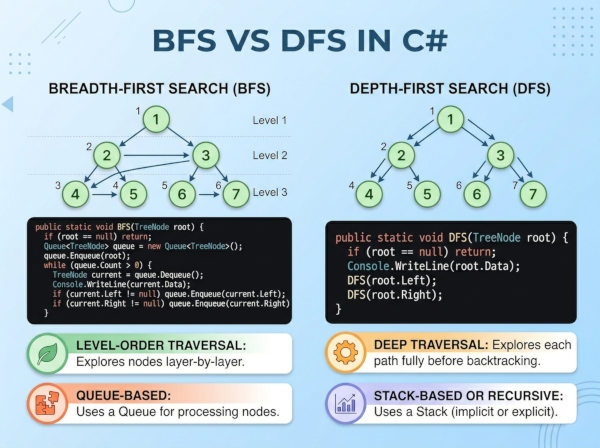
Breadth-First Search (BFS) is a graph or tree traversal algorithm that explores nodes level by level before moving deeper into the structure.
BFS starts from a root or starting node and visits all immediate neighbors first. After finishing one level, it continues to the next level of connected nodes. This approach guarantees the shortest path in unweighted graphs because nodes are explored in order of distance from the source. BFS commonly uses a queue data structure to keep track of nodes waiting to be processed.
What is DFS?
Depth-First Search (DFS) is a graph or tree traversal algorithm that explores one branch completely before backtracking and exploring another branch.
DFS starts from a node and follows one path as deeply as possible until no further nodes are available. It then backtracks to previous nodes and continues exploring remaining branches. This algorithm is commonly implemented using recursion or a stack data structure. DFS is widely used in pathfinding, dependency resolution, cycle detection, and recursive problem-solving scenarios.
Why Do We Need BFS and DFS?
Graphs and trees are everywhere in software engineering, including social networks, routing systems, recommendation engines, compilers, and file systems. BFS and DFS provide systematic ways to explore connected data structures efficiently.
BFS is useful when the shortest route or nearest result matters. DFS is useful when the goal is exhaustive exploration, dependency traversal, or recursive analysis. These algorithms form the foundation for many advanced systems including AI search engines, network analysis tools, and optimization algorithms.
BFS Traversal Logic
BFS processes nodes in this order:
• Visit the starting node.
• Add its neighbors to a queue.
• Process neighbors one by one.
• Continue level by level.
BFS always explores the closest nodes first.
DFS Traversal Logic
DFS processes nodes in this order:
• Visit the starting node.
• Move deeply into one branch.
• Continue until no nodes remain.
• Backtrack and explore other branches.
DFS focuses on depth before breadth.
BFS Implementation in C#
BFS Using Queue
using System;
using System.Collections.Generic;
class Graph
{
private Dictionary<string, List<string>> adjacencyList =
new Dictionary<string, List<string>>();
public void AddEdge(string node, string neighbor)
{
if (!adjacencyList.ContainsKey(node))
adjacencyList[node] = new List<string>();
adjacencyList[node].Add(neighbor);
}
public void BFS(string startNode)
{
Queue<string> queue = new Queue<string>();
HashSet<string> visited = new HashSet<string>();
queue.Enqueue(startNode);
visited.Add(startNode);
while (queue.Count > 0)
{
string current = queue.Dequeue();
Console.WriteLine(current);
foreach (var neighbor in adjacencyList[current])
{
if (!visited.Contains(neighbor))
{
visited.Add(neighbor);
queue.Enqueue(neighbor);
}
}
}
}
}
class Program
{
static void Main()
{
Graph graph = new Graph();
graph.AddEdge("A", "B");
graph.AddEdge("A", "C");
graph.AddEdge("B", "D");
graph.AddEdge("B", "E");
graph.AddEdge("C", "F");
Console.WriteLine("BFS Traversal:");
graph.BFS("A");
}
}
How BFS Works in This Example
The algorithm begins with node A. It visits all directly connected neighbors before moving deeper into the graph. Internally, the queue ensures nodes are processed in the order they were discovered.
This behavior makes BFS ideal for shortest-path calculations, nearest-neighbor searches, and layered traversal systems.
DFS Implementation in C#
DFS Using Recursion
using System;
using System.Collections.Generic;
class Graph
{
private Dictionary<string, List<string>> adjacencyList =
new Dictionary<string, List<string>>();
private HashSet<string> visited =
new HashSet<string>();
public void AddEdge(string node, string neighbor)
{
if (!adjacencyList.ContainsKey(node))
adjacencyList[node] = new List<string>();
adjacencyList[node].Add(neighbor);
}
public void DFS(string node)
{
if (visited.Contains(node))
return;
visited.Add(node);
Console.WriteLine(node);
foreach (var neighbor in adjacencyList[node])
{
DFS(neighbor);
}
}
}
class Program
{
static void Main()
{
Graph graph = new Graph();
graph.AddEdge("A", "B");
graph.AddEdge("A", "C");
graph.AddEdge("B", "D");
graph.AddEdge("B", "E");
graph.AddEdge("C", "F");
Console.WriteLine("DFS Traversal:");
graph.DFS("A");
}
}
How DFS Works in This Example
The algorithm starts from node A and explores one branch completely before moving to another branch. If it reaches a dead end, recursion automatically backtracks to earlier nodes.
This depth-oriented behavior makes DFS excellent for solving recursive problems, exploring possibilities, and traversing complex dependency trees.
BFS vs DFS Core Difference
The main difference is traversal strategy.
• BFS explores horizontally level by level.
• DFS explores vertically branch by branch.
BFS prioritizes shortest distance, while DFS prioritizes deep exploration. Their internal data structures also differ:
• BFS uses a Queue (FIFO)
• DFS uses a Stack or Recursion (LIFO)
Real-World BFS Use Cases
1. Shortest Path in Navigation Systems
Navigation systems use BFS to find the minimum number of steps between locations in unweighted graphs. For example, a subway routing application may use BFS to identify the fewest station transfers between two destinations. Because BFS explores nearby nodes first, it naturally discovers the shortest route.
Example Scenario
graph.BFS("CentralStation");
This traversal helps transportation systems process route calculations efficiently.
2. Social Network Friend Suggestions
Social media platforms analyze connections level by level to recommend nearby users. BFS helps identify friends-of-friends before exploring more distant relationships. This improves recommendation relevance while reducing unnecessary processing.
Example Scenario
graph.BFS("User123");
The algorithm can discover second-degree and third-degree connections systematically.
3. Web Crawlers
Search engines use BFS-like traversal strategies to discover pages layer by layer across the internet. Starting from known websites, crawlers explore connected links gradually. This controlled expansion prevents excessive deep traversal into isolated website branches.
Example Scenario
queue.Enqueue("https://www.howcsharp.com");
This mechanism helps search engines index websites efficiently.
Real-World DFS Use Cases
1. File System Traversal
Operating systems often use DFS when scanning nested folders and files. The algorithm explores one directory deeply before returning to sibling folders. This behavior is efficient for recursive file operations such as backups or cleanup tasks.
Example Scenario
DFS("RootFolder");
DFS naturally matches hierarchical file system structures.
2. Solving Mazes and Puzzles
DFS is commonly used in maze-solving algorithms because it aggressively explores one path until reaching a dead end. Once blocked, the algorithm backtracks automatically and tries another route. This strategy works well for recursive problem-solving systems.
Example Scenario
DFS("MazeStart");
Game engines and puzzle solvers often use this approach.
3. Dependency Resolution
Package managers and build systems use DFS to process dependencies recursively. A dependency tree may contain many nested libraries that must be resolved before compilation. DFS ensures child dependencies are processed before parent components.
Example Scenario
DFS("MainProject");
This guarantees correct build order in software compilation pipelines.
BFS vs DFS Performance Comparison
| Category | BFS | DFS |
|---|---|---|
| Traversal Strategy | Level by level | Depth first |
| Main Data Structure | Queue | Stack / Recursion |
| Shortest Path Support | Yes (unweighted graphs) | No guarantee |
| Memory Usage | Higher in wide graphs | Usually lower |
| Best for Deep Structures | Less efficient | Very efficient |
| Time Complexity | O(V + E) | O(V + E) |
| Space Complexity | O(V) | O(V) |
| Typical Use Cases | Shortest path, nearest search | Recursive exploration, dependency traversal |
When Should You Choose BFS?
Choose BFS when finding the shortest path or nearest result is important. Systems involving routing, recommendation layers, or minimum-step calculations benefit significantly from BFS because it guarantees the shortest solution in unweighted graphs.
BFS is also better when the target is likely to exist near the starting point. Since it explores nearby nodes first, it avoids unnecessary deep traversal.
When Should You Choose DFS?
Choose DFS when deep exploration matters more than shortest paths. Recursive systems such as compilers, file scanners, dependency managers, and puzzle solvers often perform better with DFS.
DFS is also useful when memory efficiency is important in wide graphs. Because DFS explores one branch at a time, it often stores fewer active nodes in memory compared to BFS.
Alternatives and Related Algorithms
Dijkstra’s Algorithm
Dijkstra’s Algorithm extends BFS concepts to weighted graphs where edges have different costs. Navigation systems and logistics platforms use it to calculate the cheapest or fastest route instead of the shortest number of steps.
A* Search Algorithm
A* improves pathfinding by using heuristics to guide traversal toward the target. Video games and robotics systems commonly use A* because it reduces unnecessary exploration compared to pure BFS.
Bidirectional Search
Bidirectional search runs BFS simultaneously from both the start and target nodes. This significantly reduces search space in large graphs and improves performance for route-finding systems.
Iterative Deepening DFS (IDDFS)
IDDFS combines DFS memory efficiency with BFS depth guarantees. It repeatedly performs DFS with increasing depth limits. AI systems and game engines often use this hybrid approach.
Final Recommendation
BFS and DFS are foundational graph traversal algorithms that solve different types of problems effectively.
Use BFS when shortest paths, nearest matches, or level-based exploration are required. Use DFS when recursive exploration, dependency traversal, or deep structural analysis matters more.
In real-world systems, both algorithms are frequently combined with advanced search techniques, caching strategies, and graph optimizations to handle large-scale datasets efficiently.