Clustering in ML
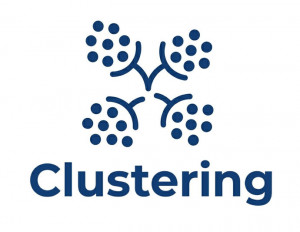
Clustering is an unsupervised machine learning technique used to group similar data points together based on their characteristics, without using labeled outputs.
Unlike classification, clustering does not rely on predefined labels. Instead, it discovers hidden structures or patterns in the data.
Clustering is widely used in:
• Customer segmentation
• Market analysis
• Document grouping
• Image compression
• Anomaly detection
• Social network analysis
Why Do We Use Clustering?
Many datasets do not come with labels, making supervised learning impossible.
Clustering helps identify natural groupings in data, enabling insights that are not immediately visible.
It is especially useful for exploratory data analysis and pattern discovery.
When Should You Use Clustering?
Clustering should be used when:
• Data is unlabeled
• You want to discover hidden patterns
• You need to group similar items
• You are exploring datasets
Common scenarios include:
• Customer segmentation in marketing
• Grouping similar documents or articles
• Detecting anomalies in system behavior
• Organizing large datasets
How Clustering Works
Clustering algorithms measure similarity between data points using distance metrics such as Euclidean distance.
The algorithm then groups points into clusters where intra-group similarity is high and inter-group similarity is low.
Typical workflow:
• Collect data
• Normalize features
• Choose clustering algorithm
• Define number of clusters (if required)
• Run clustering model
• Analyze results
Types of Clustering Algorithms
Centroid-Based Clustering
Groups data around central points (centroids).
Example: K-Means clustering
Best for well-separated spherical clusters.
Hierarchical Clustering
Builds a tree-like structure of clusters.
Types:
• Agglomerative (bottom-up)
• Divisive (top-down)
Useful when the number of clusters is unknown.
Density-Based Clustering
Groups data based on dense regions of points.
Example: DBSCAN
Can detect noise and irregular cluster shapes.
Distribution-Based Clustering
Assumes data comes from probability distributions.
Example: Gaussian Mixture Models (GMM)
Popular Clustering Algorithms
K-Means Clustering
Partitions data into K clusters by minimizing distance to centroids.
Steps:
• Choose K
• Initialize centroids
• Assign points to nearest centroid
• Recalculate centroids
• Repeat until convergence
Hierarchical Clustering
Creates a dendrogram representing nested clusters.
No need to predefine number of clusters.
DBSCAN (Density-Based Spatial Clustering of Applications with Noise)
Groups points based on density and identifies outliers as noise.
Useful for irregular-shaped clusters.
Clustering Evaluation Methods
Since clustering is unsupervised, evaluation is more complex.
Silhouette Score
Measures how similar a point is to its own cluster compared to other clusters.
Davies-Bouldin Index
Measures cluster separation and compactness.
Elbow Method
Used to determine optimal number of clusters in K-Means.
Clustering vs Classification
| Feature | Clustering | Classification |
|---|---|---|
| Learning Type | Unsupervised | Supervised |
| Labels | Not required | Required |
| Goal | Group similar data | Predict categories |
| Output | Clusters | Class labels |
Real-World Use Cases
• Customer segmentation in marketing
• Recommendation systems
• Fraud detection anomaly grouping
• Document clustering in search engines
• Image compression and grouping
• Social network community detection
Advantages of Clustering
• Works without labeled data
• Useful for exploratory analysis
• Discovers hidden patterns
• Scalable to large datasets
• Flexible across domains
Disadvantages of Clustering
• Hard to evaluate accuracy
• Sensitive to feature scaling
• Requires parameter tuning
• Results may vary by algorithm
• Can struggle with high-dimensional data
Common Mistakes
• Not normalizing data
• Choosing wrong number of clusters
• Ignoring outliers
• Using inappropriate distance metrics
• Misinterpreting clusters as ground truth
Best Practices
• Always scale features
• Try multiple clustering algorithms
• Validate with internal metrics
• Visualize clusters when possible
• Reduce dimensions before clustering
Conclusion
Clustering is a powerful unsupervised learning technique that helps discover hidden structures in data. It is widely used in customer segmentation, anomaly detection, and exploratory data analysis.
Understanding clustering algorithms and evaluation methods is essential for extracting meaningful insights from unlabeled datasets.