Reinforcement Learning: Concepts, Algorithms and Applications
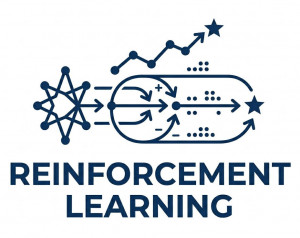
Reinforcement Learning (RL) is a type of machine learning where an agent learns how to make decisions by interacting with an environment and receiving rewards or penalties based on its actions.
Unlike supervised learning, RL does not rely on labeled datasets. Instead, it learns through trial and error over time.
Reinforcement learning is widely used in:
• Game AI systems
• Robotics
• Autonomous driving
• Recommendation systems
• Resource optimization
• Trading and financial systems
Why Do We Use Reinforcement Learning?
Many real-world problems involve sequential decision-making where each action affects future outcomes.
Reinforcement learning is designed to optimize long-term rewards rather than immediate results.
It is especially useful when:
• The environment is dynamic
• Decisions are sequential
• Feedback is delayed
• No labeled data exists
When Should You Use Reinforcement Learning?
Reinforcement learning is suitable when:
• An agent must learn by interacting with an environment
• You need optimal decision-making over time
• Rules are not explicitly defined
• Long-term reward optimization is required
Common applications include:
• Game-playing AI (e.g., chess, Go)
• Robotics control systems
• Dynamic pricing systems
• Traffic signal optimization
• Recommendation ranking systems
How Reinforcement Learning Works
RL is based on the interaction between an agent and an environment:
• The agent takes an action
• The environment responds with a new state
• The agent receives a reward or penalty
• The process repeats
The goal is to maximize cumulative reward over time.
Core Concepts of Reinforcement Learning
Agent
The learner or decision-maker that interacts with the environment.
Environment
The system with which the agent interacts.
State
A representation of the current situation of the environment.
Action
Choices made by the agent.
Reward
A feedback signal that indicates how good or bad an action was.
Policy
A strategy used by the agent to decide actions based on states.
Value Function
Estimates how good a state or action is in terms of future rewards.
Exploration vs Exploitation
One of the key challenges in RL is balancing:
• Exploration: trying new actions
• Exploitation: using known best actions
Too much exploration slows learning, while too much exploitation may miss better strategies.
Common Reinforcement Learning Algorithms
Q-Learning
A value-based algorithm that learns the best action-value pairs using a Q-table.
Deep Q Network (DQN)
Uses neural networks to approximate Q-values for large state spaces.
Policy Gradient Methods
Directly optimize the policy instead of value functions.
Actor-Critic Methods
Combine value-based and policy-based approaches for improved performance.
Markov Decision Process (MDP)
Reinforcement learning is often modeled using MDPs, which define:
• States
• Actions
• Rewards
• Transition probabilities
MDPs assume the future depends only on the current state, not past history.
Real-World Use Cases
• Game AI (chess, Go, video games)
• Robotics control systems
• Autonomous vehicle navigation
• Recommendation ranking optimization
• Financial trading strategies
• Resource allocation in cloud systems
Advantages of Reinforcement Learning
• Learns optimal strategies through experience
• Works in dynamic environments
• Does not require labeled data
• Optimizes long-term rewards
• Can handle complex decision-making problems
Disadvantages of Reinforcement Learning
• Requires large training time
• Computationally expensive
• Hard to tune hyperparameters
• Unstable training in complex environments
• Requires careful reward design
Common Mistakes
• Poor reward function design
• Ignoring exploration-exploitation balance
• Overfitting to simulated environments
• Insufficient training episodes
• Not normalizing state inputs
Best Practices
• Design clear reward functions
• Start with simple environments
• Use experience replay (for deep RL)
• Normalize state representations
• Monitor convergence carefully
Conclusion
Reinforcement learning is a powerful machine learning paradigm focused on learning through interaction and reward feedback. It enables intelligent decision-making systems capable of adapting to dynamic environments.
With applications in robotics, gaming, and autonomous systems, RL is a key component of modern artificial intelligence research and development.