Application Program Interface (API)
Application Program Interface (API) is a set of rules and protocols that allows different software systems to communicate with each other.
An API defines how requests and responses should be structured so that one application can access features or data from another system in a standardized way.
APIs are used everywhere in modern software development, including:
• Web applications
• Mobile applications
• Cloud services
• Microservices architectures
• Third-party integrations
Why Do We Use APIs?
APIs solve the problem of system integration. Instead of building everything from scratch, developers can reuse existing services and data through APIs.
They allow:
• Communication between frontend and backend
• Integration with external services
• Modular system design
• Code reuse and scalability
For example, a weather app does not calculate weather data itself; it calls a weather API.
When Should You Use an API?
APIs are used when:
• You need to expose data or functionality to other systems
• You want to build microservices
• You integrate third-party services (payment, maps, authentication)
• You separate frontend and backend architecture
Common scenarios include:
• ASP.NET Core Web APIs
• Mobile backend services
• SaaS platforms
• Cloud-based systems
How APIs Work
APIs work using a request-response model:
• A client sends a request
• The server processes the request
• The server returns a response
Communication usually happens over HTTP using formats like JSON or XML.
API Architecture
Most modern APIs follow a client-server architecture.
The client (frontend, mobile app, or another service) communicates with the API server through endpoints.
Each endpoint represents a specific function or resource.
Types of APIs
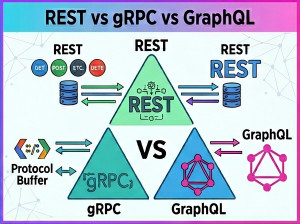
REST API
REST (Representational State Transfer) is the most common API architecture style.
It uses HTTP methods like GET, POST, PUT, DELETE.
REST APIs are stateless and typically use JSON format.
SOAP API
SOAP (Simple Object Access Protocol) is a protocol-based API that uses XML.
It is more rigid and secure but heavier than REST.
GraphQL API
GraphQL allows clients to request exactly the data they need.
It reduces over-fetching and under-fetching of data.
gRPC API
gRPC is a high-performance API framework developed by Google.
It uses Protocol Buffers and is commonly used in microservices.
HTTP Methods in REST APIs
GET
Used to retrieve data.
POST
Used to create new resources.
PUT
Used to update existing resources.
DELETE
Used to delete resources.
Example: ASP.NET Core Web API
[ApiController]
[Route("api/[controller]")]
public class UsersController : ControllerBase
{
[HttpGet]
public IEnumerable<string> Get()
{
return new[] { "Alice", "Bob" };
}
}
This simple API returns a list of users.
API Request Example
Example request:
GET /api/users HTTP/1.1
Host: howcsharp.com
Example response:
[ "Alice", "Bob" ]
API Security
APIs must be protected to prevent unauthorized access.
Common security methods include:
• Authentication (JWT, OAuth)
• API Keys
• Rate limiting
• HTTPS encryption
Advantages of APIs
• Reusability of services
• Faster development
• Scalability
• Easy integration
• Separation of concerns
Disadvantages of APIs
• Security risks if not protected
• Network dependency
• Versioning complexity
• Performance overhead
Common Mistakes
• Poor endpoint design
• Missing authentication
• Overexposing internal data
• Not using versioning
• Ignoring error handling
Best Practices
• Use RESTful naming conventions
• Implement proper authentication
• Use versioned APIs (v1, v2)
• Return consistent response formats
• Document APIs using Swagger/OpenAPI
API vs SDK
| Feature | API | SDK |
|---|---|---|
| Definition | Interface for communication | Development toolkit |
| Scope | Narrow (communication only) | Broader (tools + libraries) |
| Usage | System integration | Application development |
| Complexity | Lower | Higher |
Conclusion
An API is a fundamental building block of modern software architecture. It enables communication between systems, supports scalability, and allows developers to build modular applications.
With technologies like REST, GraphQL, and gRPC, APIs have become the backbone of distributed systems, microservices, and cloud-native applications.