Test-Driven Development (TDD) in C#: Principles, Workflow, Benefits and Best Practices
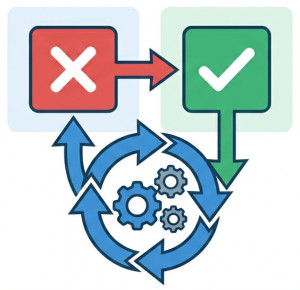
Test-Driven Development (TDD) is a software development methodology where automated tests are written before the actual application code. Instead of implementing features first and testing later, developers begin by defining the expected behavior through tests.
TDD follows a simple iterative cycle:
• Write a failing test
• Implement the minimum code required to pass the test
• Refactor the code while keeping tests green
This workflow is commonly known as the Red-Green-Refactor cycle.
TDD is heavily used in modern software engineering because it improves:
• Code quality
• Maintainability
• Reliability
• Refactoring safety
• Test coverage
• Long-term scalability
In C# and ASP.NET Core ecosystems, TDD is widely adopted in:
• Enterprise backend systems
• Microservices
• Financial systems
• SaaS applications
• Domain-driven design (DDD)
• Clean Architecture projects
Why Do We Use Test-Driven Development?
As applications grow, maintaining software quality becomes increasingly difficult. Manual testing alone is rarely sufficient for large-scale systems.
TDD helps developers create safer and more predictable systems by validating behavior continuously during development.
One major advantage is early bug detection. Since tests are written before implementation, developers often discover design problems earlier in the development lifecycle.
TDD also encourages loosely coupled and modular code because tightly coupled systems are difficult to test.
Another important benefit is refactoring confidence. Developers can safely improve internal implementation details while relying on automated tests to detect regressions.
When Should You Use TDD?
TDD is especially valuable when building:
• Business-critical systems
• Financial applications
• APIs and backend services
• Long-term enterprise software
• Reusable libraries
• Complex domain logic
• Microservices
TDD works particularly well for:
• Domain-driven design
• Dependency injection architectures
• SOLID-based systems
• Clean Architecture implementations
However, TDD may provide limited value for:
• Simple prototypes
• Experimental UI-heavy projects
• Very short-lived applications
• Pure static content websites
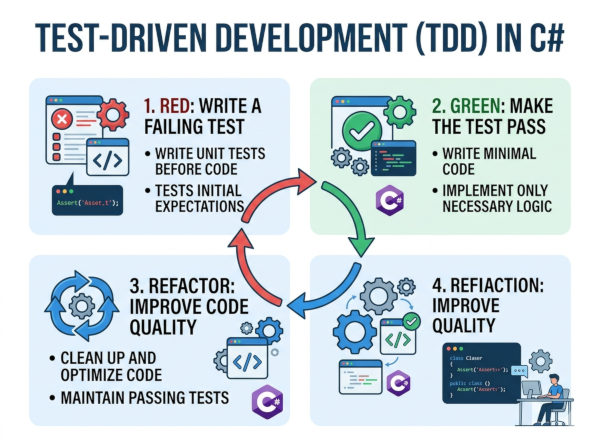
Understanding the Red-Green-Refactor Cycle
Red Phase
The developer writes a failing test first.
The purpose is defining expected behavior before implementation exists.
Example:
[Fact] public void Add_ShouldReturnCorrectResult() { var calculator = new Calculator();var result = calculator.Add(2, 3);Assert.Equal(5, result); }
The test initially fails because the Add method does not exist yet.
Green Phase
The developer writes the minimum amount of code required to pass the test.
public class Calculator {public int Add(int a, int b){return a + b;} }
The objective is not perfection initially. The goal is making the test pass.
Refactor Phase
After tests pass, developers improve the implementation while preserving functionality.
Refactoring may include:
• Removing duplication
• Improving naming
• Simplifying logic
• Extracting services
• Optimizing performance
Automated tests ensure behavior remains correct during refactoring.
Installing xUnit in .NET
xUnit is one of the most popular testing frameworks in modern .NET applications.
dotnet new xunit
Add the test project reference:
dotnet add reference ../MyProject/MyProject.csproj
Writing Your First TDD Test in C#
Example service:
public class DiscountService {public decimal Calculate(decimal price){if (price > 100)return price * 0.9m;return price;} }
TDD test:
[Fact] public void Calculate_ShouldApplyDiscount_WhenPriceExceeds100() {var service = new DiscountService();var result = service.Calculate(200);Assert.Equal(180, result); }
Using Mocking in TDD
Real enterprise systems often depend on external services and infrastructure components.
Mocking isolates dependencies during testing.
public interface IEmailService {void Send(string email); }
[Fact] public void Register_ShouldSendWelcomeEmail() {var emailMock = new Mock();emailMock.Verify(x => x.Send("test@howcsharp.com"),Times.Once); }
TDD in ASP.NET Core APIs
TDD is heavily used in ASP.NET Core backend systems.
Typical test targets include:
• Business services
• Domain logic
• Validation rules
• Authentication logic
• Repository layers
• API endpoints
Example validation test:
[Fact] public void CreateUser_ShouldThrowException_WhenEmailIsInvalid() {var service = new UserService();Assert.Throws(() => service.CreateUser("invalid-email")); }
Best Practices for TDD
Keep Tests Small
Each test should validate a single behavior.
Use Meaningful Test Names
Good naming improves readability and maintainability.
Good example:
Calculate_ShouldApplyDiscount_WhenPriceExceeds100
Keep Tests Deterministic
Tests should always produce consistent results.
Avoid:
• Random values
• Real-time dependencies
• External network calls
• Shared mutable state
Run Tests Automatically
TDD works best when integrated into CI/CD pipelines.
Common TDD Mistakes
Writing Too Much Code Before Tests
TDD requires developers to write tests first.
Overusing Mocking
Excessive mocking creates fragile tests tightly coupled to implementation details.
Ignoring Integration Tests
Unit tests alone are insufficient for large production systems.
Slow Test Suites
Very slow tests reduce developer productivity and discourage continuous testing.
Advantages of TDD
• Improved code quality
• Safer refactoring
• Better maintainability
• Reduced bug rates
• Better architectural design
• Higher long-term reliability
Disadvantages of TDD
• Initial learning curve
• Additional upfront development time
• Poor tests may become maintenance burden
• Not ideal for every project type
Popular Testing Frameworks in .NET
| Framework | Description | Common Usage |
|---|---|---|
| xUnit | Modern .NET Testing Framework | ASP.NET Core |
| NUnit | Mature and Flexible | Enterprise Applications |
| MSTest | Microsoft Testing Framework | Visual Studio Ecosystem |
| Moq | Mocking Framework | Dependency Isolation |
Conclusion
Test-Driven Development is one of the most effective software engineering practices for building reliable, maintainable, and scalable applications.
By following the Red-Green-Refactor workflow, developers continuously validate application behavior while improving architecture quality over time.
In modern C# and ASP.NET Core systems, TDD helps teams reduce bugs, improve maintainability, increase refactoring confidence, and build production-ready enterprise applications with stronger long-term stability.