PostgreSQL vs MySQL vs MariaDB: Architecture, Performance, Use Cases and Key Differences
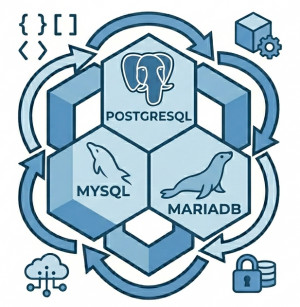
PostgreSQL, MySQL, and MariaDB are three of the most widely used relational database management systems (RDBMS) in modern software development.
All three use SQL and support relational data modeling, but they differ significantly in architecture, extensibility, performance characteristics, and ecosystem design.
They are commonly used in:
• Web applications
• Enterprise systems
• SaaS platforms
• E-commerce systems
• Cloud-native microservices
High-Level Overview
PostgreSQL is an advanced open-source database focused on extensibility and strict standards compliance.
MySQL is a widely adopted relational database optimized for simplicity and web workloads.
MariaDB is a community-driven fork of MySQL designed to improve performance and remain fully open source.
Architecture Comparison
All three systems follow a client-server architecture, but differ in internal design.
PostgreSQL uses a highly extensible process-based architecture with strong ACID compliance and advanced query planning.
MySQL uses a storage engine-based architecture where engines like InnoDB handle data storage and transactions.
MariaDB extends MySQL’s architecture with additional storage engines and performance optimizations.
Core Feature Comparison
PostgreSQL:
• Advanced SQL compliance
• Complex queries and joins
• JSON support (strong document features)
• Extensibility (custom types, functions)
• GIS support (PostGIS)
MySQL:
• Simple and fast setup
• High read performance
• Widely supported ecosystem
• Strong web application usage
• Mature tooling
MariaDB:
• MySQL compatibility
• Additional storage engines
• Better community-driven development
• Performance improvements in some workloads
• Open governance model
Performance Comparison
Performance depends heavily on workload type rather than raw speed.
PostgreSQL performs best in:
• Complex queries
• Analytical workloads
• Large joins
• Data integrity-heavy systems
MySQL performs best in:
• Simple read-heavy workloads
• Web applications
• High-traffic CRUD systems
MariaDB performs best in:
• MySQL-like workloads
• High concurrency systems
• Optimized storage engine usage scenarios
ACID and Consistency Model
All three databases support ACID transactions, but with different strengths.
PostgreSQL provides the strongest consistency guarantees and strict SQL compliance.
MySQL (InnoDB) provides solid ACID compliance optimized for performance.
MariaDB also supports ACID via InnoDB and additional engines depending on configuration.
Replication and Scalability
MySQL and MariaDB use traditional replication models with master-slave or master-replica setups.
PostgreSQL supports streaming replication and advanced logical replication mechanisms.
In modern cloud systems, all three support horizontal scaling patterns through read replicas.
C# Integration Example
All three databases can be used in .NET applications using ADO.NET or ORM tools like Entity Framework Core.
Example connection pattern (PostgreSQL / MySQL / MariaDB):
using System.Data;
using MySqlConnector;
// For PostgreSQL: using Npgsql;

var connectionString =
    "Server=localhost;" +
    "Database=AppDb;" +
    "User=root;" +
    "Password=secret;";

using var connection = new MySqlConnection(connectionString);

await connection.OpenAsync();

Console.WriteLine("Database connected.");
With minimal changes, the same pattern works across all three databases using different drivers.
Query Example Comparison
MySQL / MariaDB:
SELECT * FROM Users LIMIT 10;
PostgreSQL (same syntax, more advanced capabilities)
PostgreSQL differentiates itself in advanced queries like window functions and recursive CTEs.
Indexing Differences
PostgreSQL supports advanced indexing types:
• B-tree
• Hash
• GIN
• GiST
MySQL and MariaDB primarily rely on B-tree indexing via InnoDB.
Use Case Comparison
PostgreSQL is best for:
• Complex analytical systems
• Financial applications
• Data-intensive platforms
• GIS and geospatial systems
MySQL is best for:
• Web applications
• CMS systems
• Startup MVPs
• High-read workloads
MariaDB is best for:
• MySQL-compatible systems
• Open-source focused architectures
• Performance-tuned web systems
Advantages and Disadvantages
PostgreSQL:
• Very powerful and extensible
• Strong consistency
• Slower learning curve
MySQL:
• Easy to use and deploy
• Very popular
• Limited advanced features compared to PostgreSQL
MariaDB:
• Open-source friendly
• MySQL compatible
• Some ecosystem fragmentation risks
Conclusion
PostgreSQL, MySQL, and MariaDB are all production-ready relational databases, but they serve different priorities.
PostgreSQL is best for advanced and complex systems, MySQL dominates in simplicity and web usage, and MariaDB provides a strong open-source alternative with MySQL compatibility.
The best choice depends on application complexity, scalability requirements, and ecosystem preferences.