Redis vs Memcached vs In-Memory Cache (.NET MemoryCache): Architecture, Performance and Use Cases
Caching is a fundamental performance optimization technique used to reduce database load, improve response times, and increase scalability in modern applications.
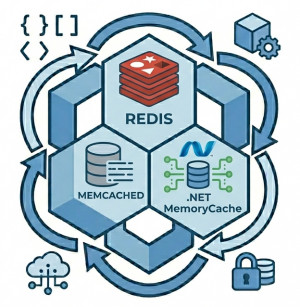
Redis, Memcached, and .NET MemoryCache are three commonly used caching solutions, but they differ significantly in architecture and capabilities.
They are widely used in:
• Web applications
• Microservices
• High-traffic APIs
• Distributed systems
• Real-time applications
High-Level Overview
Redis is an in-memory data structure store used as a distributed cache, message broker, and database.
Memcached is a simple, high-performance distributed memory caching system focused purely on key-value caching.
.NET MemoryCache is an in-process caching system used within a single application instance.
Architecture Comparison
Redis runs as a standalone server and supports distributed caching across multiple application instances.
Memcached also runs as a distributed caching server but with a simpler architecture and fewer features.
.NET MemoryCache runs inside the application process and does not require a separate server.
Key Differences
Redis:
• Advanced data structures (lists, sets, hashes)
• Persistence support
• Pub/Sub messaging
• High scalability
• Distributed cache support
Memcached:
• Simple key-value store
• Extremely fast
• No persistence
• Lightweight architecture
• Horizontal scaling via client-side sharding
.NET MemoryCache:
• In-process caching
• Very low latency
• No network overhead
• Limited to single application instance
• Automatic eviction policies
Performance Comparison
Performance depends on use case and architecture.
.NET MemoryCache is the fastest because it avoids network calls entirely.
Redis provides slightly higher latency due to network communication but scales across distributed systems.
Memcached is extremely fast but simpler and less feature-rich than Redis.
Scalability Comparison
Redis supports clustering, replication, and persistence, making it suitable for large-scale distributed systems.
Memcached scales horizontally but lacks advanced replication or persistence features.
.NET MemoryCache does not scale across multiple servers because it is local to the process.
Data Structure Support
Redis supports rich data structures:
• Strings
• Lists
• Sets
• Sorted sets
• Hashes
Memcached only supports simple key-value pairs.
.NET MemoryCache supports object caching but no advanced structures.
C# Usage Examples
.NET MemoryCache Example:
using Microsoft.Extensions.Caching.Memory;

var cache = new MemoryCache(new MemoryCacheOptions());

cache.Set("user_1", "Alice");

var value = cache.Get("user_1");

Console.WriteLine(value);
Redis Example (StackExchange.Redis):
using StackExchange.Redis;

var redis = ConnectionMultiplexer.Connect("localhost");

var db = redis.GetDatabase();

await db.StringSetAsync("user_1", "Alice");

var value = await db.StringGetAsync("user_1");

Console.WriteLine(value);
Memcached Conceptual Example:
cache.set("user_1", "Alice");
value = cache.get("user_1");
Use Case Comparison
Redis is best for:
• Distributed caching
• Session storage
• Real-time systems
• Message queues (Pub/Sub)
• High-scale architectures
Memcached is best for:
• Simple caching needs
• High-speed read-heavy workloads
• Stateless web applications
• Temporary data storage
.NET MemoryCache is best for:
• Single-instance applications
• Lightweight caching needs
• Fast local lookups
• In-process optimization
Advantages and Disadvantages
Redis:
• Feature-rich
• Highly scalable
• Supports persistence
• More complex setup
Memcached:
• Extremely fast
• Simple architecture
• No persistence
• Limited functionality
.NET MemoryCache:
• Zero network latency
• Very easy to use
• Not distributed
• Memory-bound to process
Common Mistakes
• Using MemoryCache in distributed systems
• Storing large objects without expiration policies
• Not handling cache invalidation
• Overusing Redis for simple local caching
Conclusion
Redis, Memcached, and .NET MemoryCache are all effective caching solutions, but they serve different architectural needs.
Redis is the most powerful and scalable option, Memcached is the simplest high-speed distributed cache, and MemoryCache is ideal for in-process optimization.
Choosing the right caching strategy depends on system architecture, scalability requirements, and performance goals.