Producer-Consumer vs Pipeline vs Actor Model in C#: Concurrency Patterns and System Design
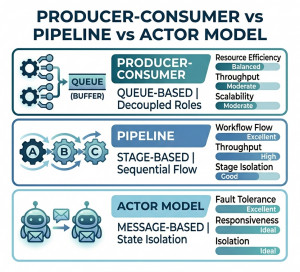
Modern distributed and high-performance applications rely on structured concurrency patterns to manage data flow, parallelism, and state safely.
The three most important patterns in this category are Producer-Consumer, Pipeline, and Actor Model. Each solves concurrency challenges in a different way.
These patterns are widely used in:
• High-throughput backend systems
• Microservices architectures
• Data processing pipelines
• Real-time systems
• Cloud-native applications
High-Level Overview
Producer-Consumer separates data production and consumption using a shared queue or channel.
Pipeline breaks processing into sequential stages where each stage transforms data and passes it forward.
Actor Model encapsulates state inside independent actors that communicate via message passing.
Core Concept Differences
Producer-Consumer:
• Shared queue or buffer
• Multiple producers and consumers
• Decouples workload execution
• Focus on task distribution
Pipeline:
• Sequential processing stages
• Each stage transforms data
• Data flows in one direction
• Focus on processing transformation
Actor Model:
• Independent stateful actors
• Message-based communication
• No shared memory
• Focus on isolation and safety
Architecture Comparison
Producer-Consumer: Producers push tasks into a queue, and consumers process them independently.
Pipeline: Data flows through multiple processing stages, each stage acting as both consumer and producer.
Actor Model: Each actor receives messages, processes them, and optionally sends messages to other actors.
Producer-Consumer Example
var channel = Channel.CreateUnbounded<int>(); // Producer _ = Task.Run(async () => { for (int i = 0; i < 10; i++){await channel.Writer.WriteAsync(i);}channel.Writer.Complete(); }); // Consumer await foreach (var item in channel.Reader.ReadAllAsync()) {Console.WriteLine($"Processed: {item}"); }
Pipeline Example
int[] data = { 1, 2, 3, 4, 5 }; var result = data.Select(x => x * 2) // Stage 1.Select(x => x + 1) // Stage 2.Where(x => x % 2 == 0) // Stage 3.ToList(); Console.WriteLine(string.Join(",", result));
A pipeline processes data step-by-step, where each stage transforms the input.
Actor Model Example (Conceptual)
public class Actor {public async Task Handle(Message msg){switch (msg.Type){case "CreateOrder":Console.WriteLine("Order created");break;case "CancelOrder":Console.WriteLine("Order cancelled");break;}} }
Each actor processes messages independently and maintains its own state.
Performance Comparison
Producer-Consumer:
• High throughput
• Simple scaling
• Potential queue contention
Pipeline:
• Efficient for transformation workflows
• CPU-friendly processing stages
• Latency depends on stage complexity
Actor Model:
• Highly scalable
• Strong isolation
• Message passing overhead
State Management Differences
Producer-Consumer: Shared or partially shared state must be synchronized carefully.
Pipeline: State is typically passed along stages, reducing shared state complexity.
Actor Model: Each actor fully owns its state, eliminating shared memory issues.
Scalability Comparison
Producer-Consumer scales by increasing consumer threads.
Pipeline scales by parallelizing stages or splitting workloads.
Actor Model scales horizontally by distributing actors across nodes.
When to Use Which?
Use Producer-Consumer when:
• Processing background jobs
• Handling task queues
• Decoupling workloads
Use Pipeline when:
• Data transformation workflows
• ETL processes
• Image or signal processing
Use Actor Model when:
• Building highly concurrent systems
• Avoiding shared state complexity
• Designing distributed systems
Common Mistakes
• Using Producer-Consumer for complex stateful workflows
• Overusing Pipeline for simple tasks
• Ignoring message ordering in Actor systems
• Sharing mutable state between actors
Advantages and Disadvantages
Producer-Consumer:
• Simple and effective
• Easy to implement
• Risk of queue bottlenecks
Pipeline:
• Clean transformation flow
• Easy to reason about stages
• Limited flexibility for branching logic
Actor Model:
• Strong isolation
• Scales well in distributed systems
• Higher complexity and overhead
Conclusion
Producer-Consumer, Pipeline, and Actor Model are foundational concurrency patterns in modern software architecture.
Producer-Consumer is ideal for task distribution, Pipeline is best for sequential data transformations, and Actor Model is powerful for building scalable, state-isolated distributed systems.
Choosing the right pattern depends on system complexity, scalability needs, and state management requirements.