Monolith vs Microservices vs Modular Monolith:Architecture Comparison Guide
Choosing the right software architecture is one of the most critical decisions in backend system design.
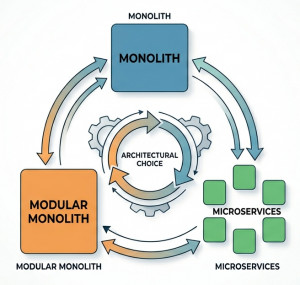
Monolith, Microservices, and Modular Monolith represent three different approaches to structuring modern applications in .NET and other backend ecosystems.
Each architecture has trade-offs in terms of scalability, complexity, deployment strategy, and long-term maintainability.
These architectures are commonly used in:
• Enterprise business applications
• SaaS platforms
• E-commerce systems
• Cloud-native backend services
• High-scale distributed systems
What is Monolithic Architecture?
A Monolith is a traditional architecture where all application components are tightly coupled and deployed as a single unit.
UI, business logic, and data access layers are packaged together in one codebase and one deployment pipeline.
What is Microservices Architecture?
Microservices architecture splits an application into small independent services that communicate over APIs or messaging systems.
Each service is responsible for a specific business capability and can be deployed independently.
What is Modular Monolith?
A Modular Monolith is a hybrid approach where the system is built as a single deployable unit but internally divided into well-defined modules.
Each module has clear boundaries, reducing coupling while keeping deployment simple.
Core Concept Differences
Monolith:
• Single codebase and deployment unit
• Tight coupling between components
• Simple development and testing
Microservices:
• Multiple independent services
• Distributed system architecture
• High operational complexity
Modular Monolith:
• Single deployment with internal modules
• Clear separation of concerns
• Balanced complexity and scalability
Architecture Comparison Table
| Feature | Monolith | Microservices | Modular Monolith |
|---|---|---|---|
| Deployment | Single unit | Multiple services | Single unit |
| Scalability | Limited | High | Medium to High |
| Complexity | Low | High | Medium |
| Team Independence | Low | High | Medium |
| Maintainability | Decreases over time | High if well-designed | High |
| Communication | In-process | Network-based | In-process |
Execution Model Differences
Monolith executes all components in the same process, making communication fast but tightly coupled.
Microservices communicate over HTTP/gRPC or messaging queues, introducing network latency but enabling independent scaling.
Modular Monolith keeps in-process communication while enforcing strict module boundaries.
Monolith Example (Conceptual)
public class OrderService { public void CreateOrder(){var payment = new PaymentService();payment.Process();var inventory = new InventoryService();inventory.Reserve();} }
This structure is simple but tightly coupled.
Microservices Example (Conceptual)
// Order Service public async Task CreateOrder() {await httpClient.PostAsync("https://payment/api/pay", ...);await httpClient.PostAsync("https://inventory/api/reserve", ...); }
Each service runs independently and communicates over the network.
Modular Monolith Example
public class OrderModule {private readonly PaymentModule _payment;private readonly InventoryModule _inventory;public OrderModule(PaymentModule payment, InventoryModule inventory){_payment = payment;_inventory = inventory;}public void CreateOrder(){_payment.Process();_inventory.Reserve();} }
Modules are separated logically but remain in the same application boundary.
Performance Considerations
Monolith: Fast in-process calls but hard to scale independently.
Microservices: Scales well but introduces network overhead.
Modular Monolith: Balanced performance with low communication cost.
When to Use Each?
Use Monolith when:
• Building MVP or early-stage products
• Small development teams
• Simple domain logic
Use Microservices when:
• Large-scale distributed systems
• Independent team scaling required
• High availability and fault isolation needed
Use Modular Monolith when:
• You want scalability without distributed complexity
• You are transitioning from monolith to microservices
• You need clean architecture with simple deployment
Common Mistakes
• Over-engineering early with microservices
• Creating tightly coupled monoliths without structure
• Ignoring module boundaries in modular monoliths
• Premature distribution of systems
Advantages and Disadvantages
Monolith:
• Simple to build and deploy
• Hard to scale long-term
• Tight coupling issues
Microservices:
• Highly scalable
• Complex infrastructure
• Requires strong DevOps maturity
Modular Monolith:
• Balanced architecture
• Easier migration path
• Requires discipline in design
Conclusion
Monolith, Microservices, and Modular Monolith each solve different architectural needs.
Monolith is ideal for simplicity, Microservices for scalability, and Modular Monolith for balanced system design.
The best choice depends on team size, scalability requirements, and long-term system complexity.