Event-Driven Architecture vs Request-Response vs CQRS: Architecture Comparison in C#
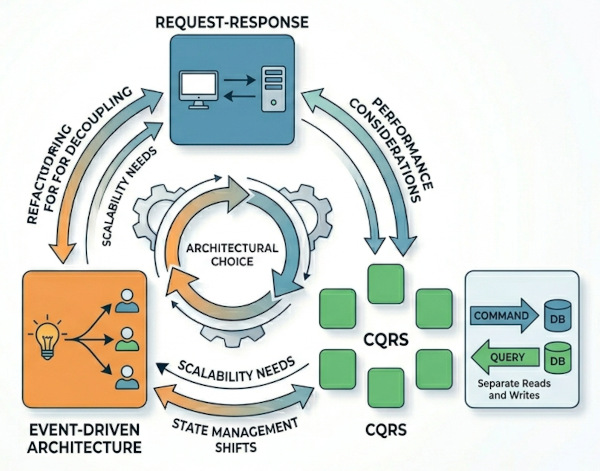
Modern distributed systems in C# rely heavily on different communication and architectural patterns to handle scalability, maintainability, and performance requirements.
Event-Driven Architecture, Request-Response, and CQRS are three fundamental approaches used in backend system design.
Each of these patterns solves different problems in system communication and data flow.
They are widely used in:
• Microservices architectures
• Cloud-native applications
• Real-time systems
• Enterprise integration platforms
• High-throughput backend services
What is Request-Response Architecture?
Request-Response is the most traditional communication model where a client sends a request and waits for a direct response from the server.
It is commonly implemented using HTTP REST APIs in C# applications.
What is Event-Driven Architecture?
Event-Driven Architecture (EDA) is a system design pattern where services communicate by producing and consuming events asynchronously.
Instead of direct communication, services react to events published through message brokers.
What is CQRS?
CQRS (Command Query Responsibility Segregation) separates read and write operations into different models.
Commands modify state, while queries retrieve data independently for better scalability and performance.
Core Concept Differences
Request-Response:
• Synchronous communication model
• Client waits for response
• Simple and widely used
Event-Driven Architecture:
• Asynchronous communication via events
• Loose coupling between services
• Highly scalable and reactive
CQRS:
• Separates read and write models
• Optimized for performance and scalability
• Often combined with event-driven systems
Comparison Table
| Feature | Request-Response | Event-Driven | CQRS |
|---|---|---|---|
| Communication | Synchronous | Asynchronous | Mixed |
| Coupling | Tight | Loose | Medium |
| Scalability | Medium | High | High |
| Complexity | Low | Medium | High |
| Data Flow | Direct | Event-based | Separated read/write |
| Use Case | CRUD APIs | Event streaming systems | High-scale domains |
Execution Model Comparison
Request-Response blocks the client until the server returns a response.
Event-Driven Architecture publishes events to a broker, and consumers react independently.
CQRS splits commands and queries into separate paths for optimized handling.
Request-Response Example
public async Task<OrderDto> GetOrder(int id) { var order = await _dbContext.Orders.FindAsync(id);return new OrderDto(order); }
This is a simple synchronous request-response flow commonly used in REST APIs.
Event-Driven Architecture Example
public async Task CreateOrder(Order order) {await _repository.AddAsync(order);await _eventBus.PublishAsync(new OrderCreatedEvent{OrderId = order.Id,CreatedAt = DateTime.UtcNow}); }
Here, services react to events instead of direct method calls.
CQRS Example
// Command public class CreateOrderCommand {public int ProductId { get; set; } } // Handler public class CreateOrderHandler {public async Task Handle(CreateOrderCommand command){var order = new Order(command.ProductId);await _dbContext.Orders.AddAsync(order);} } // Query public async Task<OrderDto> GetOrder(int id) {var order = await _queryDb.GetOrderAsync(id);return order; }
This pattern separates read and write operations for better scalability.
Performance Considerations
Request-Response: Fast and simple but can become a bottleneck under high load.
Event-Driven Architecture: Highly scalable but introduces eventual consistency.
CQRS: Optimized read/write performance but increases system complexity.
When to Use Each?
Use Request-Response when:
• Building simple APIs
• CRUD-based applications
• Low complexity systems
Use Event-Driven Architecture when:
• Building distributed systems
• Real-time processing required
• High scalability is needed
Use CQRS when:
• High-performance systems
• Complex domain logic
• Large-scale applications with heavy read/write load separation
Common Mistakes
• Using CQRS for simple CRUD apps
• Overusing events causing debugging complexity
• Ignoring consistency issues in event-driven systems
• Using request-response for highly scalable systems
Advantages and Disadvantages
Request-Response:
• Simple and easy to implement
• Poor scalability at high load
Event-Driven:
• Highly scalable and decoupled
• Harder debugging and tracing
CQRS:
• High performance for complex systems
• Increased architectural complexity
Conclusion
Request-Response, Event-Driven Architecture, and CQRS are powerful patterns in modern C# backend design.
Choosing the right architecture depends on system scale, complexity, and performance requirements.
In many real-world systems, these patterns are often combined for optimal results.