Load Balancer vs API Gateway vs Reverse Proxy: Architecture Comparison in Modern Backend Systems
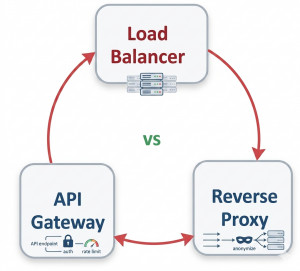
Modern backend systems rely on multiple infrastructure components to handle traffic routing, scalability, security, and request management.
Load Balancer, API Gateway, and Reverse Proxy are three critical building blocks in distributed system architecture.
Although they may seem similar at first glance, each serves a distinct purpose in handling client requests and backend service communication.
These components are widely used in:
• Microservices architectures
• Cloud-native applications
• High-traffic web systems
• Enterprise APIs
• Scalable backend infrastructures
What is a Load Balancer?
A Load Balancer distributes incoming network traffic across multiple servers to ensure no single server becomes overloaded.
It improves availability, reliability, and scalability of applications.
What is an API Gateway?
An API Gateway acts as a single entry point for client requests in microservices architectures.
It handles request routing, authentication, rate limiting, and sometimes response aggregation.
What is a Reverse Proxy?
A Reverse Proxy sits between clients and backend servers, forwarding client requests to appropriate services while hiding internal infrastructure.
It is commonly used for security, caching, SSL termination, and request routing.
Core Concept Differences
Load Balancer:
• Distributes traffic across multiple servers
• Focuses on availability and performance
• Works at network or application level
API Gateway:
• Central entry point for APIs
• Handles authentication and routing
• Designed for microservices communication
Reverse Proxy:
• Forwards requests to backend servers
• Provides security and abstraction
• Can include caching and SSL termination
Comparison Table
| Feature | Load Balancer | API Gateway | Reverse Proxy |
|---|---|---|---|
| Primary Role | Traffic distribution | API management | Request forwarding |
| Layer | L4 / L7 | Application layer | L7 (mostly) |
| Authentication | No | Yes | Limited |
| Routing Logic | Basic | Advanced | Basic to moderate |
| Rate Limiting | No | Yes | Sometimes |
| Best Use Case | Scaling servers | Microservices entry point | Security & proxy layer |
Execution Model Differences
Load Balancer distributes requests across multiple backend instances based on algorithms like round-robin or least connections.
API Gateway receives all client requests and routes them to appropriate microservices with additional logic like authentication and aggregation.
Reverse Proxy acts as an intermediary that forwards requests to backend services while hiding internal network structure.
Load Balancer Example (Conceptual)
var servers = new List { "server1.api.local","server2.api.local","server3.api.local" }; var request = GetIncomingRequest(); // Round-robin selection (simplified) var selectedServer = servers[new Random().Next(servers.Count)]; ForwardRequest(selectedServer, request);
This demonstrates basic traffic distribution logic.
API Gateway Example (Conceptual)
public async Task RouteRequest(HttpRequest request) {if (!Authenticate(request))throw new UnauthorizedAccessException();var route = GetServiceRoute(request.Path);var response = await _httpClient.PostAsync(route, request.Content);return await response.Content.ReadAsStringAsync(); }
This shows how an API Gateway handles authentication and routing logic.
Reverse Proxy Example (Conceptual)
public async Task Forward(HttpContext context) {var targetUrl = "https://internal-service/api";var response = await _httpClient.SendAsync(new HttpRequestMessage(HttpMethod.Get, targetUrl));context.Response.StatusCode = (int)response.StatusCode; }
This illustrates basic request forwarding behavior.
Performance Considerations
Load Balancer: Optimized for high throughput and low latency traffic distribution.
API Gateway: Adds processing overhead due to authentication and routing logic.
Reverse Proxy: Lightweight but depends on additional features like caching or SSL termination.
When to Use Each?
Use Load Balancer when:
• Scaling backend servers
• Distributing traffic evenly
• Ensuring high availability
Use API Gateway when:
• Building microservices architecture
• Centralizing authentication
• Managing API traffic and policies
Use Reverse Proxy when:
• Hiding backend infrastructure
• Enabling SSL termination
• Adding caching or routing layers
Common Mistakes
• Using API Gateway for simple monolith systems
• Confusing reverse proxy with API gateway responsibilities
• Overloading load balancers with business logic
• Not separating concerns between layers
Advantages and Disadvantages
Load Balancer:
• High scalability
• No application awareness
API Gateway:
• Centralized API management
• Can become bottleneck if misconfigured
Reverse Proxy:
• Improves security and abstraction
• Limited business logic capability
Conclusion
Load Balancer, API Gateway, and Reverse Proxy serve different but complementary roles in modern backend architectures.
Load Balancers handle traffic distribution, API Gateways manage service communication, and Reverse Proxies provide abstraction and security layers.
Choosing the right combination is essential for building scalable and secure distributed systems.