REST vs gRPC vs GraphQL: API Architecture Comparison in Modern Backend Systems
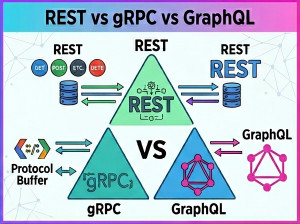
Modern backend systems require efficient, scalable, and flexible API communication models to support web, mobile, and microservices architectures.
REST, gRPC, and GraphQL are three widely used API paradigms, each designed for different performance and data access needs.
Although they all enable client-server communication, they differ significantly in structure, efficiency, and flexibility.
These API styles are commonly used in:
• Microservices architectures
• Mobile and web applications
• High-performance distributed systems
• Cloud-native backend services
• Real-time data platforms
What is REST API?
REST (Representational State Transfer) is a stateless API architecture that uses HTTP methods like GET, POST, PUT, and DELETE to operate on resources.
It is simple, widely adopted, and works well with standard web infrastructure.
What is gRPC?
gRPC is a high-performance RPC framework developed by Google that uses HTTP/2 and Protocol Buffers for efficient binary communication.
It is designed for low latency and high throughput communication between microservices.
What is GraphQL?
GraphQL is a query language for APIs that allows clients to request exactly the data they need, reducing over-fetching and under-fetching issues.
It provides a flexible schema-based approach to API design.
Core Concept Differences
REST:
• Resource-based architecture
• Uses standard HTTP methods
• Simple and cache-friendly
gRPC:
• Binary communication using Protocol Buffers
• High performance and low latency
• Strongly typed contracts
GraphQL:
• Query-based API structure
• Client defines response shape
• Reduces over-fetching
Comparison Table
| Feature | REST | gRPC | GraphQL |
|---|---|---|---|
| Data Format | JSON | Protobuf (binary) | JSON |
| Performance | Medium | Very High | Medium |
| Flexibility | Medium | Low | Very High |
| Learning Curve | Low | Medium | High |
| Best Use Case | Public APIs | Microservices communication | Frontend-driven APIs |
| Caching | Excellent | Limited | Complex |
Execution Model Differences
REST relies on stateless HTTP requests where each endpoint represents a resource.
gRPC uses contract-first communication with strongly typed service definitions.
GraphQL allows clients to dynamically query and shape responses from a single endpoint.
REST API Example
[HttpGet("orders/{id}")] public async Task<OrderDto> GetOrder(int id) { var order = await _dbContext.Orders.FindAsync(id);return new OrderDto(order); }
REST APIs are simple and widely supported across all platforms.
gRPC Example
public override async Task<OrderResponse> GetOrder(OrderRequest request, ServerCallContext context) {var order = await _repository.GetByIdAsync(request.Id);return new OrderResponse{Id = order.Id,Amount = order.Amount}; }
gRPC provides high-performance communication using strongly typed contracts.
GraphQL Example
public class Query {public Order GetOrder(int id){return _repository.GetOrder(id);} }
Clients can request only the fields they need using a single endpoint.
Performance Considerations
REST: Reliable and cache-friendly but may suffer from over-fetching.
gRPC: Extremely fast and efficient for internal service communication.
GraphQL: Flexible but can introduce query complexity and server load challenges.
When to Use Each?
Use REST when:
• Building public APIs
• Simplicity and compatibility are important
• Caching is required
Use gRPC when:
• Microservices communication
• High-performance internal systems
• Low-latency requirements
Use GraphQL when:
• Frontend requires flexible data fetching
• Multiple clients consume the same API
• Reducing over-fetching is important
Common Mistakes
• Using gRPC for public-facing APIs
• Overcomplicating simple systems with GraphQL
• Ignoring caching limitations in GraphQL
• Treating REST as outdated for all cases
Advantages and Disadvantages
REST:
• Simple and widely adopted
• Can lead to over-fetching
gRPC:
• High performance
• Requires strict contracts
GraphQL:
• Highly flexible
• Complex server-side implementation
Conclusion
REST, gRPC, and GraphQL each serve different API design needs in modern backend systems.
REST is best for simplicity and public APIs, gRPC for high-performance service-to-service communication, and GraphQL for flexible client-driven data fetching.
Choosing the right API architecture depends on performance needs, system complexity, and client requirements.