WebSockets vs HTTP Polling vs Server-Sent Events: Real-Time Communication in C#
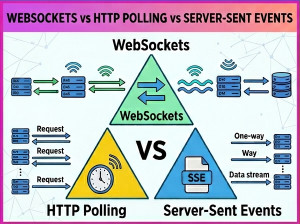
Real-time communication is a core requirement in modern web applications such as chat systems, live dashboards, notifications, and streaming services.
WebSockets, HTTP Polling, and Server-Sent Events (SSE) are three common approaches used to deliver real-time data between server and client.
Each technique uses a different communication model with distinct trade-offs in performance, complexity, and scalability.
These approaches are widely used in:
• Chat applications
• Live dashboards
• Financial trading systems
• Notification systems
• Multiplayer online services
What is HTTP Polling?
HTTP Polling is a technique where the client repeatedly sends requests to the server at fixed intervals to check for new data.
It is the simplest real-time approach but can be inefficient due to constant network requests.
What are Server-Sent Events (SSE)?
Server-Sent Events (SSE) allow the server to push updates to the client over a single HTTP connection.
It is unidirectional (server → client) and ideal for continuous data streams.
What are WebSockets?
WebSockets provide a full-duplex communication channel between client and server over a single persistent connection.
They allow both sides to send messages independently in real time.
Core Concept Differences
HTTP Polling:
• Client repeatedly requests data
• High latency and inefficiency
• Simple to implement
SSE:
• Server pushes updates to client
• One-way communication
• Efficient for streaming updates
WebSockets:
• Full-duplex communication
• Real-time bidirectional messaging
• Best for interactive applications
Comparison Table
| Feature | HTTP Polling | SSE | WebSockets |
|---|---|---|---|
| Communication | Client → Server (repeated) | Server → Client | Bidirectional |
| Latency | High | Low | Very Low |
| Efficiency | Low | Medium | High |
| Complexity | Low | Medium | High |
| Connection Type | Stateless requests | Persistent HTTP | Persistent socket |
| Best Use Case | Simple updates | Live feeds | Interactive apps |
Execution Model Differences
HTTP Polling relies on repeated HTTP requests at intervals, which increases server load and network traffic.
SSE maintains a single open HTTP connection where the server streams updates as events occur.
WebSockets establish a persistent connection allowing both client and server to exchange messages freely.
HTTP Polling Example
public async Task<IActionResult> GetUpdates() { var updates = await _service.GetLatestUpdates();return Ok(updates); } // Client calls this endpoint every few seconds
This approach is simple but inefficient for high-frequency updates.
SSE Example (Conceptual)
[HttpGet("stream")] public async Task Stream() {Response.ContentType = "text/event-stream";for (int i = 0; i < 10; i++){await Response.WriteAsync($"data: Message {i}\n\n");await Response.Body.FlushAsync();await Task.Delay(1000);} }
SSE allows the server to continuously push updates to the client.
WebSockets Example
public async Task HandleWebSocket(HttpContext context) {var socket = await context.WebSockets.AcceptWebSocketAsync();var buffer = new byte[1024];while (socket.State == WebSocketState.Open){var result = await socket.ReceiveAsync(buffer, CancellationToken.None);await socket.SendAsync(new ArraySegment(buffer, 0, result.Count),WebSocketMessageType.Text,true,CancellationToken.None);} }
WebSockets enable real-time two-way communication.
Performance Considerations
HTTP Polling: High overhead due to repeated requests.
SSE: Efficient for server-to-client streaming but limited to one direction.
WebSockets: Most efficient for real-time bidirectional communication but more complex to manage.
When to Use Each?
Use HTTP Polling when:
• Real-time needs are minimal
• Simplicity is more important than performance
• Legacy systems are involved
Use SSE when:
• You need server-to-client updates
• Live feeds or dashboards are required
• Simpler alternative to WebSockets is preferred
Use WebSockets when:
• Building chat applications
• Real-time multiplayer systems
• Low-latency bidirectional communication is required
Common Mistakes
• Using polling for high-frequency updates
• Overengineering simple notification systems with WebSockets
• Using SSE for bidirectional communication needs
• Ignoring scalability limits of persistent connections
Advantages and Disadvantages
HTTP Polling:
• Very simple
• Inefficient at scale
SSE:
• Lightweight and efficient
• One-way only
WebSockets:
• Fully real-time and bidirectional
• Higher complexity
Conclusion
HTTP Polling, Server-Sent Events, and WebSockets are key real-time communication strategies in modern web development.
Polling is simple but inefficient, SSE is optimized for server push scenarios, and WebSockets provide the most powerful real-time communication model.
The correct choice depends on latency requirements, direction of communication, and system complexity.