Stack Allocation vs Heap Allocation vs Memory Pooling: Memory Management in C#
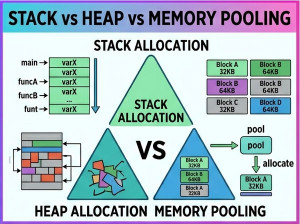
Memory management is one of the most critical aspects of high-performance software development in .NET and C# applications.
Stack Allocation, Heap Allocation, and Memory Pooling represent three different strategies for managing memory usage efficiently.
Understanding how these mechanisms work is essential for reducing garbage collection pressure, improving performance, and writing scalable applications.
These concepts are widely used in:
• High-performance backend systems
• Game development
• Real-time processing systems
• Cloud services
• Low-latency applications
What is Stack Allocation?
Stack Allocation is a memory management technique where data is stored in a LIFO (Last In First Out) structure called the stack.
It is fast, automatically managed, and has a very short lifetime tied to method execution.
What is Heap Allocation?
Heap Allocation is used for dynamically allocated memory that persists beyond method scope.
In .NET, objects created with new are typically allocated on the managed heap and are cleaned up by the Garbage Collector (GC).
What is Memory Pooling?
Memory Pooling is a performance optimization technique where memory is reused instead of repeatedly allocating and deallocating objects.
It reduces GC pressure and improves performance in high-throughput systems.
Core Concept Differences
Stack Allocation:
• Very fast allocation and deallocation
• Limited size
• Automatically managed lifetime
Heap Allocation:
• Flexible dynamic memory usage
• Managed by Garbage Collector
• Higher overhead compared to stack
Memory Pooling:
• Reuses existing memory blocks
• Reduces GC pressure
• Optimized for high-performance workloads
Comparison Table
| Feature | Stack Allocation | Heap Allocation | Memory Pooling |
|---|---|---|---|
| Speed | Very High | Medium | High |
| Lifetime | Method scope | GC managed | Controlled reuse |
| Memory Size | Limited | Large | Efficient reuse |
| GC Impact | None | High | Low |
| Best Use Case | Local variables | Objects and references | High-performance systems |
Execution Model Differences
Stack memory is automatically allocated and freed when a method is called and returns.
Heap memory requires Garbage Collector intervention to clean unused objects.
Memory Pooling reuses pre-allocated memory blocks to avoid repeated allocations.
Stack Allocation Example
public void Process() { int x = 10;int y = 20;int result = x + y;Console.WriteLine(result); }
Stack variables are automatically cleaned up when the method ends.
Heap Allocation Example
public class User {public string Name { get; set; } } public void CreateUser() {var user = new User{Name = "John"};Console.WriteLine(user.Name); }
Objects created with new are stored in heap memory.
Memory Pooling Example
using System.Buffers; public void ProcessData() {var pool = ArrayPool.Shared;byte[] buffer = pool.Rent(1024);try{// Use bufferConsole.WriteLine("Processing data...");}finally{pool.Return(buffer);} }
Memory pooling reduces allocations and improves performance in high-load scenarios.
Performance Considerations
Stack: Fastest but limited in size and scope.
Heap: Flexible but introduces GC overhead.
Memory Pooling: Optimized for performance-critical systems with reduced garbage collection pressure.
When to Use Each?
Use Stack Allocation when:
• Working with small local variables
• Performance-critical method scope operations
• No need for long-lived data
Use Heap Allocation when:
• Creating complex objects
• Data needs to persist beyond method scope
• Working with reference types
Use Memory Pooling when:
• High-frequency allocations occur
• Working with large buffers or arrays
• Optimizing high-performance systems
Common Mistakes
• Overusing heap allocations in hot paths
• Ignoring GC pressure in high-load systems
• Forgetting to return rented memory to pool
• Using pooling where simplicity is more important
Advantages and Disadvantages
Stack:
• Extremely fast
• Very limited size
Heap:
• Flexible memory usage
• GC overhead
Memory Pooling:
• High performance
• Requires careful management
Conclusion
Stack Allocation, Heap Allocation, and Memory Pooling represent different strategies for memory management in C#.
Stack is best for short-lived data, heap is used for dynamic object lifetimes, and memory pooling is essential for high-performance, low-latency applications.
Choosing the right strategy directly impacts performance, GC pressure, and system scalability.