RAII vs Garbage Collection vs Manual Memory Management: Memory Lifecycle Comparison
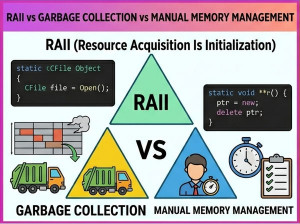
Memory management is a fundamental concept in software engineering that directly impacts performance, reliability, and system stability.
RAII (Resource Acquisition Is Initialization), Garbage Collection (GC), and Manual Memory Management represent three different paradigms for handling memory and resources in modern programming languages.
Each approach reflects a different philosophy: deterministic cleanup, automated management, or explicit developer control.
These models are commonly used in:
• System-level programming (C++)
• Managed runtime environments (.NET, Java)
• Embedded systems
• High-performance backend systems
• Game engines and real-time systems
What is RAII?
RAII (Resource Acquisition Is Initialization) is a C++ programming paradigm where resource management is tied to object lifetime.
When an object is created, it acquires resources, and when it goes out of scope, its destructor automatically releases them.
What is Garbage Collection?
Garbage Collection (GC) is an automatic memory management system used in languages like C# and Java.
It periodically identifies and frees memory that is no longer referenced by the application.
What is Manual Memory Management?
Manual Memory Management requires developers to explicitly allocate and free memory using constructs like new/delete in C++ or malloc/free in C.
This approach provides full control but introduces higher risk of memory leaks and errors.
Core Concept Differences
RAII:
• Deterministic resource cleanup
• Tied to object lifetime
• Common in C++
Garbage Collection:
• Automatic memory cleanup
• Non-deterministic timing
• Managed runtime systems
Manual Memory Management:
• Full developer control
• High risk of memory leaks
• Used in low-level systems
Comparison Table
| Feature | RAII | Garbage Collection | Manual Memory Management |
|---|---|---|---|
| Memory Cleanup | Deterministic | Automatic (non-deterministic) | Manual |
| Performance | High | Medium | Very High (but risky) |
| Complexity | Medium | Low | High |
| Safety | High | High | Low |
| Control Level | Medium | Low | Very High |
| Typical Languages | C++ | C#, Java | C, C++ |
Execution Model Differences
RAII ensures resources are released immediately when objects go out of scope.
Garbage Collection runs periodically and frees unreachable objects automatically.
Manual Memory Management requires explicit allocation and deallocation by the developer.
RAII Example (C++)
#include <fstream> class FileHandler { public: FileHandler(const std::string& filename) {file.open(filename); } ~FileHandler() {file.close(); } private:std::ofstream file; };
RAII automatically releases resources when the object goes out of scope.
Garbage Collection Example (C#)
public class User {public string Name { get; set; } } public void CreateUser() {var user = new User{Name = "Alice"};Console.WriteLine(user.Name); }
The .NET Garbage Collector automatically cleans up unused objects.
Manual Memory Management Example (C++)
#include <iostream> int* createArray() {int* arr = new int[10];return arr; } int main() {int* data = createArray();delete[] data; // manual cleanupreturn 0; }
Manual memory management requires explicit deallocation to avoid leaks.
Performance Considerations
RAII: Predictable performance with deterministic cleanup.
Garbage Collection: Easier development but introduces GC pauses.
Manual Memory Management: Maximum performance but high risk of bugs.
When to Use Each?
Use RAII when:
• Writing C++ applications
• Managing file handles, sockets, or locks
• Deterministic cleanup is required
Use Garbage Collection when:
• Building .NET or Java applications
• Developer productivity is prioritized
• Large-scale business applications
Use Manual Memory Management when:
• Working in embedded systems
• Writing performance-critical low-level code
• Full control over memory is required
Common Mistakes
• Ignoring object lifetimes in RAII design
• Forcing manual cleanup in GC environments unnecessarily
• Memory leaks due to missing delete/free calls
• Overusing heap allocations in performance-critical systems
Advantages and Disadvantages
RAII:
• Safe and deterministic
• Limited to C++ style systems
Garbage Collection:
• Easy to use and safe
• Less predictable performance
Manual Memory Management:
• Maximum control
• Error-prone and complex
Conclusion
RAII, Garbage Collection, and Manual Memory Management represent three fundamentally different approaches to resource handling.
RAII provides deterministic cleanup, GC provides automation and safety, while manual memory management provides maximum control at the cost of complexity.
Choosing the right model depends on language, performance requirements, and system constraints.