Lazy Loading vs Eager Loading vs Explicit Loading: Entity Framework Loading Strategies Explained
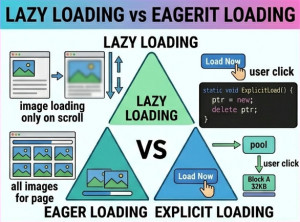
In ORM-based systems like Entity Framework Core, how and when data is loaded from the database has a major impact on application performance.
Lazy Loading, Eager Loading, and Explicit Loading are three core strategies used to control when related data is retrieved from the database.
Choosing the correct loading strategy helps prevent performance issues such as N+1 query problems and excessive memory usage.
These strategies are commonly used in:
• ASP.NET Core web applications
• Enterprise backend systems
• Microservices using EF Core
• Data-driven APIs
• Reporting and analytics systems
What is Lazy Loading?
Lazy Loading is a strategy where related data is automatically loaded only when it is accessed for the first time.
It defers database queries until navigation properties are used in code.
What is Eager Loading?
Eager Loading retrieves related data immediately in a single query using mechanisms like Include().
It loads all required data upfront to avoid additional database calls.
What is Explicit Loading?
Explicit Loading gives developers full control over when related data is loaded by manually triggering database queries.
It sits between Lazy and Eager loading in terms of control and performance.
Core Concept Differences
Lazy Loading:
• Loads data on demand
• May cause multiple database queries
• Simple but risky for performance
Eager Loading:
• Loads related data immediately
• Uses JOINs or multiple queries
• Prevents N+1 query problems
Explicit Loading:
• Manual control over loading
• Developer decides when to load data
• Balanced flexibility and performance
Comparison Table
| Feature | Lazy Loading | Eager Loading | Explicit Loading |
|---|---|---|---|
| Loading Time | On demand | At query time | Manually triggered |
| Database Queries | Multiple small queries | Single/optimized query | Controlled queries |
| Performance | Risky (N+1 problem) | Efficient | Optimizable |
| Control Level | Low | Medium | High |
| Best Use Case | Simple object graphs | Performance-critical reads | Complex conditional loading |
Execution Model Differences
Lazy Loading delays database access until navigation properties are accessed in code execution.
Eager Loading retrieves all required related entities in a single query or optimized joins.
Explicit Loading allows developers to decide exactly when and what related data should be loaded.
Lazy Loading Example
public class Order { public int Id { get; set; }public virtual Customer Customer { get; set; } } // Access triggers automatic DB query var order = dbContext.Orders.First(); var customerName = order.Customer.Name;
Lazy loading automatically fetches related data when accessed.
Eager Loading Example
var orders = dbContext.Orders.Include(o => o.Customer).ToList();
Eager loading retrieves related entities in a single query to improve performance.
Explicit Loading Example
var order = dbContext.Orders.First(); dbContext.Entry(order).Reference(o => o.Customer).Load();
Explicit loading gives full control over when related data is loaded.
Performance Considerations
Lazy Loading: Easy to use but can cause performance issues due to multiple queries.
Eager Loading: Best for reducing database round-trips and improving read performance.
Explicit Loading: Offers fine-grained control but requires careful management.
When to Use Each?
Use Lazy Loading when:
• Working with simple object graphs
• Data relationships are not performance-critical
• Rapid development is prioritized
Use Eager Loading when:
• Performance is important
• Known data relationships exist
• Avoiding N+1 queries is critical
Use Explicit Loading when:
• Conditional data loading is required
• Fine-grained control is needed
• Optimizing complex queries
Common Mistakes
• Using Lazy Loading in high-traffic APIs
• Over-fetching data with Eager Loading
• Forgetting to load navigation properties explicitly
• Ignoring query performance analysis
Advantages and Disadvantages
Lazy Loading:
• Simple and intuitive
• Performance risks at scale
Eager Loading:
• High performance for known relationships
• Can lead to heavy queries
Explicit Loading:
• Full control over data loading
• More complex to manage
Conclusion
Lazy Loading, Eager Loading, and Explicit Loading are essential data loading strategies in Entity Framework Core.
Lazy loading prioritizes simplicity, eager loading prioritizes performance, and explicit loading provides maximum control.
Choosing the right strategy is critical for building efficient and scalable .NET applications.