gRPC, Remote Procedure Call framework
gRPC is a high-performance, open-source Remote Procedure Call (RPC) framework originally developed by Google. It allows applications to communicate by calling functions on remote servers as if they were local methods.
Under the hood, gRPC uses:
• HTTP/2 for transport
• Protocol Buffers as the default data format
Why gRPC is used?
gRPC is used to build fast, efficient, and scalable distributed systems. It is especially popular in microservices architectures.
Key reasons:
• High performance communication
• Low latency and low bandwidth usage
• Strong contract-based APIs (via .proto files)
• Multi-language support
• Built-in streaming capabilities
• Better efficiency than REST/JSON in many cases
How gRPC works?
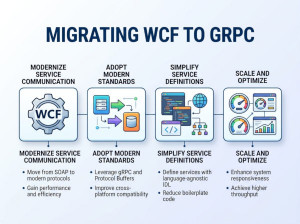
• You define a service in a .proto file
• Code is generated for client and server
• Client calls a method like a local function
• gRPC handles network communication transparently
• Server processes request and returns response
Example concept:
• Client calls: GetUser(id)
• Server responds with user data
Key concepts in gRPC
1. Service
Defines RPC methods exposed by the server
2. RPC Method Types
gRPC supports four communication styles:
• Unary RPC: One request → One response (like REST API)
• Server Streaming RPC: One request → Stream of responses
• Client Streaming RPC: Stream of requests → One response
• Bidirectional Streaming RPC: Both client and server stream messages simultaneously
3. Protocol Buffers
Used for defining messages and serialization:
• Compact binary format
• Strongly typed schema
• Cross-language compatibility
4. Stub (Client)
Auto-generated client code used to call remote methods
Key features of gRPC
• High-performance binary communication
• Built on HTTP/2 (multiplexing, streaming)
• Strongly typed APIs via .proto contracts
• Automatic code generation
• Bi-directional streaming support
• Built-in authentication support
• Cross-platform and multi-language
• Load balancing and deadline support
Advantages of gRPC
• Very fast and efficient
• Lower bandwidth usage than JSON/REST
• Strong API contracts reduce errors
• Great for microservices communication
• Supports streaming natively
• Auto-generated client/server code reduces boilerplate
• Works across many programming languages
Disadvantages of gRPC
• Not human-readable (binary format)
• Requires learning .proto schema and tooling
• Harder to debug compared to REST/JSON
• Browser support is limited (needs gRPC-Web)
• Not ideal for public APIs (REST is more common)
• Slightly more complex setup than REST APIs
When to use gRPC?
Use gRPC when:
• Building microservices communication
• You need high-performance internal APIs
• You require real-time streaming
• You want strongly typed service contracts
• You are working in multi-language backend systems
Avoid or reconsider when:
• You are building public APIs (REST is simpler and more widely supported)
• You need human-readable API responses
• You require simple integration with browsers (without gRPC-Web)