Microservices Communication Patterns
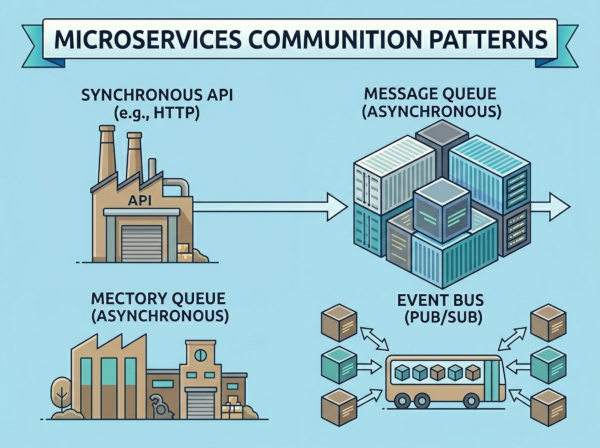
Microservices communication patterns define how independent services exchange data and coordinate actions while remaining loosely coupled. Choosing the right pattern is important because it directly impacts system scalability, fault tolerance, latency, and maintainability in distributed architectures.
Microservices Communication Patterns
Synchronous Communication (REST / gRPC)
Synchronous communication is when one microservice directly calls another and waits for an immediate response. This is commonly implemented using HTTP REST APIs or high-performance frameworks like gRPC.
This pattern is simple and easy to understand because it behaves like a traditional function call. However, it creates tight runtime dependency between services, meaning if the called service is slow or unavailable, the calling service is also affected.
Asynchronous Messaging
Asynchronous messaging allows services to communicate by sending messages through a broker without waiting for an immediate response. Systems like Apache Kafka or RabbitMQ are commonly used for this purpose.
This approach improves scalability and resilience because services do not depend on each other being available at the same time. However, it introduces complexity in debugging and requires handling eventual consistency instead of immediate results.
Publish–Subscribe Pattern
In the publish–subscribe pattern, one service publishes events, and multiple other services subscribe to those events independently. For example, when an order is placed, inventory, billing, and notification services can all react to the same event.
This pattern is useful when one event needs to trigger multiple independent actions. It improves extensibility because new consumers can be added without modifying the original service, but it can make tracing system behavior more complex.
Request–Reply over Messaging
This pattern combines asynchronous messaging with the need for a response. A service sends a request message to a queue and later receives a response message from another queue.
It is useful when you want the decoupling benefits of messaging but still need a result, such as validating credit or checking inventory availability. However, it adds complexity in correlating requests and responses across distributed components.
Event-Driven Architecture (EDA)
Event-driven architecture is a broader style where system behavior is driven entirely by events. Every significant change in the system, such as “OrderCreated” or “PaymentProcessed,” is published as an event for other services to consume.
This architecture improves scalability and flexibility because services react independently to changes. However, it requires careful event design and strong observability to avoid confusion in complex workflows.
Saga Pattern (Distributed Transactions)
The Saga pattern manages long-running business transactions that span multiple microservices. Instead of a single database transaction, each service performs its own local transaction and publishes events to trigger the next step.
There are two approaches: choreography, where services react to events independently, and orchestration, where a central coordinator manages the workflow. This pattern ensures consistency without distributed locks, but it increases system design complexity.
Ref: more details and examples about Saga Pattern
API Gateway Pattern
An API Gateway acts as a single entry point for all client requests in a microservices system. It routes requests to appropriate services and can also handle cross-cutting concerns like authentication, rate limiting, and logging.
This simplifies client-side logic because clients do not need to know about individual services. However, if not properly scaled, the gateway can become a bottleneck or single point of failure.
Backend-for-Frontend (BFF)
Backend-for-Frontend is a variation of the API Gateway pattern where separate backends are created for different client types such as web, mobile, or desktop applications. Each BFF is optimized for the specific data needs of its client.
This improves performance and reduces unnecessary data transfer because each client receives only what it needs. The trade-off is increased maintenance overhead due to multiple backend layers.
Ref: details and examples about BFF pattern
Circuit Breaker Pattern
The circuit breaker pattern is used to prevent repeated calls to a failing service. When failures exceed a defined threshold, the circuit “opens” and stops further calls temporarily.
This protects the system from cascading failures and improves stability during partial outages. However, it requires careful tuning of thresholds and fallback logic to avoid unnecessary service blocking.
Ref: detailed examples and explanations about circuit breaker pattern
Service Mesh Communication
A service mesh manages service-to-service communication at the infrastructure level rather than inside application code. It provides features like secure communication, traffic routing, retries, and observability.
This pattern is especially useful in large distributed systems because it centralizes networking concerns. However, it introduces additional infrastructure complexity and requires operational expertise.
Comparison of Key Microservices Communication Patterns
| Pattern | Type | Description |
|---|---|---|
| Synchronous Communication (REST/gRPC) | Request–Response | Direct service-to-service call where the caller waits for an immediate response. It is simple but tightly couples services at runtime. |
| Asynchronous Messaging | Message-based | Services communicate via message brokers like Kafka or RabbitMQ without waiting for responses, improving scalability and resilience. |
| Publish–Subscribe | Event-driven | One service publishes events while multiple services consume them independently, enabling decoupled and extensible system behavior. |
| Request–Reply over Messaging | Hybrid | Uses message queues for communication but still expects a response message, combining decoupling with response handling. |
| Saga Pattern | Transaction management | Coordinates distributed transactions across services using event-based steps and compensation actions for failure handling. |
| API Gateway | Edge routing | Central entry point that routes requests to services and handles cross-cutting concerns like authentication and rate limiting. |
| Backend-for-Frontend (BFF) | Client-specific gateway | Custom backend layer for each client type that optimizes responses for specific UI or device requirements. |
| Circuit Breaker | Resilience | Prevents repeated calls to failing services by temporarily blocking requests and allowing fallback responses. |
| Service Mesh | Infrastructure communication | Manages service-to-service networking, security, and observability outside application code. |