What Is Event-Driven Architecture?
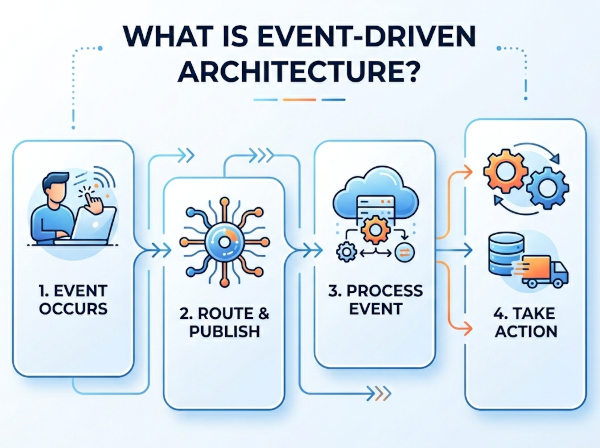
Event-Driven Architecture (EDA) is a software architecture pattern where different parts of a system communicate through events. An event represents something that happened in the system, such as a user placing an order, a payment being completed, or a file being uploaded. Instead of one service directly calling another service and waiting for a response, services publish events and other services react to them asynchronously. This approach creates loosely coupled systems where components can evolve independently without tightly depending on each other. Event-driven systems are commonly built using message brokers such as Apache Kafka, RabbitMQ, Azure Service Bus, or AWS EventBridge.
Why Do We Use Event-Driven Architecture?
We use Event-Driven Architecture because modern applications often need to process many actions simultaneously while remaining scalable and responsive. In traditional architectures, services are tightly connected, which means a failure or slowdown in one service can impact the entire system. EDA solves this problem by allowing services to communicate asynchronously through events, making systems more resilient and easier to scale.
Another reason for using EDA is flexibility. New services can subscribe to existing events without modifying the original application logic. For example, if an e-commerce platform already publishes an "OrderCreated" event, developers can later add analytics, recommendation engines, or fraud detection systems simply by subscribing to that event. This reduces coupling and accelerates feature development.
EDA is also useful for real-time processing. Applications such as financial systems, IoT platforms, live notifications, and monitoring tools require immediate reactions to system changes. Event-driven systems are designed specifically for these types of real-time workflows.
When Should We Use Event-Driven Architecture?
Event-Driven Architecture should be used when systems need scalability, asynchronous communication, and real-time responsiveness. It works especially well in distributed systems and microservice architectures where independent services must communicate without being tightly connected. If your application experiences high traffic or sudden spikes in workload, EDA can distribute processing efficiently across multiple consumers.
EDA is also a good choice when business processes involve multiple independent actions triggered by a single event. For example, after an order is placed, different services may need to handle payment, inventory updates, notifications, shipping, and analytics independently. Instead of implementing all logic inside one service, events allow each process to operate independently and concurrently.
However, EDA may not be ideal for simple CRUD applications with straightforward synchronous workflows. If the application is small, has minimal scaling requirements, or requires immediate transactional consistency across all operations, a traditional synchronous architecture may be easier to maintain.
Best Use Cases of Event-Driven Architecture
E-Commerce Platforms
E-commerce systems are one of the most common use cases for Event-Driven Architecture. When a customer places an order, multiple actions happen almost simultaneously: payment processing, inventory updates, shipping preparation, invoice generation, email notifications, and analytics tracking. Instead of forcing a single service to manage all these responsibilities, the application publishes an "OrderPlaced" event that different services consume independently.
This design improves scalability because each consumer can process events at its own speed. If the notification service temporarily fails, the inventory and payment services continue operating without interruption. This isolation increases fault tolerance and keeps the overall platform responsive during high traffic periods such as holiday sales.
Fraud Detection Systems
Fraud detection platforms often need to analyze transactions in real time. When a payment event occurs, the system can immediately send transaction data to multiple fraud analysis services that evaluate patterns, suspicious behavior, geolocation mismatches, or unusual purchase volumes.
Event-driven processing is useful here because fraud checks can occur asynchronously without blocking the user experience. The transaction can continue through the system while separate services independently calculate risk scores and trigger alerts if suspicious behavior is detected. This architecture is heavily used in banking and fintech applications where speed and responsiveness are critical.
IoT and Sensor Platforms
IoT systems generate massive streams of events from sensors, smart devices, industrial machines, and monitoring systems. Every temperature change, GPS update, motion detection, or device heartbeat becomes an event that must be processed in real time.
EDA is ideal for this scenario because it supports high-throughput streaming and asynchronous event handling. Different consumers can independently process telemetry data for analytics, alerts, storage, machine learning, or dashboard visualization. This prevents one processing pipeline from slowing down the entire system.
Real-Time Notification Systems
Applications such as messaging platforms, social networks, and collaboration tools rely heavily on events. When a user sends a message, uploads a file, or mentions another user, multiple notification services may react immediately.
With EDA, notification systems become more scalable and resilient because event producers do not need to know which notification channels exist. Email services, mobile push notification systems, SMS gateways, and in-app alerts can all independently subscribe to the same event stream.
Video Streaming and Media Processing
Media platforms frequently process uploaded videos through multiple asynchronous workflows. After a user uploads a video, the platform may need to generate thumbnails, transcode videos into multiple resolutions, scan content for violations, and update recommendation systems.
An event-driven approach allows each processing step to execute independently. This reduces bottlenecks and improves performance because heavy processing tasks do not block the original upload operation. Large streaming platforms commonly rely on this pattern to process millions of media files efficiently.
Event-Driven Architecture Components
Event Producer
The event producer is the component that creates and publishes events when something happens in the system. For example, an order service may publish an "OrderCreated" event after a successful purchase. Producers typically do not know which services will consume the event.
Event Broker
The event broker acts as the communication layer between producers and consumers. Tools such as Apache Kafka or RabbitMQ store and distribute events to subscribers. Brokers improve reliability by buffering messages and ensuring consumers receive events even during temporary outages.
Event Consumer
Consumers listen for specific event types and react accordingly. One consumer may send emails while another updates inventory or logs analytics data. Consumers operate independently, allowing systems to scale horizontally.
Example Event-Driven Flow
A simple order processing flow might look like this:
• Customer places an order.
• Order service publishes an "OrderPlaced" event.
• Payment service consumes the event and processes payment.
• Inventory service reduces stock quantity.
• Notification service sends a confirmation email.
• Analytics service records customer activity.
Each service works independently without directly calling the others.
C# Example: Basic Event-Driven Architecture
Simple Event Publisher and Subscriber
using System;
public class OrderPlacedEvent
{
public int OrderId { get; set; }
public decimal Amount { get; set; }
}
public class OrderService
{
public event Action<OrderPlacedEvent> OrderPlaced;
public void CreateOrder(int orderId, decimal amount)
{
Console.WriteLine($"Order created: {orderId}");
var orderEvent = new OrderPlacedEvent
{
OrderId = orderId,
Amount = amount
};
OrderPlaced?.Invoke(orderEvent);
}
}
public class EmailService
{
public void SendConfirmation(OrderPlacedEvent orderEvent)
{
Console.WriteLine(
$"Email sent for Order {orderEvent.OrderId}"
);
}
}
public class InventoryService
{
public void UpdateInventory(OrderPlacedEvent orderEvent)
{
Console.WriteLine(
$"Inventory updated for Order {orderEvent.OrderId}"
);
}
}
public class Program
{
public static void Main()
{
var orderService = new OrderService();
var emailService = new EmailService();
var inventoryService = new InventoryService();
orderService.OrderPlaced += emailService.SendConfirmation;
orderService.OrderPlaced += inventoryService.UpdateInventory;
orderService.CreateOrder(1001, 299.99m);
}
}
This example demonstrates the core idea of Event-Driven Architecture. The OrderService publishes an event, while multiple independent services subscribe and react to it. The publisher does not need to know how subscribers process the event.
C# Example Using RabbitMQ
// Producer Example
using RabbitMQ.Client;
using System.Text;
var factory = new ConnectionFactory()
{
HostName = "localhost"
};
using var connection = factory.CreateConnection();
using var channel = connection.CreateModel();
channel.QueueDeclare(
queue: "orders",
durable: false,
exclusive: false,
autoDelete: false,
arguments: null);
string message = "Order Created: 1001";
var body = Encoding.UTF8.GetBytes(message);
channel.BasicPublish(
exchange: "",
routingKey: "orders",
basicProperties: null,
body: body);
Console.WriteLine("Event Published");
// Consumer Example
using RabbitMQ.Client;
using RabbitMQ.Client.Events;
using System.Text;
var factory = new ConnectionFactory()
{
HostName = "localhost"
};
using var connection = factory.CreateConnection();
using var channel = connection.CreateModel();
channel.QueueDeclare(
queue: "orders",
durable: false,
exclusive: false,
autoDelete: false,
arguments: null);
var consumer = new EventingBasicConsumer(channel);
consumer.Received += (model, ea) =>
{
var body = ea.Body.ToArray();
var message = Encoding.UTF8.GetString(body);
Console.WriteLine($"Received: {message}");
};
channel.BasicConsume(
queue: "orders",
autoAck: true,
consumer: consumer);
Console.WriteLine("Waiting for events...");
Console.ReadLine();
This example shows how events can be distributed through a message broker. Producers publish events into a queue, and consumers independently process those events whenever they become available.
Advantages of Event-Driven Architecture
High Scalability
EDA allows services to scale independently based on workload. If one consumer experiences heavy traffic, developers can add more consumer instances without affecting the rest of the system. This makes event-driven systems highly suitable for cloud-native and distributed applications.
Loose Coupling
Services do not need direct knowledge of each other. Producers simply publish events, while consumers independently decide whether to process them. This reduces dependencies between services and simplifies future modifications or feature additions.
Better Fault Isolation
Failures in one service typically do not stop the entire system. If a notification service crashes, order processing can continue while failed events are retried later. This improves resilience and system availability.
Real-Time Processing
EDA is highly effective for real-time systems where immediate reactions are required. Financial transactions, IoT telemetry, and live notifications benefit from low-latency asynchronous event handling.
Easier Feature Expansion
New consumers can subscribe to existing events without modifying the producer logic. This allows teams to introduce analytics, auditing, monitoring, or machine learning services incrementally with minimal disruption.
Disadvantages of Event-Driven Architecture
Increased Complexity
EDA introduces additional infrastructure such as message brokers, queues, event schemas, retries, and monitoring systems. Debugging distributed event flows can become significantly harder than debugging a monolithic application.
Difficult Debugging and Tracing
Since events travel asynchronously across multiple services, understanding the complete execution flow may require distributed tracing tools. Developers often need centralized logging and monitoring systems to troubleshoot production issues effectively.
Eventual Consistency
Event-driven systems frequently rely on eventual consistency instead of immediate consistency. Data changes may take time to propagate across services, which can create temporary inconsistencies between components.
Message Ordering Challenges
In distributed environments, events may arrive out of order or be processed multiple times. Developers must design consumers carefully to handle duplicate messages and maintain idempotency.
Operational Overhead
Running Kafka, RabbitMQ, Azure Service Bus, or similar infrastructure requires operational expertise. Teams must manage scaling, retries, dead-letter queues, monitoring, and event retention policies.
Alternatives to Event-Driven Architecture
Request-Response Architecture
Request-response systems use synchronous communication where one service directly calls another and waits for a response. REST APIs are the most common example of this architecture style. This approach is simpler and easier to debug, making it suitable for smaller applications or systems requiring immediate consistency.
However, synchronous communication creates tighter coupling between services. If one service becomes slow or unavailable, upstream services may also fail or experience delays.
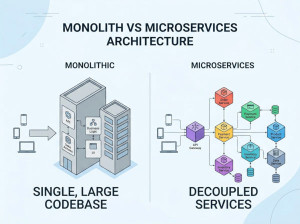
Monolithic Architecture
In a monolithic application, all components run inside a single deployable unit. Communication occurs through direct function or method calls rather than events. This architecture is easier to develop initially because deployment, debugging, and testing are simpler.
Monoliths work well for small applications or early-stage startups. However, they can become difficult to scale and maintain as the application grows.
Service-Oriented Architecture (SOA)
SOA organizes systems into reusable services that communicate through APIs or enterprise service buses. While similar to microservices, SOA often relies more heavily on centralized orchestration and synchronous communication.
EDA differs because it focuses on asynchronous event streams and decentralized reactions rather than direct service coordination.
Workflow-Oriented Architecture
Workflow-based systems use orchestrators such as Temporal, Camunda, or Azure Durable Functions to coordinate processes explicitly. Instead of services independently reacting to events, a workflow engine controls the execution order and handles retries, compensation, and state transitions.
This approach is useful when business processes require strict sequencing, visibility, and transactional guarantees.
Comparison of Different Architectures
| Architecture | Communication Style | Best For | Main Limitation |
|---|---|---|---|
| Event-Driven Architecture | Asynchronous | Scalable distributed systems | Complex debugging |
| Request-Response | Synchronous | Simple APIs and CRUD systems | Tight coupling |
| Monolithic Architecture | Direct internal calls | Small applications | Scaling difficulty |
| Workflow-Oriented Architecture | Orchestrated execution | Complex business workflows | Central orchestration overhead |