RabbitMQ
RabbitMQ is an open-source message broker used to enable communication between different applications or services by sending messages asynchronously.
It implements the Advanced Message Queuing Protocol (AMQP) and is widely used in distributed systems and microservices architectures.
Instead of services calling each other directly, they exchange messages through RabbitMQ, which handles routing, delivery, and reliability.
Why RabbitMQ is used?
RabbitMQ is used to:
• Decouple services (producers and consumers don’t depend on each other)
• Enable asynchronous communication
• Improve system reliability and fault tolerance
• Handle background jobs and task queues
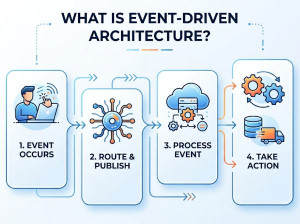
• Support event-driven architectures
• Smooth out traffic spikes using buffering (queueing)
How RabbitMQ works?
• A producer sends a message
• Message goes to an exchange
• Exchange routes it to one or more queues
• A consumer reads the message from the queue
This routing model is one of RabbitMQ’s key strengths.
Key components of RabbitMQ
1. Producer
Sends messages to RabbitMQ
2. Exchange
Receives messages from producers and decides routing logic
Types of exchanges:
• Direct
• Fanout
• Topic
• Headers
3. Queue
Stores messages until they are consumed
4. Consumer
Receives and processes messages from queues
5. Binding
Defines relationship between exchange and queue
Key features of RabbitMQ
• Reliable message delivery (acknowledgments)
• Message persistence
• Flexible routing using exchanges
• Clustering and high availability support
• Load balancing across consumers
• Dead-letter queues for failed messages
• Plugin ecosystem (monitoring, protocols, etc.)
• Supports multiple messaging protocols (AMQP, MQTT, STOMP)
Advantages of RabbitMQ
• Easy to use and well-documented
• Strong support for messaging patterns (queue + pub/sub)
• Reliable delivery guarantees
• Good performance for general workloads
• Flexible routing mechanisms
• Mature and widely adopted
• Works well in microservices architectures
Disadvantages of RabbitMQ
• Not ideal for very high-throughput streaming workloads
• Requires operational effort for clustering and scaling
• Memory usage can grow with large queues
• Less suitable for big data streaming compared to Kafka
• Complex routing configurations in large systems
When to use RabbitMQ?
Use RabbitMQ when:
• You need reliable task queues
• Building microservices-based systems
• Implementing event-driven architecture
• Handling background processing (emails, jobs, notifications)
• You require complex routing logic
Avoid or reconsider when:
• You need massive-scale event streaming (use Kafka instead)
• You need long-term event storage and replay capabilities
• Your system is extremely high-throughput (millions of events/sec)
RabbitMQ vs other messaging systems
vs Apache ActiveMQ
• RabbitMQ: better routing flexibility and modern protocol support
• ActiveMQ: strong JMS integration, more traditional enterprise usage
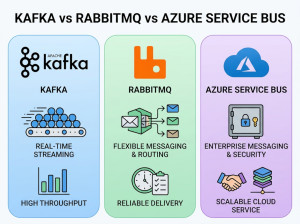
vs Apache Kafka
• RabbitMQ: best for task queues and low/medium throughput messaging
• Kafka: best for high-throughput event streaming and log processing