What is Read Replica? Architecture, Use Cases, C# Examples
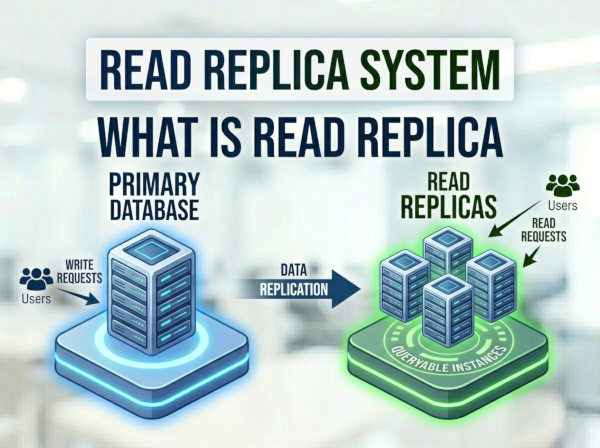
A read replica is a copy of a primary database that receives replicated data changes from the main database server. The primary database usually handles write operations such as INSERT, UPDATE, and DELETE, while the replica database is mainly responsible for handling read operations like SELECT queries. Read replicas help distribute database workload by reducing pressure on the main server, especially in applications with heavy read traffic. Data is synchronized from the primary database to replicas either synchronously or asynchronously depending on the database technology and replication configuration. Most modern relational and NoSQL databases support some form of read replication.
In practical systems, read replicas are commonly used in applications where thousands or millions of users continuously request data. For example, an e-commerce website may receive significantly more product browsing requests than purchase requests. Instead of forcing the primary database to process every read query, replicas can serve most read traffic while the primary focuses on transactional writes.
Why Do We Need Read Replicas?
Modern applications often experience much higher read traffic than write traffic. Social media platforms, reporting dashboards, news websites, analytics systems, and e-commerce platforms typically perform thousands of reads for every write operation. If all reads and writes go to a single database server, performance bottlenecks eventually appear as traffic grows.
Read replicas help solve this scalability problem by distributing read operations across multiple database instances. This reduces CPU usage, memory pressure, disk I/O, and query contention on the primary server. As a result, the application becomes more responsive and can handle larger numbers of concurrent users.
Another important reason is availability and fault tolerance. In some architectures, read replicas can temporarily serve traffic even if the primary database becomes unavailable. Although replicas are not always perfect failover replacements, they improve system resilience and operational flexibility.
Read replicas are also valuable for heavy reporting and analytics queries. Complex analytical queries can consume large amounts of resources and slow down transactional workloads. Running those queries against replicas prevents business-critical write operations from being affected.
When Should We Use Read Replicas?
High read traffic applications
Applications with significantly more read requests than write requests are ideal candidates for read replicas. For example, news websites may have millions of visitors reading articles while only a few editors publish content. In such cases, replicas reduce the load on the primary database and improve response times.
Reporting and analytics systems
Business intelligence dashboards and analytical reports often execute expensive queries involving aggregations and large scans. Running these operations on the primary database can negatively impact transactional workloads. Read replicas isolate reporting workloads from production operations, improving overall stability.
Globally distributed applications
Applications serving users from multiple geographic regions may place replicas closer to users in different locations. This reduces latency because users access nearby replica servers instead of communicating with a distant primary database. Streaming services, gaming platforms, and global SaaS products commonly use this approach.
Backup and maintenance scenarios
Read replicas can help during maintenance operations or backups. Instead of running expensive backup jobs on the primary database, organizations can use replicas to minimize performance impact. This approach helps maintain stable production performance during operational tasks.
Microservices and scalable architectures
Large-scale distributed systems often separate read and write responsibilities. Microservices handling search, recommendations, reporting, or analytics can use replicas independently without affecting transactional services. This architecture improves scalability and service isolation.
How Read Replication Works?
In a typical architecture, the primary database handles all write operations and records those changes in transaction logs or replication streams. Replica databases continuously receive and apply those changes to stay synchronized with the primary. Applications then route read queries to replicas while keeping writes directed to the primary server.
Some systems use asynchronous replication, where replicas receive updates slightly after the primary transaction completes. This improves performance but introduces replication lag. Other systems use synchronous replication, where writes are confirmed only after replicas acknowledge the change, improving consistency but potentially increasing latency.
| Replication Type | Explanation | Main Tradeoff |
|---|---|---|
| Asynchronous Replication | Replicas receive updates after the primary commits transactions. This method is faster and commonly used in scalable systems. | Replica data may temporarily lag behind the primary database. |
| Synchronous Replication | The primary waits for replicas to confirm changes before completing transactions. This improves consistency guarantees. | Write latency increases because multiple servers participate in transaction confirmation. |
| Semi-Synchronous Replication | At least one replica confirms receipt before the transaction completes, balancing consistency and performance. | More complex operational behavior compared to fully asynchronous systems. |
C# Usage Examples of Read Replicas
PostgreSQL Read Replica Example with C#
This example uses Npgsql and separate connection strings for primary and replica databases.
// Write connection to primary database
using Npgsql;
string primaryConnection =
"Host=primary-db;Port=5432;Username=postgres;Password=123456;Database=shopdb";
using var primaryConn = new NpgsqlConnection(primaryConnection);
await primaryConn.OpenAsync();
var insertCommand = new NpgsqlCommand(
"INSERT INTO products(name, price) VALUES (@name, @price)",
primaryConn);
insertCommand.Parameters.AddWithValue("name", "Laptop");
insertCommand.Parameters.AddWithValue("price", 1500);
await insertCommand.ExecuteNonQueryAsync();
// Read connection to replica database
using Npgsql;
string replicaConnection =
"Host=replica-db;Port=5432;Username=postgres;Password=123456;Database=shopdb";
using var replicaConn = new NpgsqlConnection(replicaConnection);
await replicaConn.OpenAsync();
var selectCommand = new NpgsqlCommand(
"SELECT * FROM products",
replicaConn);
using var reader = await selectCommand.ExecuteReaderAsync();
while (await reader.ReadAsync())
{
Console.WriteLine(reader["name"]);
}
This architecture allows PostgreSQL to isolate read traffic from write traffic. Large applications often use load balancers or proxy layers to automatically distribute read queries across multiple replicas.
MySQL Read Replica Example with C#
This example uses MySqlConnector.
// Write to primary server
using MySqlConnector;
string primaryConnection =
"Server=primary-db;Database=shopdb;User=root;Password=123456";
using var primaryConn = new MySqlConnection(primaryConnection);
await primaryConn.OpenAsync();
var command = new MySqlCommand(
"INSERT INTO orders(customer_name) VALUES(@name)",
primaryConn);
command.Parameters.AddWithValue("@name", "John Doe");
await command.ExecuteNonQueryAsync();
// Read from replica server
using MySqlConnector;
string replicaConnection =
"Server=replica-db;Database=shopdb;User=root;Password=123456";
using var replicaConn = new MySqlConnection(replicaConnection);
await replicaConn.OpenAsync();
var command = new MySqlCommand(
"SELECT * FROM orders",
replicaConn);
using var reader = await command.ExecuteReaderAsync();
while (await reader.ReadAsync())
{
Console.WriteLine(reader["customer_name"]);
}
MySQL read replicas are frequently used in content-heavy web applications where traffic patterns are heavily read-oriented. Many hosting providers and managed cloud services support automated MySQL replication setups.
MongoDB Secondary Replica Example with C#
MongoDB uses replica sets where secondary nodes can serve read operations.
// Configure read preference
using MongoDB.Driver;
var settings = MongoClientSettings.FromConnectionString(
"mongodb://mongo1,mongo2,mongo3");
settings.ReadPreference = ReadPreference.Secondary;
var client = new MongoClient(settings);
var database = client.GetDatabase("shopdb");
var collection = database.GetCollection<Product>("products");
var products = await collection.Find(_ => true).ToListAsync();
foreach (var product in products)
{
Console.WriteLine(product.Name);
}
MongoDB automatically routes read operations to secondary replicas when configured with secondary read preference. This setup is useful for analytics, search operations, and high-scale read workloads.
SQL Server Read Replica Example with C#
Microsoft SQL Server supports read-only replicas through Always On Availability Groups.
// Connect to read-only replica
using Microsoft.Data.SqlClient;
string replicaConnection =
"Server=sql-replica;Database=shopdb;User Id=sa;Password=123456";
using var conn = new SqlConnection(replicaConnection);
await conn.OpenAsync();
var command = new SqlCommand(
"SELECT TOP 10 * FROM Products",
conn);
using var reader = await command.ExecuteReaderAsync();
while (await reader.ReadAsync())
{
Console.WriteLine(reader["Name"]);
}
SQL Server read replicas are heavily used in enterprise reporting systems where operational queries must remain isolated from transactional business processes.
Advantages of Using Read Replicas
Improved scalability
Read replicas distribute traffic across multiple servers instead of forcing one database to handle every request. Applications with large user bases can scale more effectively because reads are often the dominant workload. This approach allows infrastructure growth without immediately redesigning the entire application architecture.
Better application performance
Separating reads from writes reduces contention on the primary database. Queries complete faster because the main server has fewer competing operations. End users experience lower latency and more stable response times during peak traffic periods.
Reduced risk for reporting workloads
Analytical queries and reporting operations often consume substantial resources. Running these workloads on replicas prevents expensive queries from slowing down transactional operations. This separation improves reliability for business-critical systems.
Improved operational flexibility
Read replicas provide additional infrastructure options for maintenance, backups, and disaster recovery strategies. Administrators can perform certain operational tasks on replicas instead of impacting the primary database directly. This reduces downtime risks and operational disruptions.
Geographic distribution support
Global applications can place replicas in multiple regions to improve user experience. Users connect to nearby replicas instead of communicating with distant servers. This reduces network latency and improves application responsiveness internationally.
Disadvantages of Using Read Replicas
Replication lag
Most read replica systems use asynchronous replication, meaning replicas may not immediately reflect the latest data changes. Applications requiring real-time consistency may experience issues when users read outdated information shortly after writes occur.
Increased infrastructure cost
Every replica requires additional servers, storage, monitoring, maintenance, and networking resources. While replicas improve scalability, they also increase operational expenses. Organizations must balance performance gains against infrastructure costs.
More architectural complexity
Applications often need logic for read/write splitting, failover handling, connection management, and consistency strategies. Development and operational complexity increase significantly compared to single-database architectures.
Potential consistency problems
Users may encounter situations where recently updated data does not appear immediately on replicas. This can create confusing user experiences in applications requiring immediate consistency, such as banking or real-time inventory management systems.
Monitoring and failover challenges
Replica environments require careful monitoring of replication health, synchronization delays, and failover readiness. If replicas fall behind significantly or become unavailable, application behavior may degrade unexpectedly.
Common Mistakes When Using Read Replicas
Sending write operations to replicas
Read replicas are usually configured as read-only systems. Accidentally sending write operations to replicas can cause application failures or unexpected errors. Teams should clearly separate read and write data access layers in application code.
Ignoring replication lag
Some developers assume replicas always contain perfectly current data. In reality, asynchronous replication often introduces delays ranging from milliseconds to several seconds. Applications requiring immediate consistency should avoid routing critical reads to replicas.
Using replicas for transactional workflows
Multi-step transactional workflows often require strongly consistent reads immediately after writes. Using replicas in these workflows may produce inconsistent business behavior because recent changes may not yet be replicated.
Poor load balancing strategies
Simply adding replicas does not automatically solve scalability issues. Without proper query routing and load balancing, some replicas may become overloaded while others remain underutilized.
Assuming replicas replace backups
Read replicas improve availability and scalability, but they are not substitutes for backups. If corrupted or deleted data replicates from the primary database, replicas will also contain corrupted data. Organizations still need proper backup and recovery strategies.
Alternatives to Read Replicas
Database caching with Redis
Redis is commonly used to cache frequently requested data in memory. Instead of querying the database repeatedly, applications retrieve data directly from Redis, dramatically reducing database load. This approach is extremely effective for session storage, product catalogs, and frequently accessed API responses.
Query optimization and indexing
Sometimes database performance problems come from inefficient queries rather than insufficient infrastructure. Proper indexing, query tuning, and schema optimization can significantly improve performance without adding replicas. Many applications gain large improvements simply by optimizing slow queries correctly.
Horizontal database sharding
Sharding distributes data across multiple independent database servers instead of replicating the same data everywhere. Large-scale systems with enormous datasets often use sharding because it scales both reads and writes. However, sharding introduces substantial architectural complexity.
CQRS (Command Query Responsibility Segregation)
CQRS separates read and write models into independent systems. Write operations use one optimized data model while read operations use another optimized structure. Large enterprise systems sometimes adopt CQRS when read and write workloads differ dramatically.
Search engines and analytics platforms
Applications with heavy search or analytics requirements often offload those workloads to systems like Elasticsearch. Instead of executing expensive search queries on transactional databases, specialized search platforms handle indexing and querying more efficiently.