Migrating WCF to gRPC in C#: Step-by-Step Guide with Real Examples
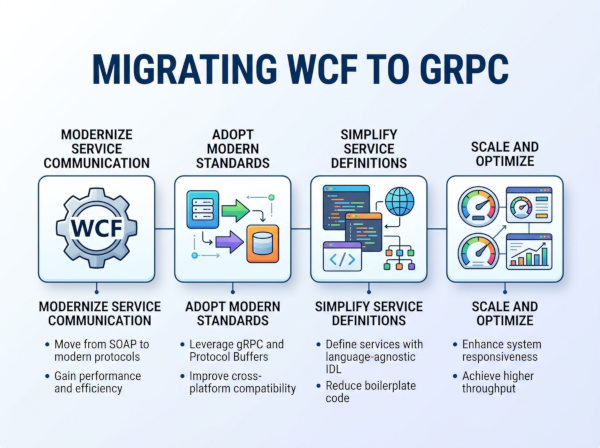
WCF to gRPC migration is the process of replacing legacy SOAP-based WCF services with modern, high-performance gRPC services using Protocol Buffers and HTTP/2.
Understanding Why We Migrate from WCF to gRPC
Windows Communication Foundation (WCF) was designed for SOAP-based enterprise service communication in early .NET applications. It relies heavily on XML serialization, complex configuration, and multiple binding types such as BasicHttpBinding and NetTcpBinding.
While WCF was powerful in its time, modern distributed systems require faster, lighter, and cross-platform communication mechanisms.
gRPC solves these limitations by using HTTP/2, binary serialization (Protocol Buffers), and strongly typed service contracts. It is significantly faster, more efficient, and better suited for microservices and cloud-native systems.
Why Replace WCF with gRPC?
WCF is often replaced because:
• XML payloads are heavy and slow to parse
• Configuration complexity is high
• Cross-platform support is limited
• Performance is lower compared to modern alternatives
• Microservices architectures require lightweight communication
gRPC addresses these issues by providing:
• Binary serialization using Protocol Buffers
• Built-in streaming support
• Strongly typed contracts
• Cross-language compatibility
• High performance over HTTP/2
When Should You Migrate?
You should consider migration when:
• Moving from monolithic to microservices architecture
• Building cloud-native applications
• Replacing SOAP-based integrations
• Improving service performance and latency
• Supporting cross-platform clients (Java, Go, Python, etc.)
If your system is stable, heavily dependent on SOAP tooling, or tightly integrated with legacy systems, migration should be gradual.
WCF vs gRPC: Key Differences
WCF is a SOAP-based communication framework for building service-oriented applications in .NET.
gRPC is a high-performance RPC framework that uses HTTP/2 and Protocol Buffers for efficient service communication.
Communication Format
WCF uses XML-based SOAP messages, which are verbose and slower to serialize. gRPC uses binary Protocol Buffers, which are compact and much faster.
Transport Protocol
WCF supports multiple bindings including HTTP and TCP. gRPC uses HTTP/2 exclusively, enabling multiplexed streams over a single connection.
Performance
gRPC generally outperforms WCF due to reduced payload size, binary serialization, and efficient connection reuse.
Cross-Platform Support
WCF is primarily Windows/.NET Framework focused, while gRPC supports multiple languages and platforms.
Migration Strategy Overview
Migrating from WCF to gRPC is not a direct replacement. It requires redesigning service contracts using .proto files instead of .svc interfaces.
The migration typically follows these steps:
• Analyze existing WCF services
• Map service operations to gRPC methods
• Define protobuf contracts
• Implement gRPC server
• Implement gRPC clients
• Gradually replace WCF endpoints
• Remove legacy services
Step 1: Example WCF Service (Legacy)
[ServiceContract]
public interface IOrderService
{
[OperationContract]
OrderResponse GetOrder(OrderRequest request);
}
This WCF service uses SOAP contracts and synchronous request/response patterns.
Step 2: Equivalent gRPC Proto Definition
syntax = "proto3";
option csharp_namespace = "OrderServiceGrpc";
service OrderService {
rpc GetOrder (OrderRequest) returns (OrderResponse);
}
message OrderRequest {
int32 orderId = 1;
}
message OrderResponse {
int32 orderId = 1;
string customerName = 2;
double totalAmount = 3;
}
This .proto file defines a strongly typed contract shared between client and server.
Step 3: gRPC Server Implementation in C#
public class OrderServiceImpl : OrderService.OrderServiceBase
{
public override Task<OrderResponse> GetOrder(
OrderRequest request,
ServerCallContext context)
{
var response = new OrderResponse
{
OrderId = request.OrderId,
CustomerName = "John Doe",
TotalAmount = 250.75
};
return Task.FromResult(response);
}
}
This replaces the WCF service implementation with a gRPC service class.
Step 4: Configure gRPC in ASP.NET Core
var builder = WebApplication.CreateBuilder(args);
builder.Services.AddGrpc();
var app = builder.Build();
app.MapGrpcService<OrderServiceImpl>();
app.Run();
This registers the gRPC service inside an ASP.NET Core application.
Step 5: gRPC Client in C#
var channel = GrpcChannel.ForAddress("https://localhost:5001");
var client = new OrderService.OrderServiceClient(channel);
var response = await client.GetOrderAsync(new OrderRequest
{
OrderId = 1
});
Console.WriteLine(response.CustomerName);
This replaces WCF-generated proxies with a strongly typed gRPC client.
Key Migration Mapping (WCF → gRPC)
| WCF Concept | gRPC Equivalent |
|---|---|
| ServiceContract | .proto service definition |
| OperationContract | rpc method |
| DataContract | message |
| SOAP XML | Protocol Buffers (binary) |
| Bindings | HTTP/2 channel |
| Client Proxy | Generated gRPC client |
Key Components in gRPC Migration
Protocol Buffers
Protocol Buffers define the contract between client and server in a language-neutral format. They replace WCF’s XML-based DataContracts.
gRPC Services
Services define RPC methods that clients can call remotely. These are strongly typed and compiled into client/server code.
HTTP/2 Transport
gRPC uses HTTP/2, enabling multiplexing multiple requests over a single connection, reducing latency and improving throughput.
Advantages of Migrating to gRPC
High Performance
Binary serialization and HTTP/2 significantly reduce latency compared to SOAP-based communication.
Strong Typing
Contracts are defined once and shared across client and server, reducing runtime errors.
Cross-Platform Support
gRPC supports .NET, Java, Python, Go, and many other languages, making it ideal for microservices ecosystems.
Streaming Support
gRPC supports client, server, and bidirectional streaming, which is not natively available in WCF.
Disadvantages of Migration
Learning Curve
Teams must learn Protocol Buffers and gRPC concepts.
Debugging Complexity
Binary payloads are harder to inspect compared to XML SOAP messages.
Browser Limitations
Direct browser support for gRPC is limited (requires gRPC-Web).
Migration Effort
Legacy WCF systems require careful redesign rather than simple replacement.
Common Migration Issues
Contract Mismatch
WCF data models often do not map directly to protobuf messages.
Synchronous to Asynchronous Shift
gRPC is naturally asynchronous, requiring redesign of synchronous WCF methods.
Large System Dependency
Legacy systems tightly coupled with WCF bindings may require gradual migration instead of full replacement.
Real-World Migration Strategy
Strangler Pattern
Instead of replacing all WCF services at once, new gRPC services are introduced alongside WCF, gradually replacing endpoints.
Dual Running Systems
Both WCF and gRPC services run in parallel during transition to ensure backward compatibility.
API Gateway Approach
An API gateway routes traffic between legacy WCF services and modern gRPC services.
Best Use Cases After Migration
Microservices Architecture
gRPC is ideal for service-to-service communication in distributed systems.
High-Performance APIs
Systems requiring low latency and high throughput benefit significantly from gRPC.
Internal Enterprise Services
Backend communication between internal systems becomes more efficient and scalable.
Real-Time Systems
Streaming capabilities make gRPC suitable for real-time data pipelines and monitoring systems.
Final Thoughts
Migrating from WCF to gRPC is not just a technical upgrade but a fundamental modernization of service architecture.
WCF was designed for SOAP-based enterprise systems, while gRPC is built for modern distributed cloud-native applications. The transition improves performance, scalability, and cross-platform compatibility but requires careful planning, especially for large legacy systems.
A gradual migration strategy using parallel systems and incremental service replacement is often the safest and most effective approach.