Span<T> in C#: Memory Efficiency, Stack Allocation and High-Performance Programming
Span<T> is a type in C# that provides a safe and efficient way to work with contiguous regions of memory without creating additional allocations on the managed heap.
It is designed for high-performance scenarios where reducing memory allocations and improving execution speed are critical.
Span<T> allows developers to work with:
• Arrays
• Stack-allocated memory
• Slices of arrays or strings
• Native memory buffers
Why Do We Use Span<T>?
Traditional array operations often create unnecessary memory allocations when slicing or copying data.
Span<T> solves this problem by providing a lightweight “view” over existing memory without copying it.
This improves:
• Performance
• Memory usage
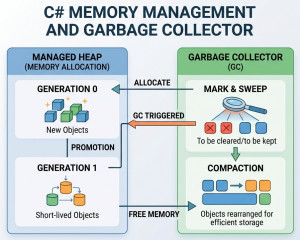
• Garbage Collector pressure
When Should You Use Span<T>?
Span<T> is useful when:
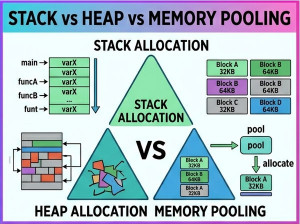
• You want to avoid heap allocations
• You are processing large buffers
• You need fast slicing of arrays or strings
• You are writing performance-critical code
Common use cases include:
• Parsing text or binary data
• Network buffer processing
• File streaming operations
• High-performance APIs
• Serialization/deserialization systems
How Span<T> Works
Span<T> is a stack-only type that acts as a lightweight reference to a memory region.
It does not own the data; instead, it points to existing memory safely.
This allows operations like slicing without copying data.
Basic Example of Span<T>
int[] numbers = { 1, 2, 3, 4, 5 };
Span<int> span = numbers;
Span<int> slice = span.Slice(1, 3);
This creates a view over the array without copying data.
stackalloc with Span<T>
Span<T> can be used with stack-allocated memory for maximum performance.
Span<int> numbers = stackalloc int[5];
numbers[0] = 10;
This avoids heap allocation entirely.
Span<T> vs Array
| Feature | Span<T> | Array |
|---|---|---|
| Memory allocation | No extra allocation (view) | Heap allocated |
| Slicing | Zero-copy slicing | Requires copying |
| Performance | High | Standard |
| Lifespan | Stack-only | Heap-managed |
| Flexibility | Limited (ref struct) | High |
Span<T> vs Memory<T>
| Feature | Span<T> | Memory<T> |
|---|---|---|
| Heap usage | No | Yes |
| Async support | No | Yes |
| Performance | Faster | Slightly slower |
| Use case | Synchronous high-performance code | Async/await scenarios |
Limitations of Span<T>
Span<T> has some restrictions:
• Cannot be used in async methods
• Cannot be stored in classes
• Must live on the stack
• Limited lifetime scope
These limitations exist to ensure memory safety.
Real-World Use Cases
• High-performance parsing systems
• Networking buffers
• File I/O processing
• Serialization frameworks
• String manipulation
• Low-latency backend systems
Advantages of Span<T>
• Zero allocation slicing
• Reduces GC pressure
• High performance
• Safe memory access
• Works with stack memory
Disadvantages of Span<T>
• Cannot be used in async/await
• Limited lifetime constraints
• Steeper learning curve
• Not suitable for all architectures
Common Mistakes
• Trying to store Span<T> in class fields
• Using it in async methods
• Confusing Span<T> with Memory<T>
• Overusing it in non-performance-critical code
Best Practices
• Use Span<T> only in performance-critical paths
• Prefer Memory<T> for async scenarios
• Avoid long-lived spans
• Combine with stackalloc for maximum efficiency
Conclusion
Span<T> is a powerful C# feature designed for high-performance memory manipulation. It enables zero-allocation slicing and efficient data processing while maintaining safety.
When used correctly, it significantly improves performance in systems that process large amounts of data or require low latency execution.