Fourier Transform in C#
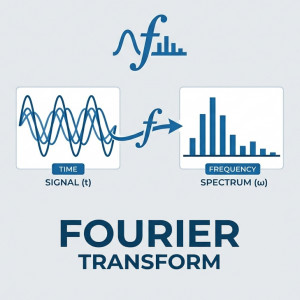
When working with digital signals, sensor data, audio recordings, or scientific measurements, we typically observe values that change over time. This representation is known as the time domain. While viewing a signal in the time domain is useful, it does not always reveal the underlying patterns that exist within the data. In many situations, understanding the frequency components of a signal provides far more valuable insights than simply observing its amplitude over time.
The Fourier Transform is one of the most important mathematical tools used to achieve this. It allows us to transform a signal from the time domain into the frequency domain, making it possible to analyze the frequencies that compose the original signal.
What is the Fourier Transform?
The Fourier Transform (FT) is a mathematical transformation that decomposes a signal into its constituent frequencies. Instead of describing how a signal changes over time, the transform describes which frequencies are present within the signal and the contribution of each frequency component.
The concept is based on the idea that even highly complex signals can be represented as a combination of simple sine and cosine waves. By identifying these waves and their amplitudes, the Fourier Transform provides a completely different perspective on the same data.
For example, a musical note played on a piano may appear as a complex waveform in the time domain. After applying the Fourier Transform, the waveform can be separated into its fundamental frequency and harmonic frequencies, making it possible to analyze the sound in greater detail.
In simple terms, the Fourier Transform answers the following question:
"Which frequencies exist inside this signal, and how strong are they?"
Why is the Fourier Transform Important?
Many real-world problems become easier to solve when data is represented in the frequency domain rather than the time domain. Noise reduction, compression, filtering, pattern recognition, and anomaly detection often rely on frequency analysis.
Without the Fourier Transform, engineers would have difficulty identifying periodic behavior, removing unwanted frequencies, or understanding the spectral characteristics of a signal. The transform acts as a bridge between two different views of the same information.
- Audio and speech analysis
- Image processing and compression
- Medical signal analysis (ECG, EEG, MRI)
- Telecommunications and wireless networks
- Radar and sonar systems
- Scientific and engineering simulations
- Financial trend and cycle analysis
How Does the Fourier Transform Work?
At a high level, the Fourier Transform compares a signal against a series of sine and cosine waves with different frequencies. For each frequency, it measures how strongly that frequency appears in the original signal.
The result is a frequency spectrum that shows the magnitude of each detected frequency. Peaks within the spectrum indicate dominant frequencies, while smaller values indicate weaker frequency components.
This process allows a complex waveform to be represented as a collection of simpler periodic components. Once transformed into the frequency domain, many signal processing operations become significantly easier to perform.
The Mathematical Definition
The continuous Fourier Transform is commonly defined as:
F(ω) = ∫ f(t)e-iωt dt
Although the mathematical notation may initially appear intimidating, the underlying idea is relatively straightforward. The formula measures how much of a particular frequency exists within a signal. By repeating this calculation for all possible frequencies, the complete frequency representation of the signal can be obtained.
In practical software applications, continuous signals rarely exist. Instead, computers work with discrete samples, which leads to the use of the Discrete Fourier Transform (DFT).
Discrete Fourier Transform (DFT)
Because computers process finite sets of sampled data, the Discrete Fourier Transform is used to approximate the Fourier Transform. The DFT produces a finite number of frequency components from a finite number of input samples.
The DFT preserves the same fundamental objective as the Fourier Transform: converting information from the time domain into the frequency domain. However, it is specifically designed for digital systems and numerical computation.
| Transform Type | Input | Typical Usage |
|---|---|---|
| Fourier Transform (FT) | Continuous Signal | Mathematical Analysis |
| Discrete Fourier Transform (DFT) | Sampled Digital Data | Software and Digital Systems |
Implementing a Simple DFT in C#
The following example demonstrates a simplified implementation of the Discrete Fourier Transform in C#. The code calculates the frequency spectrum of a sampled signal using the standard DFT formula.
using System;
using System.Numerics;
public static class DFT
{
public static Complex[] Compute(double[] samples)
{
int n = samples.Length;
Complex[] result = new Complex[n];
for (int k = 0; k < n; k++)
{
Complex sum = Complex.Zero;
for (int t = 0; t < n; t++)
{
double angle = -2 * Math.PI * k * t / n;
sum += samples[t] *
new Complex(Math.Cos(angle), Math.Sin(angle));
}
result[k] = sum;
}
return result;
}
}
This implementation demonstrates the underlying principle behind frequency analysis, although it is not optimized for large datasets. As the number of samples increases, the computational cost grows rapidly.
Limitations of the Fourier Transform in Software Applications
While the Fourier Transform and its discrete variant are powerful analytical tools, they are not always computationally efficient. A direct DFT implementation requires O(N²) operations, meaning that processing large signals can become expensive in terms of execution time and computational resources.
For small datasets this may not be noticeable, but applications that perform real-time audio processing, video analysis, or communication signal processing often require much faster solutions.
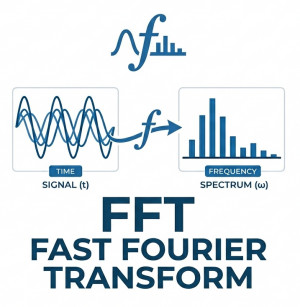
This limitation eventually led to the development of the Fast Fourier Transform (FFT), an optimized algorithm capable of producing the same result as the DFT while dramatically reducing computational complexity.
| Method | Complexity | Performance |
|---|---|---|
| Direct DFT | O(N²) | Slow for large datasets |
| FFT | O(N log N) | Suitable for real-time processing |
Because of this significant performance difference, modern software systems rarely implement a direct DFT for large-scale processing tasks. Instead, optimized FFT algorithms are typically used behind the scenes while still relying on the same mathematical principles established by the Fourier Transform.
Common .NET Libraries
Developers who need Fourier analysis in production applications usually rely on well-established numerical libraries rather than implementing the algorithms from scratch.
- MathNet.Numerics
- Accord.NET
- ILNumerics
- NWaves
These libraries provide optimized implementations for frequency analysis, spectral processing, filtering, and other advanced numerical operations.
Summary
The Fourier Transform is a foundational concept in mathematics, engineering, and computer science. By converting signals from the time domain into the frequency domain, it allows developers and researchers to understand the hidden frequency structure of complex data.
Although software applications generally use the Discrete Fourier Transform and its optimized counterpart, the Fast Fourier Transform, the core principles remain rooted in the original Fourier Transform. Understanding these principles provides valuable insight into how modern signal processing systems operate.
Conclusion
The Fourier Transform fundamentally changed the way signals are analyzed and processed. Its ability to reveal the frequency composition of data has enabled breakthroughs in audio engineering, telecommunications, medical imaging, scientific research, and countless software applications. Before exploring advanced optimizations such as the Fast Fourier Transform, it is essential to understand the concepts introduced by the Fourier Transform itself, as they form the basis of nearly every modern frequency analysis technique.