Fast Fourier Transform (FFT) in C#
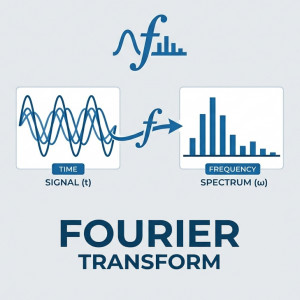
In the Fourier Transform tutorial, we have learned how signals can be transformed from the time domain into the frequency domain. While the concept is extremely powerful, a practical challenge quickly emerges when working with large datasets. Calculating frequency components directly requires a significant amount of computation, making real-time processing difficult or even impossible for many applications.
To solve this problem, mathematicians and computer scientists developed the Fast Fourier Transform, commonly known as FFT. Today, FFT is considered one of the most influential algorithms in computer science and forms the foundation of countless applications involving signal analysis, image processing, telecommunications, audio engineering, and scientific computing.
What is Fast Fourier Transform?
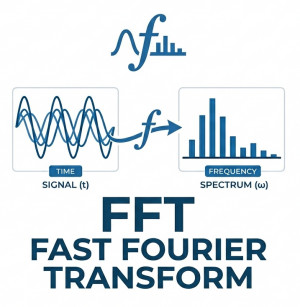
The Fast Fourier Transform (FFT) is an optimized algorithm used to compute the Discrete Fourier Transform (DFT). The result produced by FFT is mathematically identical to the result produced by a traditional DFT calculation. The difference lies entirely in how the calculation is performed.
Rather than calculating every frequency component independently, FFT applies a divide-and-conquer strategy that breaks a large problem into multiple smaller problems. By reusing intermediate results and eliminating redundant calculations, FFT dramatically reduces the amount of work required.
FFT does not produce a different result than DFT. It simply reaches the same result much faster.
Why Was FFT Needed?
As computers became capable of processing larger amounts of digital information, the limitations of traditional DFT calculations became increasingly apparent. A signal containing thousands or millions of samples could require an enormous number of mathematical operations.
For applications such as live audio processing, wireless communication, radar systems, video compression, and scientific simulations, these computational requirements were often too expensive.
FFT was developed specifically to address this performance bottleneck. By reducing computational complexity, FFT made real-time frequency analysis practical and opened the door for many technologies that are now considered standard.
Computational Complexity
One of the most important reasons FFT became so popular is its efficiency. A direct DFT implementation requires O(N²) operations. As the input size grows, the number of calculations increases dramatically.
FFT reduces this complexity to O(N log N), resulting in massive performance improvements when processing large datasets.
DFT Complexity = O(N²)
FFT Complexity = O(N log N)
| Sample Count | DFT Operations | FFT Operations |
|---|---|---|
| 1,024 | 1,048,576 | ~10,240 |
| 8,192 | 67,108,864 | ~106,496 |
| 65,536 | 4,294,967,296 | ~1,048,576 |
As the dataset grows, the performance gap becomes increasingly significant. This is why virtually every modern signal processing library relies on FFT instead of direct DFT calculations.
How FFT Works
The most common FFT implementation is based on the Cooley-Tukey algorithm. The algorithm repeatedly divides the input sequence into smaller sequences, computes smaller transforms, and combines the results efficiently.
Instead of processing every sample against every frequency, FFT exploits mathematical symmetries within the transform itself. These optimizations eliminate a large number of duplicate calculations.
The divide-and-conquer approach allows FFT to scale exceptionally well, making it suitable for datasets containing millions of samples.
Fourier Transform vs FFT
Many developers initially assume that Fourier Transform and FFT are competing technologies. In reality, FFT is simply an efficient method for computing a discrete version of the Fourier Transform.
| Feature | Fourier Transform / DFT | FFT |
|---|---|---|
| Purpose | Frequency Analysis | Frequency Analysis |
| Result Accuracy | Exact | Exact |
| Complexity | O(N²) | O(N log N) |
| Performance | Slower | Much Faster |
| Real-Time Processing | Limited | Excellent |
| Industry Usage | Rare | Standard |
Most modern software never performs a direct DFT calculation unless the dataset is extremely small or educational purposes are involved.
Implementing FFT in C#
The following example demonstrates a simplified recursive FFT implementation. This example is intended to illustrate the core concept behind FFT rather than provide a production-ready implementation.
using System;
using System.Numerics;
public static class FFT
{
public static Complex[] Compute(Complex[] input)
{
int n = input.Length;
if (n == 1)
return new Complex[] { input[0] };
Complex[] even = new Complex[n / 2];
Complex[] odd = new Complex[n / 2];
for (int i = 0; i < n / 2; i++)
{
even[i] = input[2 * i];
odd[i] = input[2 * i + 1];
}
Complex[] evenFFT = Compute(even);
Complex[] oddFFT = Compute(odd);
Complex[] result = new Complex[n];
for (int k = 0; k < n / 2; k++)
{
Complex twiddle = Complex.Exp(-2 * Math.PI * Complex.ImaginaryOne * k / n);
result[k] = evenFFT[k] + twiddle * oddFFT[k];
result[k + n / 2] = evenFFT[k] - twiddle * oddFFT[k];
}
return result;
}
}
Using MathNet.Numerics
In production environments, developers typically rely on optimized numerical libraries rather than implementing FFT manually.
MathNet.Numerics is one of the most popular numerical computing libraries available for .NET applications.
using MathNet.Numerics.IntegralTransforms;
using System.Numerics;
Complex[] samples =
{
new Complex(1, 0),
new Complex(2, 0),
new Complex(3, 0),
new Complex(4, 0),
new Complex(5, 0),
new Complex(6, 0),
new Complex(7, 0),
new Complex(8, 0)
};
Fourier.Forward(samples);
Popular FFT Libraries for .NET
- MathNet.Numerics
- NWaves
- ILNumerics
- Accord.NET
- SciSharp Ecosystem
Summary
Fast Fourier Transform is one of the most important optimization algorithms ever created. By reducing the computational complexity of frequency analysis from O(N²) to O(N log N), FFT makes large-scale and real-time signal processing practical.
Although the mathematical result is identical to a traditional DFT, the performance improvements are substantial. This efficiency is why FFT has become the standard approach for audio processing, image analysis, telecommunications, scientific computing, and many other domains.
For .NET developers, understanding FFT provides valuable insight into how modern frequency analysis systems operate. Whether implemented manually for learning purposes or through specialized libraries for production workloads, FFT remains a cornerstone of digital signal processing.