Moving Average in C#
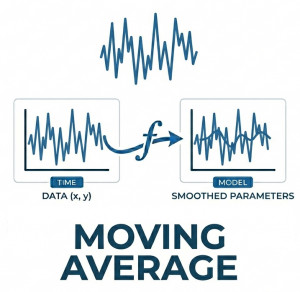
In real-world data analysis, raw data is often noisy, irregular, and difficult to interpret directly. Whether you are working with financial markets, sensor readings, or performance metrics, the data usually contains short-term fluctuations that can hide the underlying trend.
The Moving Average is one of the simplest and most widely used techniques to smooth data and reveal its general direction. It works by calculating the average of a fixed number of consecutive data points, then "moving" that window across the dataset.
What is Moving Average?
A Moving Average is a statistical technique that computes the average of a subset of data points within a sliding window. Each new value is calculated by taking the average of the most recent N values, where N is the window size.
MA(t) = (x(t) + x(t-1) + ... + x(t-n+1)) / n
The result is a smoother version of the original dataset, where short-term fluctuations are reduced and long-term trends become more visible.
Moving Average does not predict future values; it only smooths existing data to make patterns easier to observe.
Where is Moving Average Used?
Moving Average is widely used in many domains because of its simplicity and effectiveness. It is especially popular in time-series analysis and real-time data monitoring systems.
- Stock market trend analysis
- Financial technical indicators (SMA, EMA basis)
- Sensor data smoothing (IoT systems)
- Temperature and weather trend analysis
- Network traffic monitoring
- Audio and signal noise reduction
Types of Moving Average
There are several variations of moving averages, but the two most commonly used types are Simple Moving Average (SMA) and Weighted Moving Average (WMA).
| Type | Description | Behavior |
|---|---|---|
| Simple Moving Average (SMA) | Equal weight for all values in the window | Smooth but reacts slowly |
| Weighted Moving Average (WMA) | More weight given to recent values | More responsive to changes |
How Moving Average Works
The idea behind Moving Average is straightforward: instead of analyzing every single raw value, we analyze a rolling subset of values. This reduces noise and makes patterns easier to interpret.
For example, if you choose a window size of 3, each output value is the average of the current value and the previous two values.
Larger window sizes produce smoother results but reduce sensitivity to sudden changes. Smaller window sizes react faster but produce more noise.
Implementing Simple Moving Average in C#
The following example demonstrates a basic implementation of Simple Moving Average (SMA) in C#. It uses a sliding window approach to compute the average for each position in the dataset.
using System;
public class MovingAverage
{
public static double[] SMA(double[] data, int windowSize)
{
int n = data.Length;
double[] result = new double[n - windowSize + 1];
for (int i = 0; i < result.Length; i++)
{
double sum = 0;
for (int j = 0; j < windowSize; j++)
{
sum += data[i + j];
}
result[i] = sum / windowSize;
}
return result;
}
}
This implementation recalculates the sum for every window, which makes it simple but not optimal. For large datasets, a more efficient sliding window technique can reduce computational overhead significantly.
Optimized Version (Sliding Window)
public static double[] SMAOptimized(double[] data, int windowSize)
{
int n = data.Length;
double[] result = new double[n - windowSize + 1];
double windowSum = 0;
for (int i = 0; i < windowSize; i++)
windowSum += data[i];
result[0] = windowSum / windowSize;
for (int i = windowSize; i < n; i++)
{
windowSum += data[i] - data[i - windowSize];
result[i - windowSize + 1] = windowSum / windowSize;
}
return result;
}
Libraries in .NET Ecosystem
While Moving Average is simple enough to implement manually, many developers use existing libraries for time-series and financial analysis.
- MathNet.Numerics
- Accord.NET
- Deedle (data frame library)
- Skender.Stock.Indicators
- TA-Lib wrappers for .NET
Moving Average vs Raw Data
| Feature | Raw Data | Moving Average |
|---|---|---|
| Noise Level | High | Reduced |
| Trend Visibility | Low | High |
| Responsiveness | Instant | Smooth / Delayed |
| Use Case | Raw analysis | Trend detection |
Summary
Moving Average is one of the simplest yet most powerful tools in data analysis and signal processing. By smoothing out short-term fluctuations, it helps reveal long-term trends that would otherwise be hidden in noisy datasets.
Although it does not provide predictive power on its own, it is often used as a foundation for more advanced techniques such as exponential smoothing, time-series forecasting, and financial indicators.
In C#, Moving Average can be implemented easily with just a few lines of code, making it an excellent starting point for developers entering the world of data analysis and signal processing.