Exponential Moving Average (EMA) in C#
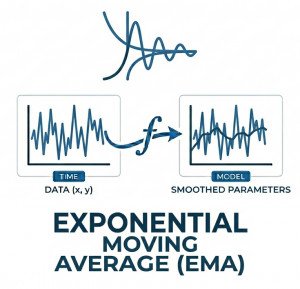
In data analysis and signal processing, smoothing noisy data is a fundamental requirement. While Simple Moving Average (SMA) is often used as a starting point, it has a major limitation: it treats all values in the window equally and reacts slowly to new changes in the data.
The Exponential Moving Average (EMA) improves on this by giving more weight to recent values while still considering older data. This makes EMA significantly more responsive to changes, especially in dynamic systems such as financial markets or real-time sensor streams.
What is Exponential Moving Average?
Exponential Moving Average is a weighted moving average technique where the weights decrease exponentially as the data points get older. Instead of using a fixed window with equal importance, EMA continuously updates its value based on the previous average and the newest data point.
EMA(t) = α × x(t) + (1 − α) × EMA(t−1)
Here, α (alpha) is the smoothing factor between 0 and 1. A higher alpha makes the EMA more sensitive to recent changes, while a lower alpha makes it smoother and more stable.
Unlike Simple Moving Average, EMA does not require storing a full window of past values. It only depends on the previous EMA value.
Why Use EMA Instead of SMA?
The main advantage of EMA is its responsiveness. While SMA reacts equally to all values in the window, EMA prioritizes recent data, which makes it better suited for fast-changing environments.
- More responsive to recent changes
- No need for a fixed-size sliding window
- Better for real-time systems
- Widely used in financial trading systems
- Smoother than raw data but faster than SMA
Where is EMA Used?
EMA is widely used in domains where recent data is more important than older data. It is especially popular in financial and real-time analytics systems.
- Stock market trend indicators (trading strategies)
- Algorithmic trading systems
- Sensor data filtering in IoT systems
- Network traffic analysis
- Real-time performance monitoring
- Signal processing and forecasting systems
EMA vs SMA
Although both SMA and EMA are used for smoothing data, their behavior is fundamentally different due to how they weight historical values.
| Feature | Simple Moving Average (SMA) | Exponential Moving Average (EMA) |
|---|---|---|
| Weighting | Equal weights | Exponential decay (recent values matter more) |
| Responsiveness | Slower | Faster |
| Memory Usage | Requires window storage | No full window needed |
| Noise Reduction | Strong smoothing | Balanced smoothing |
| Use Case | General trend smoothing | Real-time analysis & trading |
How EMA Works
EMA starts with an initial value, often the first data point or an SMA of the first few values. Then each new value updates the previous EMA using a weighted formula.
The smoothing factor α determines how much influence the newest value has. For example, α = 0.2 means 20% of the new value and 80% of the previous EMA.
Higher alpha values make EMA more reactive but also more sensitive to noise.
Implementing EMA in C#
The following example demonstrates a simple and efficient implementation of Exponential Moving Average in C#.
using System;
public class ExponentialMovingAverage
{
public static double[] EMA(double[] data, double alpha)
{
int n = data.Length;
double[] result = new double[n];
result[0] = data[0];
for (int i = 1; i < n; i++)
{
result[i] = alpha * data[i] + (1 - alpha) * result[i - 1];
}
return result;
}
}
This implementation is highly efficient because it only requires a single pass through the data and constant memory usage.
Choosing Alpha Value
The smoothing factor α is one of the most important parameters in EMA. It directly controls the balance between smoothness and responsiveness.
Common practice is to calculate alpha using a time period:
α = 2 / (N + 1)
Where N represents the chosen period. Smaller values of N result in more responsive EMA curves.
Common .NET Libraries
Although EMA is simple to implement, many developers prefer using financial or time-series libraries for consistency and additional features.
- MathNet.Numerics
- Skender.Stock.Indicators
- Deedle
- Accord.NET
- TA-Lib wrappers for .NET
Summary
Exponential Moving Average is a powerful improvement over Simple Moving Average that provides faster and more adaptive smoothing of data. By assigning more weight to recent observations, EMA reacts quickly to changes while still reducing noise in the dataset.
This makes it especially useful in real-time systems such as financial trading, sensor monitoring, and signal processing applications.
In C#, EMA can be implemented with just a few lines of code, making it an efficient and practical tool for developers working with time-series data.