Azure Service Bus, ASB

Azure Service Bus (ASB) is a fully managed cloud messaging service provided by Microsoft. It enables reliable communication between applications and services using messages, queues, and publish/subscribe patterns.
It is designed for enterprise-grade messaging in distributed and cloud-native systems.
Why Azure Service Bus is used?
Azure Service Bus is used to:
• Enable asynchronous communication between services
• Decouple microservices (sender and receiver do not depend on each other)
• Ensure reliable message delivery
• Handle work queues and background processing
• Support event-driven architectures
• Integrate distributed systems in a secure and scalable way
How Azure Service Bus works?
• A producer sends a message
• Message is stored in a queue or topic
• Azure Service Bus manages delivery and durability
• A consumer receives and processes the message
It guarantees that messages are not lost even if systems fail.
Key concepts of ASB
1. Queue (Point-to-Point)
• One message to one consumer
• Used for task distribution
2. Topic (Publish-Subscribe)
• One message to multiple subscribers
• Used for event broadcasting
3. Subscription
• A filtered view of a topic
• Allows selective message consumption
4. Message
• The data being transferred between systems
5. Dead-letter Queue (DLQ)
• Stores messages that cannot be delivered or processed
Key features of Azure Service Bus
• Fully managed (no infrastructure to maintain)
• Reliable messaging with at-least-once delivery
• Message durability (persistent storage)
• Dead-lettering support
• Message ordering (sessions)
• Duplicate detection
• Scheduled message delivery
• Auto-scaling and high availability
• Security with Azure Active Directory and SAS authentication
Advantages of Azure Service Bus
• No infrastructure management required (cloud-managed)
• Highly reliable and durable messaging
• Strong support for enterprise messaging patterns
• Built-in security and access control
• Integrates well with Azure ecosystem
• Supports complex workflows and distributed systems
• Better reliability guarantees than many self-hosted brokers
Disadvantages of Azure Service Bus
• Cost can increase with heavy usage
• Vendor lock-in to Microsoft Azure
• Slight latency compared to self-hosted brokers
• Less control over internal infrastructure
• Requires Azure ecosystem knowledge
When to use Azure Service Bus?
Use Azure Service Bus when:
• You are building cloud-native applications on Azure
• You need reliable enterprise messaging
• You want managed infrastructure (no broker maintenance)
• You are implementing microservices communication
• You need complex messaging patterns (topics, sessions, DLQ)
Avoid or reconsider when:
• You need extremely high-throughput streaming (use Apache Kafka instead)
• You want a cloud-agnostic or self-hosted solution
• You need ultra-low-latency messaging
Azure Service Bus vs other systems
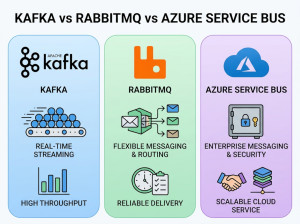
vs RabbitMQ
• Azure Service Bus: fully managed cloud service
• RabbitMQ: self-hosted, more control and flexibility
vs Apache Kafka
• Azure Service Bus: best for enterprise messaging and task queues
• Kafka: best for large-scale event streaming and analytics