Understanding Middleware in .NET
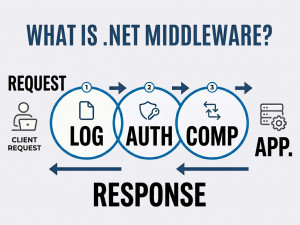
Middleware in .NET is software that sits in the request–response pipeline to process, modify, or handle HTTP requests and responses as they flow through an application.
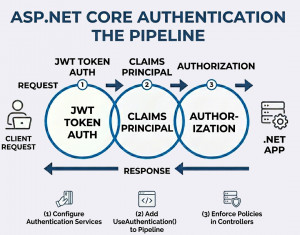
In ASP.NET Core, middleware components are assembled into a pipeline that every HTTP request passes through. Each middleware can perform operations before and after the next component in the pipeline is invoked. They are typically configured in the Program.cs file using methods like Use, Run, and Map. Middleware can handle cross-cutting concerns such as logging, authentication, routing, and error handling. The pipeline is sequential, and the order of middleware directly affects application behavior.
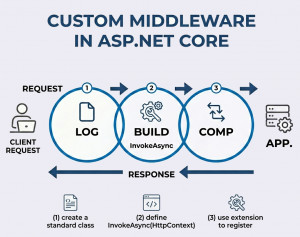
If you’re already familiar with how middleware works in ASP.NET Core, the next step is learning how to build your own custom middleware to handle application-specific requirements.
Why we use .Net Middleware (how middleware helps us)?
Middleware helps centralize common logic that applies to many requests, reducing code duplication. It enables clean separation of concerns by isolating features like authentication or logging from business logic. It also provides flexibility to intercept, short-circuit, or modify requests and responses at any stage. This improves maintainability, scalability, and readability of the application.
When should we use .Net Middleware?
Use middleware when you need to apply logic globally or across multiple endpoints, such as security checks or request logging. It is appropriate for handling cross-cutting concerns that are independent of specific controllers or pages. Middleware is also useful when you need to preprocess requests or postprocess responses. Avoid using it for logic tightly coupled to specific endpoints; controllers or filters may be better in those cases.
Key components of .Net Middleware
• Request delegate (RequestDelegate) that represents the next middleware
• Middleware class with an Invoke or InvokeAsync method
• Configuration in the application pipeline (Use, Run, Map)
• Dependency injection for accessing services
Key features of .Net Middleware
• Composable pipeline architecture
• Asynchronous execution support
• Ability to short-circuit the pipeline
• Access to HttpContext for request/response handling
• Built-in and custom middleware support
Use cases / examples of .Net Middleware
• Authentication and authorization
• Logging and monitoring requests
• Exception handling and error pages
• Serving static files
• Routing requests to endpoints
Advantages of .Net Middleware
• Promotes separation of concerns
• Reusable and modular components
• Flexible pipeline configuration
• Improves maintainability and scalability
• Works seamlessly with dependency injection
Disadvantages of .Net Middleware
• Order-sensitive; incorrect ordering can cause bugs
• Can become complex in large pipelines
• Debugging may be harder due to chained execution
• Overuse can lead to unnecessary processing overhead
Alternatives to .Net Middleware
• MVC filters (e.g., action filters, authorization filters)
• Endpoint filters (in minimal APIs)
• Custom services or helper classes inside controllers
• Reverse proxies or API gateways for cross-cutting concerns outside the app