Apache Kafka Consumer Lag: Definition, Causes, Monitoring, and Best Practices
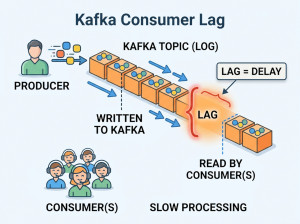
Apache Kafka is a distributed event streaming platform designed for high-throughput, fault-tolerant, and real-time data processing. It allows producers to publish messages to topics while consumers read and process those messages independently. Kafka stores messages in partitions and tracks consumer progress using offsets. Consumer lag occurs when consumers cannot process messages as fast as producers publish them, creating a delay between the latest available message and the last consumed message.
What Is Kafka Consumer Lag?
Kafka consumer lag represents the difference between the latest offset available in a partition and the latest offset successfully processed by a consumer group. It indicates how far behind a consumer is from real-time message processing. Lag can accumulate gradually during traffic spikes, infrastructure bottlenecks, slow downstream systems, or inefficient consumer logic. A small lag may be acceptable in some workloads, but continuously increasing lag often signals operational or architectural problems. Monitoring and managing consumer lag is critical because excessive lag can increase processing latency, delay analytics, impact real-time applications, and eventually overload consumers trying to catch up.
Key Components and Concepts of Consumer Lag
1. Offset
An offset is a unique sequential identifier assigned to each message within a Kafka partition. Consumers track offsets to know which messages have already been processed.
2. Consumer Group
A consumer group is a collection of consumers working together to process messages from a topic. Kafka distributes partitions among consumers within the same group.
3. Partition
Kafka topics are divided into partitions for scalability and parallelism. Consumer lag is typically measured at the partition level.
4. Latest Offset (Log End Offset)
This represents the newest message available in a partition.
5. Current Consumer Offset
This is the last message offset successfully consumed and committed by a consumer.
6. Lag Calculation
Consumer lag is commonly calculated as: Consumer Lag = Latest Offset − Consumer Offset
The higher the difference, the further behind the consumer is.
7. Rebalancing
When consumers join or leave a consumer group, Kafka redistributes partitions among consumers. Frequent rebalancing can temporarily increase lag.
8. Throughput and Processing Rate
Lag is strongly influenced by how quickly consumers can process incoming records compared to producer write speed.
Why Consumer Lag Matters?
Consumer lag directly impacts system responsiveness and real-time processing guarantees. High lag can delay fraud detection, analytics pipelines, monitoring systems, recommendation engines, and event-driven workflows. In business-critical systems, increasing lag may lead to stale data, delayed alerts, missed SLAs, and customer experience degradation. Persistent lag can also increase infrastructure pressure because consumers need additional resources to recover from backlogs. Monitoring lag helps organizations detect bottlenecks early and maintain healthy streaming architectures.
Reasons for Kafka Consumer Lag
High Producer Throughput
Producers may publish messages faster than consumers can process them, especially during traffic spikes or batch ingestion operations.
Slow Consumer Processing
Complex business logic, heavy computations, inefficient deserialization, or blocking operations can reduce consumer throughput.
Insufficient Consumer Scaling
Too few consumers or too few partitions can limit parallel processing capacity.
Consumer Rebalancing
Frequent consumer restarts, crashes, or scaling events trigger partition reassignment, temporarily pausing consumption.
Infrastructure Bottlenecks
CPU saturation, memory pressure, disk I/O issues, or network latency can slow message processing.
Downstream Dependency Delays
Databases, APIs, caches, or external systems used by consumers may respond slowly or fail intermittently.
Large Messages
Very large Kafka records increase serialization, transfer, and processing time.
Improper Consumer Configuration
Poor tuning of properties such as:
• max.poll.records
• fetch.min.bytes
• session.timeout.ms
• max.poll.interval.ms
can negatively impact throughput.
Uneven Partition Distribution
Some partitions may receive significantly more traffic than others, creating “hot partitions” and uneven lag.
Message Retry Loops
Repeated processing failures and retries can block progress and increase backlog accumulation.
How to Monitor Kafka Consumer Lag?
1. Kafka Native Command-Line Tools
Kafka provides built-in utilities such as:
kafka-consumer-groups.sh --describe --group my-group --bootstrap-server localhost:9092
This command shows:
• Current offsets
• Log end offsets
• Lag per partition
2. JMX Metrics
Kafka exposes lag-related metrics through JMX, which can be integrated into observability systems.
Common metrics include:
• Records lag
• Fetch latency
• Consumer throughput
• Poll duration
3. Prometheus and Grafana
Prometheus and Grafana are commonly used together for Kafka monitoring.
Benefits:
• Real-time dashboards
• Historical trend analysis
• Alerting
• Visualization of lag spikes
4. Confluent Control Center
Confluent Control Center provides enterprise-grade monitoring for Kafka clusters and consumer groups.
Features:
• Lag visualization
• Throughput analysis
• Cluster health monitoring
• Alert management
5. Burrow
Burrow is a dedicated Kafka lag monitoring system developed by LinkedIn.
Key capabilities:
• Consumer health evaluation
• Lag trend analysis
• HTTP APIs
• Alert integrations
6. Datadog
Datadog supports Kafka lag monitoring with dashboards and automated alerts.
7. Elastic Stack
Elastic Stack can collect Kafka metrics through Beats or exporters and visualize lag patterns.
How to Handle Kafka Consumer Lag?
Scale Consumers Horizontally
Increase the number of consumers within a consumer group to improve parallel processing capacity.
Increase Topic Partitions
More partitions allow greater parallelism, though partition increases require careful planning.
Optimize Consumer Logic
Reduce processing overhead by:
• Improving algorithms
• Avoiding blocking calls
• Using asynchronous processing
• Caching expensive operations
Batch Processing
Process records in batches instead of one-by-one to improve throughput.
Tune Consumer Configurations
Optimize Kafka settings such as:
• fetch.max.bytes
• max.poll.records
• enable.auto.commit
• fetch.max.wait.ms
based on workload characteristics.
Improve Infrastructure
Upgrade:
• CPU
• Memory
• Disk performance
• Network bandwidth
for heavily loaded consumers.
Reduce Rebalancing
Use static group membership and cooperative rebalancing to minimize partition movement disruptions.
Use Backpressure Mechanisms
Implement throttling or buffering to prevent consumers from becoming overloaded.
Offload Heavy Processing
Move expensive workloads into:
• Worker pools
• Async pipelines
• Stream processing frameworks
Dead Letter Queues (DLQ)
Failed messages can be redirected to DLQs instead of repeatedly blocking normal processing.
Alternative Technologies
Apache Pulsar
Apache Pulsar provides multi-tenant messaging, built-in geo-replication, and separate storage/compute architecture.
Advantages:
• Segment-based storage
• Flexible subscription models
• Better isolation in some workloads
RabbitMQ
RabbitMQ is a traditional message broker suitable for reliable queue-based messaging and complex routing patterns.
Best suited for:
• Task queues
• Request/reply systems
• Lower throughput workloads
Amazon Kinesis
Amazon Kinesis is a managed streaming service within AWS ecosystems.
Advantages:
• Fully managed
• Tight AWS integration
• Auto-scaling capabilities
Redpanda
Redpanda is designed as a Kafka-compatible streaming system without ZooKeeper dependency.
Advantages:
• Lower operational overhead
• Simplified deployment
• High performance
NATS
NATS is lightweight and optimized for low-latency communication and microservices.
Comparison of Monitoring Tools
| Monitoring Tool | Main Purpose | Strength |
|---|---|---|
| Prometheus + Grafana | Metrics and dashboards | Open-source ecosystem |
| Burrow | Consumer lag analysis | Kafka-specific lag monitoring |
| Confluent Control Center | Enterprise Kafka management | Integrated observability |
| Datadog | Cloud monitoring | Managed observability platform |