What is .NET? .NET Core vs .NET Framework
.NET is a software development platform created by Microsoft that allows developers to build web applications, desktop software, cloud services, APIs, mobile applications, and enterprise systems using languages such as C# and F#.
The platform provides a managed runtime environment, extensive libraries, and development tools that simplify application development. Instead of handling low-level memory management or operating system interactions manually, developers can focus on business logic and application features.
Understanding .NET and Related Technologies
CLR (Common Language Runtime)
The CLR is the execution engine of the .NET ecosystem. It manages memory allocation, garbage collection, exception handling, security, and thread execution behind the scenes. This means developers do not need to manually free memory or manage many low-level system operations as they would in languages like C or C++.
Another important feature of the CLR is language interoperability. Multiple programming languages can compile into the same intermediate language and run inside the same runtime environment. This allows different .NET languages to work together seamlessly in enterprise applications.
C# Programming Language
C# is the most widely used programming language in the .NET ecosystem. It was designed by Microsoft as a modern, object-oriented language that combines performance, readability, and productivity.
Developers commonly use C# for web APIs, enterprise applications, desktop software, cloud-native systems, and microservices. Over the years, the language has evolved significantly and now supports asynchronous programming, pattern matching, nullable reference types, and many modern programming concepts.
ASP.NET Web Development Framework
ASP.NET is the web development framework built on top of .NET. It allows developers to create web applications, REST APIs, real-time systems, and cloud services.
Earlier versions of ASP.NET mainly targeted Windows servers and IIS hosting. Modern ASP.NET Core applications can run on Windows, Linux, and macOS, making deployment much more flexible and cloud-friendly. ASP.NET Core is also optimized for containerized environments and modern DevOps workflows.
What is .NET Framework?
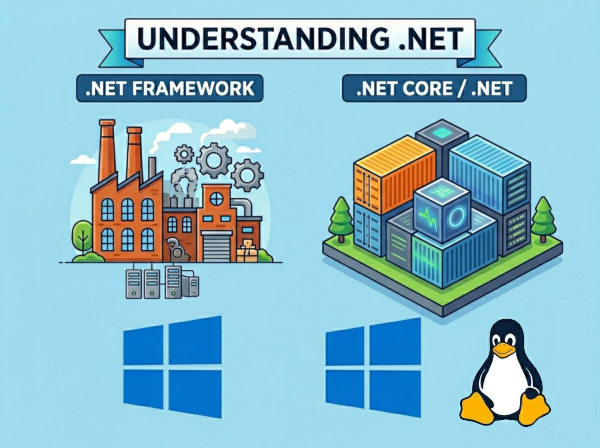
.NET Framework is the original implementation of .NET introduced by Microsoft in the early 2000s. It was primarily designed for Windows-based application development and became widely adopted in enterprise environments.
The framework includes technologies such as Windows Forms, WPF, ASP.NET Web Forms, and WCF. Many large enterprise systems still rely on .NET Framework because these applications were built years ago and continue to operate reliably in production environments.
However, .NET Framework is now considered a legacy platform for new development. Microsoft still provides maintenance and security updates, but most modern innovation now happens in newer versions of .NET.
What is .NET Core?
.NET Core was introduced as a modern, lightweight, and cross-platform version of .NET. Unlike .NET Framework, it can run on Windows, Linux, and macOS.
The primary goals of .NET Core were performance, modularity, cloud readiness, and container support. It was specifically designed for modern application architectures such as microservices, distributed systems, and cloud-native applications.
Later, Microsoft unified the platform naming and dropped the word "Core." Today, .NET 5, .NET 6, .NET 7, .NET 8, and newer versions are all continuations of .NET Core.
Differences Between .NET Core and .NET Framework
Platform Support
.NET Framework is tightly coupled to Windows. Applications built with it generally require Windows servers or desktop environments to operate.
.NET Core and modern .NET versions are cross-platform. Developers can build applications on Windows and deploy them to Linux containers, cloud platforms, or macOS systems without changing the application code significantly.
Performance and Scalability
.NET Core was designed with modern performance requirements in mind. It has a more optimized runtime, improved garbage collection, and better asynchronous processing capabilities.
Applications running on ASP.NET Core generally consume less memory and handle more concurrent requests compared to older ASP.NET Framework applications. This makes modern .NET highly suitable for cloud workloads and high-traffic APIs.
Deployment Model
.NET Framework applications usually depend on system-wide installations. Upgrading framework versions on production servers could sometimes affect multiple applications.
.NET Core introduced side-by-side deployment. Each application can carry its own runtime dependencies, reducing compatibility problems and making deployments more predictable.
Open Source Ecosystem
.NET Framework was mostly closed-source during its early years. Developers had limited visibility into the internal implementation details.
.NET Core became fully open source, allowing developers to inspect source code, contribute improvements, and participate in the ecosystem more actively. This helped increase community adoption significantly.
Performance Comparison of .Net Core vs .Net Framework
.NET Framework Performance
.NET Framework performs reliably for traditional enterprise applications, especially internal business systems hosted on Windows infrastructure. Mature applications often remain stable for years without major architectural changes.
However, compared to modern runtimes, .NET Framework may consume more memory and process requests less efficiently under heavy traffic conditions. Scaling older applications can become expensive in cloud environments.
.NET Core Performance
.NET Core introduced major runtime optimizations focused on speed and scalability. Kestrel, the built-in web server, significantly improved HTTP request processing performance compared to older IIS-dependent architectures.
Modern .NET applications also benefit from faster startup times, reduced memory allocation, optimized garbage collection, and better container performance. These improvements make .NET especially competitive for cloud-native and high-throughput systems.
Code Examples: .NET Framework vs .NET Core
Traditional ASP.NET Framework Example
This example uses the older ASP.NET MVC approach commonly found in .NET Framework applications.
public class HomeController : Controller
{
public ActionResult Index()
{
ViewBag.Message = "Hello from .NET Framework";
return View();
}
}
In this model, controllers inherit from the MVC Controller base class and usually depend heavily on IIS and System.Web infrastructure. Configuration is commonly managed through Web.config files.
ASP.NET Core Example
This example demonstrates a simplified ASP.NET Core API controller.
using Microsoft.AspNetCore.Mvc;
[ApiController]
[Route("api/[controller]")]
public class HomeController : ControllerBase
{
[HttpGet]
public IActionResult Get()
{
return Ok("Hello from .NET Core");
}
}
ASP.NET Core applications use a much lighter architecture and support dependency injection by default. The framework is optimized for APIs, microservices, and cloud deployment scenarios.
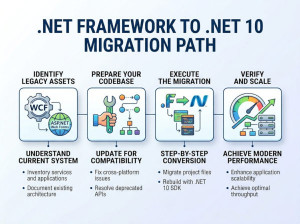
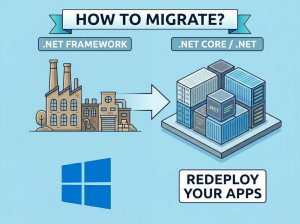
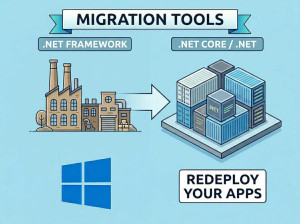
If you are planning to migrate from .NET Framework to .NET Core, read our detailed guide on How to Migrate from .NET Framework to .NET Core to understand the migration process, required code changes, and common compatibility issues. You can also explore the .NET Framework to .NET Core migration tools to simplify and accelerate your migration project.
Comparison of .NET Core and .NET Framework
| Feature | .NET Framework | .NET Core / Modern .NET |
|---|---|---|
| Platform Support | Windows only | Windows, Linux, macOS |
| Performance | Good for legacy enterprise systems | Optimized for modern high-performance workloads |
| Open Source | Limited | Fully open source |
| Cloud Readiness | Limited | Excellent |
| Container Support | Weak | Strong Docker and Kubernetes support |
| Deployment | System-wide installation | Side-by-side deployment |
When Should You Use .NET Framework?
.NET Framework is still relevant when organizations maintain older enterprise systems that depend on technologies such as Web Forms, WCF, or Windows-specific libraries.
Migrating these systems to modern .NET may require significant redevelopment effort. In many businesses, stability and compatibility are more important than adopting the newest runtime technologies immediately.
If an existing application already works reliably on Windows infrastructure and does not require cloud-native scalability, continuing with .NET Framework can still be a practical choice.
When Should You Use .NET Core or Modern .NET?
Modern .NET should be the default choice for new applications. It offers better performance, cross-platform compatibility, lower hosting costs, and stronger cloud integration.
It is particularly well suited for REST APIs, SaaS platforms, distributed systems, Docker containers, Kubernetes deployments, and microservices architectures. Developers also benefit from faster release cycles and ongoing Microsoft investment in the platform.
For startups and modern enterprise projects, choosing modern .NET usually provides better long-term scalability and maintainability.
Alternative Technologies to .NET
Java and Spring Boot
Java remains one of the largest enterprise development ecosystems in the world. Spring Boot provides a mature framework for building scalable backend systems, APIs, and distributed applications.
Many large financial institutions and enterprise companies use Java because of its long-term stability and broad ecosystem support. The platform is especially popular in environments where platform independence and extensive tooling are important.
Node.js
Node.js is widely used for lightweight APIs, real-time systems, and JavaScript-based backend development. Because frontend and backend can both use JavaScript, many teams prefer Node.js for faster full-stack development workflows.
The ecosystem is highly flexible and includes a massive package library through npm. However, managing dependency quality and long-term maintainability can sometimes become challenging in very large projects.
Python and Django
Python is popular for rapid application development, automation, and AI-related projects. Django provides a batteries-included framework that simplifies web development significantly.
The ecosystem is especially strong in machine learning, data science, and scripting tasks. While Python may not always match .NET performance in high-throughput systems, it excels in developer productivity and research-oriented environments.
Go
Go has gained popularity for cloud infrastructure, networking tools, and highly concurrent backend services. Its lightweight runtime and simple syntax make it attractive for microservices and DevOps-related systems.
Compared to .NET, Go has a smaller ecosystem for enterprise UI development, but it performs extremely well for scalable backend services and containerized applications.
Conclusion
.NET has evolved from a Windows-only enterprise framework into a modern, cross-platform development ecosystem capable of powering cloud-native applications, APIs, desktop software, and distributed systems.
While .NET Framework still serves many legacy enterprise applications, modern .NET provides better performance, scalability, and deployment flexibility for new projects. For most modern software development scenarios, .NET Core and newer unified .NET versions are now the preferred direction.