Understanding CAP Theorem in Distributed Systems with C# Examples
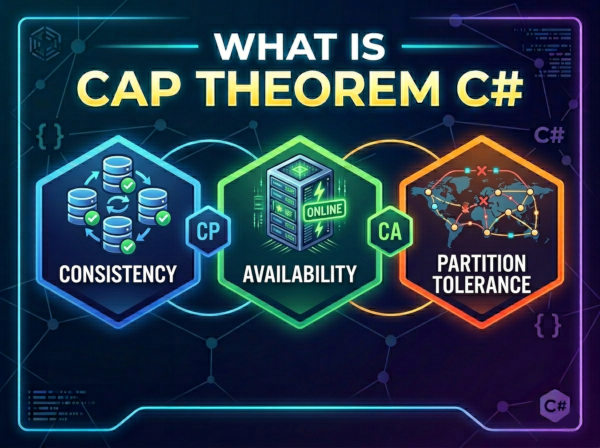
CAP Theorem is a principle in distributed systems that states a system can only guarantee two out of these three properties at the same time: Consistency (C), Availability (A), and Partition Tolerance (P). In real-world distributed environments, network failures can always happen, so partition tolerance is usually mandatory. That means system architects typically choose between stronger consistency or higher availability during network problems.
A simple way to think about it is this: when servers cannot communicate with each other, should the system stop accepting requests to preserve accurate data, or continue working even if some data becomes temporarily inconsistent?
The three components are:
• Consistency: Every user sees the same latest data at the same time.
• Availability: The system always responds to requests, even during failures.
• Partition Tolerance: The system continues operating even when network communication between nodes breaks.
Why Do We Need to Understand CAP Theorem?
Understanding CAP Theorem helps developers design systems based on business priorities instead of technical assumptions. Many engineers assume a distributed system can always be fast, accurate, and fault tolerant simultaneously, but CAP explains why trade-offs are unavoidable when network failures occur.
It also helps teams avoid architectural mistakes. For example, a banking platform usually prioritizes consistency because incorrect balances are unacceptable, while a streaming service may prioritize availability because temporary inconsistencies are less harmful than downtime. Without CAP awareness, developers often build systems that fail unpredictably under real production traffic.
How Should We Use CAP Theorem?
CAP Theorem should not be treated as a strict rule for choosing databases. Instead, it should be used as a decision-making framework when designing distributed applications.
When building a system, start by identifying what matters most during network failures. If users must always see accurate data, prioritize consistency. If the application must remain online under all circumstances, prioritize availability. After identifying priorities, select databases, replication strategies, caching mechanisms, and communication patterns that support those goals.
In modern architectures, different parts of the same application may use different CAP strategies. For example, a payment service can prioritize consistency, while a product recommendation service prioritizes availability.
CAP Theorem Visualization
The relationship is commonly represented like this:
C + A + P
This does not mean mathematical addition. It simply illustrates the three competing guarantees in distributed systems.
Real-World C# Use Cases
1. Banking and Payment Processing System
A banking application built with ASP.NET Core and distributed SQL databases usually prioritizes Consistency and Partition Tolerance (CP). If network communication fails between nodes, the system may temporarily reject transactions instead of risking duplicate transfers or incorrect balances.
For example, if two ATMs attempt to withdraw from the same account simultaneously, consistency ensures both machines do not approve transactions that exceed the available balance. In this case, temporary downtime is considered safer than corrupted financial data.
2. E-Commerce Product Catalog
An online shopping platform developed in C# may prioritize Availability and Partition Tolerance (AP) for its product catalog service. Even if some servers are temporarily disconnected, customers can still browse products, search inventory, and add items to carts.
The downside is that inventory counts might briefly become inconsistent across regions. A customer could see an item marked as available even though another server already sold the last unit. Many businesses accept this trade-off because keeping the store online is more valuable than perfect synchronization.
3. Social Media Feed and Notifications
A social media platform built using microservices in C# often chooses Availability over strict Consistency for user feeds and notifications. Users expect the platform to remain responsive even during infrastructure issues.
For example, when a user posts content, some followers may see the update a few seconds later than others. This temporary inconsistency is acceptable because users care more about platform responsiveness and uptime than immediate synchronization across every node globally.
Advantages of CAP Theorem
Better Architectural Decisions
CAP Theorem forces teams to think clearly about failure scenarios before systems reach production. Instead of assuming infrastructure will always work perfectly, developers proactively decide how applications should behave during outages.
This improves long-term reliability because system behavior becomes intentional rather than accidental. Teams can align technical decisions with business priorities more effectively.
Helps Scale Distributed Systems
As systems grow across multiple servers, cloud regions, or countries, network failures become unavoidable. CAP Theorem provides a practical framework for scaling applications while understanding the consequences of replication and synchronization delays.
This is especially important in cloud-native applications where services communicate constantly over networks rather than running on a single machine.
Improves Database Selection
Different databases are optimized for different CAP trade-offs. Understanding CAP helps developers choose technologies more intelligently instead of selecting databases only based on popularity.
For example, strongly consistent relational systems may fit financial applications better, while eventually consistent NoSQL systems may better support massive-scale social platforms.
Disadvantages of CAP Theorem
Often Oversimplified
Many developers incorrectly believe CAP means “pick only two forever.” In reality, the theorem specifically applies during network partitions. Under normal conditions, systems can often provide both consistency and availability simultaneously.
This misunderstanding causes teams to oversimplify architectural discussions and ignore important operational details.
Real Systems Are More Complex
Modern distributed systems rarely fit perfectly into pure CP or AP categories. Many systems dynamically adjust behavior depending on traffic, replication lag, or failure conditions.
As a result, CAP alone is not enough to fully evaluate distributed architecture quality. Latency, durability, scalability, and operational complexity also matter significantly.
Can Lead to Overengineering
Some teams become obsessed with CAP trade-offs too early in development. They design highly complex distributed systems before validating whether the business actually needs that complexity.
In many cases, a simpler monolithic application with a traditional relational database is easier to maintain and performs perfectly well for years.
Common Mistakes About CAP Theorem
Mistake 1: Thinking Partition Tolerance Is Optional
In modern cloud environments, network partitions are unavoidable. Servers fail, connections drop, and regions become unreachable. Because of this, distributed systems almost always require partition tolerance.
The real decision is usually between consistency and availability during failures, not whether partition tolerance should exist.
Mistake 2: Assuming Eventual Consistency Means “Broken Data”
Eventual consistency does not mean data corruption. It means updates may temporarily appear differently across nodes before synchronization completes.
For example, seeing a delayed social media like count is acceptable eventual consistency, not system failure.
Mistake 3: Applying One CAP Strategy Everywhere
Different business functions often require different trade-offs. Applying strict consistency to every service can reduce performance unnecessarily, while excessive availability can damage sensitive workflows.
Successful systems usually combine multiple strategies depending on business risk and user expectations.
Alternative Solutions and Related Models
BASE Model
BASE stands for Basically Available, Soft State, Eventually Consistent. It is commonly used in large-scale distributed applications that prioritize availability and scalability over immediate consistency.
Many NoSQL systems follow BASE principles because temporary inconsistency is acceptable for workloads like social feeds, recommendation engines, and analytics dashboards.
PACELC Theorem
PACELC extends CAP by addressing what happens when there is no network partition. It states that even when the system operates normally, developers still face trade-offs between latency and consistency.
This model is often considered more practical for modern cloud systems because latency optimization is a daily architectural concern.
Distributed Transactions and Sagas
Instead of enforcing strict consistency across all services, many microservice architectures use Saga patterns. In C# systems, developers often implement Sagas using asynchronous messaging and event-driven workflows.
This approach allows services to remain independent while still coordinating complex business operations through compensating actions rather than global database locks.
Final Thoughts
CAP Theorem is not just a theoretical computer science topic. It directly affects how modern distributed applications behave under real-world failures. Understanding it helps developers build systems that match business priorities, scale more effectively, and fail predictably instead of unpredictably.
For C# developers working with microservices, cloud infrastructure, or distributed databases, CAP awareness becomes especially important as applications grow across regions and services. The goal is not to “beat” CAP Theorem, but to make intentional trade-offs that fit the needs of the application.