Upstash Redis Explained with Real-World C# Examples
Upstash Redis is a serverless Redis platform designed for modern cloud, edge, and serverless applications with pay-per-request pricing.
Understanding Upstash Redis
Traditional Redis hosting usually requires developers to manage servers, memory sizing, scaling, networking, backups, and high availability manually. Upstash simplifies this process by providing a fully managed serverless Redis service that automatically scales based on traffic.
One of the biggest differences between Upstash and traditional Redis providers is its pricing model. Instead of paying continuously for reserved infrastructure, developers only pay for actual requests and storage usage. This makes it especially attractive for startups, hobby projects, APIs with unpredictable traffic, and serverless environments.
Upstash also provides REST-based Redis access in addition to traditional TCP connections. This allows platforms like Vercel Edge Functions, Cloudflare Workers, and serverless runtimes to communicate with Redis over HTTP where raw TCP sockets may not be supported.
Another important feature is global replication. Upstash can replicate Redis data across multiple regions to reduce latency for globally distributed applications.
Why Do We Use Upstash Redis?
Modern applications increasingly rely on serverless infrastructure because it reduces operational overhead and scales automatically. However, traditional Redis deployments often do not integrate well with serverless execution environments.
Upstash solves this problem by offering a Redis platform optimized specifically for serverless architectures. Developers can quickly integrate caching, session storage, rate limiting, queues, and distributed state management without maintaining infrastructure.
Its pay-per-request model also reduces costs significantly for low or variable traffic workloads.
When Should You Use Upstash Redis?
Upstash Redis is especially useful when:
• Building serverless applications
• Deploying APIs on Vercel or Netlify
• Running edge functions
• Handling unpredictable traffic spikes
• Needing globally distributed low-latency caching
• Wanting minimal infrastructure management
• Creating prototypes or startup MVPs
• Running cost-sensitive workloads
It is particularly effective for lightweight microservices and globally distributed frontend applications.
Key Components and Features of Upstash
Serverless Architecture
Upstash automatically scales based on demand. Developers do not manage Redis instances manually or configure autoscaling rules.
This reduces infrastructure complexity significantly and allows applications to scale naturally with traffic patterns.
Pay-Per-Request Pricing
Unlike traditional Redis providers that charge for reserved memory and server uptime continuously, Upstash bills based on actual requests and storage usage.
This pricing structure works extremely well for low-traffic or bursty workloads where always-on Redis servers would be wasteful.
REST API Support
Traditional Redis uses TCP-based communication, but many serverless platforms restrict raw socket access.
Upstash provides an HTTP REST API that works naturally with edge runtimes and serverless environments.
Global Replication
Data can be replicated across multiple geographic regions to improve read latency worldwide.
This feature is especially valuable for globally distributed applications serving users across multiple continents.
Durable Storage
Although Redis is memory-focused, Upstash also supports persistence and durability mechanisms to reduce data-loss risk.
This improves reliability for production systems requiring higher availability.
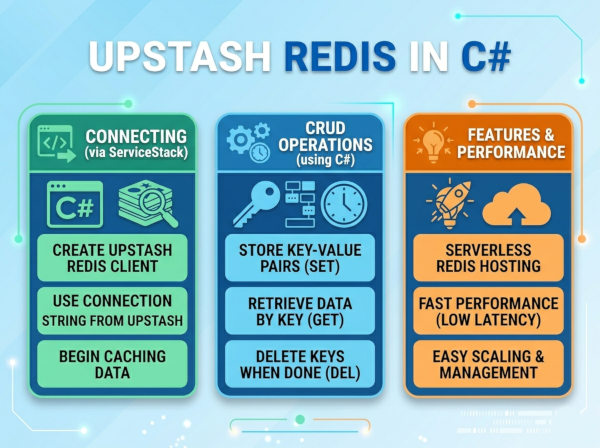
C# Connection Example
Installing the Redis Client
dotnet add package StackExchange.Redis
Basic Upstash Redis Connection
using StackExchange.Redis;
var redis = await ConnectionMultiplexer.ConnectAsync(
"your-upstash-host:6379,password=your-password");
IDatabase db = redis.GetDatabase();
await db.StringSetAsync("message", "Hello Upstash");
string value = await db.StringGetAsync("message");
Console.WriteLine(value);
This example connects to an Upstash Redis database using the standard Redis TCP protocol.
Using Upstash REST API in C#
Some serverless environments work better with HTTP APIs instead of Redis TCP sockets.
using System.Net.Http.Headers;
var client = new HttpClient();
client.DefaultRequestHeaders.Authorization =
new AuthenticationHeaderValue("Bearer", "YOUR_TOKEN");
var response = await client.GetAsync(
"https://your-url.upstash.io/get/message");
string result = await response.Content.ReadAsStringAsync();
Console.WriteLine(result);
This approach is useful for environments where TCP connections are unavailable or restricted.
Real-World Use Cases
API Rate Limiting
Rate limiting is one of the most common Upstash Redis use cases. APIs often need to restrict how many requests users can make within a time window.
Redis counters and expiration mechanisms make this process extremely fast and scalable. Upstash is especially effective because serverless APIs frequently experience burst traffic patterns.
Session Storage
Authentication systems commonly store user sessions, JWT refresh tokens, or temporary login states inside Redis.
Because Upstash is distributed and globally accessible, multiple application instances can share the same session state consistently.
Edge Caching
Frontend frameworks like Next.js often use edge rendering to serve content from locations near users.
Upstash works well in these environments because its REST API integrates naturally with edge runtimes.
Real-Time Analytics
Analytics dashboards often require temporary counters, live metrics, and rapidly changing data.
Redis performs extremely well for this because in-memory operations are extremely fast compared to relational databases.
Queue Systems
Redis lists and streams are commonly used for lightweight queue processing systems.
Applications can enqueue background jobs such as email sending, report generation, or event processing.
Upstash vs Traditional Redis Hosting
| Feature | Upstash Redis | Traditional Redis Hosting |
|---|---|---|
| Infrastructure Management | Fully managed | Developer managed |
| Scaling | Automatic | Manual or semi-automatic |
| Pricing Model | Pay per request | Fixed server pricing |
| Serverless Support | Excellent | Limited |
| REST API | Built-in | Usually unavailable |
| TCP Redis Support | Yes | Yes |
| Best For | Modern cloud/serverless apps | Long-running infrastructure |
Advantages of Upstash Redis
Minimal Operational Overhead
Developers do not manage Redis servers, failover systems, scaling policies, or infrastructure maintenance.
This allows teams to focus more on application development instead of DevOps tasks.
Cost Efficiency
Small projects and variable-traffic applications can operate much more cheaply compared to fixed-cost Redis hosting.
This pricing model is especially attractive for startups and side projects.
Excellent Serverless Compatibility
REST-based Redis access integrates naturally with serverless and edge environments.
This removes many networking limitations found in traditional Redis deployments.
Global Low Latency
Replication across multiple regions improves performance for worldwide applications.
Users receive faster responses because data is physically closer to them.
Fast Development Experience
Creating and configuring Redis instances is extremely simple compared to traditional infrastructure provisioning.
Disadvantages of Upstash Redis
Higher Cost at Massive Scale
For extremely high request volumes, traditional dedicated Redis infrastructure may become cheaper.
Pay-per-request pricing works best for moderate or unpredictable workloads.
Request Latency Variability
REST-based communication may introduce slightly higher latency compared to direct TCP Redis communication.
This is usually acceptable for serverless workloads but may matter in ultra-low-latency systems.
Vendor Lock-In Risk
Applications tightly integrated with provider-specific APIs or workflows may become harder to migrate later.
Limited Advanced Infrastructure Control
Traditional Redis hosting allows deeper customization of cluster topology, memory tuning, and infrastructure configuration.
Upstash abstracts much of this away for simplicity.
Most Common Issues about Upstash
Connection Limits
Serverless applications may generate many short-lived connections rapidly.
Connection pooling and efficient client reuse become important for performance optimization.
Cold Starts
Some serverless runtimes introduce cold start delays that affect Redis access latency temporarily.
Poor Cache Expiration Policies
Without proper TTL settings, Redis memory usage can grow unnecessarily large.
Overusing REST Instead of TCP
REST APIs are convenient, but direct TCP connections are often faster for high-throughput backend applications.
Best Use Cases of Upstash
Serverless APIs
Upstash integrates naturally with serverless frameworks and functions.
This allows APIs to scale automatically without maintaining Redis infrastructure manually.
Edge Applications
Applications running at edge locations benefit from Upstash's REST APIs and global replication.
Startup MVPs
Early-stage applications often prioritize fast development speed and low infrastructure management overhead.
Upstash helps teams launch quickly without dedicated DevOps complexity.
Event-Driven Architectures
Redis works extremely well for queues, event buffering, temporary state management, and asynchronous processing.
Alternatives to Upstash Redis
Redis Cloud
Redis Cloud provides managed Redis hosting with advanced enterprise features and broader infrastructure control.
Azure Cache for Redis
Microsoft's managed Redis platform integrates deeply with Azure services and enterprise environments.
Amazon ElastiCache
AWS ElastiCache supports Redis and Memcached with high scalability inside AWS ecosystems.
Self-Hosted Redis
Self-managed Redis deployments provide maximum customization and control but require operational maintenance.
Memcached
Memcached is a lightweight caching alternative optimized primarily for simple distributed cache workloads.
Final Thoughts
Upstash Redis represents a modern evolution of Redis infrastructure optimized for serverless and edge-native application architectures.
Its biggest strengths are simplicity, automatic scaling, REST compatibility, and cost efficiency for variable workloads. While traditional Redis hosting still makes sense for extremely large or highly specialized systems, Upstash dramatically lowers the barrier for building scalable distributed applications.
For modern ASP.NET Core APIs, serverless platforms, and globally distributed applications, Upstash provides a practical and developer-friendly Redis solution without requiring deep infrastructure management expertise.