Redis Cache Patterns with Real-World C# Examples
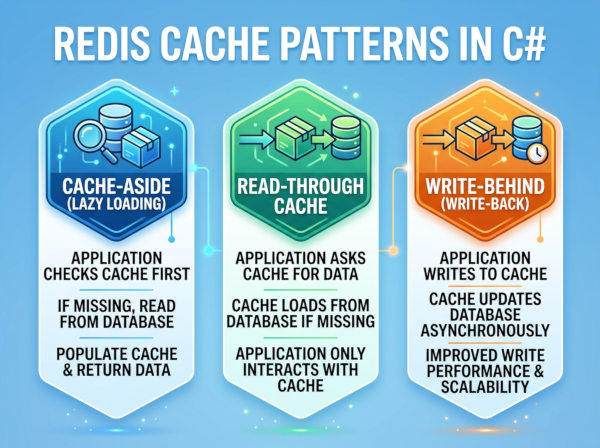
Redis cache patterns are architectural strategies that define how applications read, write, update, and invalidate cached data efficiently.
Understanding Redis Cache Patterns
Caching is not just about storing data in memory for faster access. The real challenge is deciding how and when data enters the cache, how it stays synchronized with the database, and how stale data is removed safely.
Different applications require different cache strategies because every system has unique consistency, scalability, and performance requirements. An e-commerce platform, for example, prioritizes fast product lookups, while a financial system may prioritize strict data consistency.
Redis cache patterns solve these challenges by defining standardized workflows between the application, cache layer, and primary database.
Why Do We Use Redis Cache Patterns?
Applications often struggle with database bottlenecks when traffic grows. Without caching, every request directly hits the database, increasing latency and infrastructure costs.
Redis caching patterns reduce repeated database queries, improve response times, and help systems scale under heavy traffic. They also reduce pressure on relational databases and improve user experience by returning data almost instantly.
Proper cache design becomes especially important in microservices, distributed systems, and cloud-native applications where thousands of requests may occur simultaneously.
When Should You Use Redis Caching?
Redis caching is useful when:
• Database queries are expensive or repeated frequently
• API responses rarely change
• Systems experience traffic spikes
• Low latency is important
• Applications need distributed caching across multiple servers
• Sessions or temporary state must be shared between instances
Caching is especially effective in read-heavy systems where the same data is requested repeatedly.
Most Important Redis Cache Patterns
1. Cache-Aside Pattern (Lazy Loading)
What is Cache-Aside?
The application first checks Redis for data. If the data does not exist, it loads the data from the database and stores it in Redis for future requests.
This is the most commonly used Redis caching pattern because it is simple and flexible.
How Cache-Aside Works
• Application checks Redis
• Cache miss occurs
• Database query executes
• Data is returned
• Data gets stored in Redis
• Future requests use cache
This pattern ensures only frequently accessed data enters the cache.
Real-World Scenario
An e-commerce website displaying product details benefits heavily from cache-aside. Popular products may receive thousands of repeated reads every minute, and repeatedly querying SQL databases becomes expensive.
With cache-aside, Redis stores hot products after the first request, dramatically reducing database traffic.
C# Cache-Aside Example
public async Task<Product> GetProductAsync(int productId)
{
string cacheKey = $"product:{productId}";
var cachedProduct = await _redis.StringGetAsync(cacheKey);
if (!cachedProduct.IsNullOrEmpty)
{
return JsonSerializer.Deserialize<Product>(cachedProduct);
}
var product = await _dbContext.Products
.FirstOrDefaultAsync(x => x.Id == productId);
if (product != null)
{
await _redis.StringSetAsync(
cacheKey,
JsonSerializer.Serialize(product),
TimeSpan.FromMinutes(10));
}
return product;
}
Advantages
• Reduced Database Load: Frequently requested data stays in memory, reducing expensive database operations significantly. This becomes extremely valuable during traffic spikes where databases would otherwise become overloaded.
• Flexible Cache Management: Applications fully control what enters the cache and when expiration occurs. This flexibility makes cache-aside easy to adapt for different business requirements.
Disadvantages
• Cache Miss Penalty: The first request after expiration still hits the database. If many users request the same missing data simultaneously, this may create a "cache stampede."
• Stale Data Risk: If the database updates but the cache remains unchanged, users may receive outdated information temporarily.
Common Issues
• Cache Stampede: When many requests simultaneously rebuild an expired cache entry, database load spikes suddenly. A common solution is distributed locking or randomized expiration times.
• Inconsistent Invalidation: Forgetting to clear cache after updates can produce stale application behavior that is difficult to debug.
2. Write-Through Cache Pattern
What is Write-Through?
Data is written to both Redis and the database at the same time.
This ensures the cache always contains the latest version of the data.
Real-World Scenario
User profile systems commonly use write-through caching because profile data changes infrequently but must remain consistent.
Whenever users update account settings, both Redis and the database update together.
C# Write-Through Example
public async Task UpdateUserAsync(User user)
{
_dbContext.Users.Update(user);
await _dbContext.SaveChangesAsync();
string cacheKey = $"user:{user.Id}";
await _redis.StringSetAsync(
cacheKey,
JsonSerializer.Serialize(user),
TimeSpan.FromHours(1));
}
Advantages
• Stronger Consistency: Redis always contains the latest version of the data immediately after writes. This reduces stale cache problems significantly.
• Faster Reads: Because updated data already exists in Redis, future reads become extremely fast.
Disadvantages
• Slower Writes: Every write operation must update both Redis and the database. This introduces additional network overhead.
• Unused Cached Data: Some written data may never be read again, wasting memory.
3. Write-Behind (Write-Back) Pattern
What is Write-Behind?
The application writes data to Redis immediately and updates the database asynchronously later.
This pattern prioritizes write performance.
Real-World Scenario
Analytics platforms often use write-behind caching because they process massive numbers of events rapidly.
Instead of writing every event directly to SQL, Redis temporarily stores updates and flushes them in batches.
C# Write-Behind Example
public async Task StoreAnalyticsAsync(EventData data)
{
string cacheKey = $"analytics:{Guid.NewGuid()}";
await _redis.StringSetAsync(
cacheKey,
JsonSerializer.Serialize(data));
_backgroundQueue.Enqueue(data);
}
Background services later persist queued items to the database.
Advantages
• Extremely Fast Writes: Applications respond immediately because Redis handles writes in memory. This is valuable for high-throughput systems.
• Reduced Database Pressure: Batch processing dramatically lowers database write frequency.
Disadvantages
• Risk of Data Loss: If Redis crashes before persistence occurs, some data may disappear.
• Increased Complexity: Background synchronization systems require careful monitoring and retry mechanisms.
4. Read-Through Cache Pattern
What is Read-Through?
The cache layer itself loads missing data automatically when cache misses occur.
Applications interact only with Redis instead of manually managing cache loading logic.
Real-World Scenario
Large enterprise platforms sometimes use read-through caching to centralize cache logic and reduce repeated caching code across services.
Advantages
• Cleaner Application Code: Applications do not manually manage cache misses.
• Centralized Cache Logic: Caching behavior becomes easier to standardize.
Disadvantages
• Higher Infrastructure Complexity: Read-through usually requires specialized cache middleware or abstraction layers.
• Reduced Flexibility: Applications lose some direct control over caching decisions.
5. Refresh-Ahead Pattern
What is Refresh-Ahead?
The system refreshes cache entries before expiration occurs.
This prevents expensive cache misses for highly requested data.
Real-World Scenario
Flight booking systems use refresh-ahead caching to keep frequently viewed routes available in memory continuously.
This prevents latency spikes during heavy traffic periods.
C# Refresh-Ahead Example
public async Task RefreshPopularProductsAsync()
{
var popularProducts = await _dbContext.Products
.Where(x => x.IsPopular)
.ToListAsync();
foreach (var product in popularProducts)
{
await _redis.StringSetAsync(
$"product:{product.Id}",
JsonSerializer.Serialize(product),
TimeSpan.FromMinutes(30));
}
}
This method can run periodically using a background worker.
Advantages
• Cleaner Application Code: Applications do not manually manage cache misses.
• Centralized Cache Logic: Caching behavior becomes easier to standardize.
Disadvantages
• Higher Infrastructure Complexity: Read-through usually requires specialized cache middleware or abstraction layers.
• Reduced Flexibility: Applications lose some direct control over caching decisions.
5. Refresh-Ahead Pattern
What is Refresh-Ahead?
The system refreshes cache entries before expiration occurs.
This prevents expensive cache misses for highly requested data.
Real-World Scenario
Flight booking systems use refresh-ahead caching to keep frequently viewed routes available in memory continuously.
This prevents latency spikes during heavy traffic periods.
C# Refresh-Ahead Example
public async Task RefreshPopularProductsAsync()
{
var popularProducts = await _dbContext.Products
.Where(x => x.IsPopular)
.ToListAsync();
foreach (var product in popularProducts)
{
await _redis.StringSetAsync(
$"product:{product.Id}",
JsonSerializer.Serialize(product),
TimeSpan.FromMinutes(30));
}
}
This method can run periodically using a background worker.
Comparison of Redis Cache Patterns
| Pattern | Best For | Read Speed | Write Speed | Consistency | Complexity |
|---|---|---|---|---|---|
| Cache-Aside | General applications | High | Medium | Medium | Low |
| Write-Through | Consistent read systems | High | Lower | High | Medium |
| Write-Behind | Heavy write workloads | High | Very High | Lower | High |
| Read-Through | Centralized caching | High | Medium | Medium | High |
| Refresh-Ahead | Hot frequently used data | Very High | Medium | High | Medium |
Best Use Cases
E-Commerce Platforms
Redis dramatically improves product catalog performance because product data is read far more often than written.
Inventory counts, recommendations, pricing, and session data also benefit heavily from caching.
Financial Dashboards
Real-time dashboards use Redis to reduce expensive repeated calculations and provide near-instant updates.
This is especially useful for frequently refreshed analytics screens.
API Rate Limiting
Redis is commonly used for API throttling because counters and expiration operations are extremely fast.
Applications can efficiently track requests per user or IP address.
Authentication and Sessions
Distributed authentication systems often store session tokens and login state in Redis.
This allows multiple application servers to share user sessions consistently.
Most Common Redis Problems
Memory Overuse
Poor expiration policies can cause Redis memory usage to grow uncontrollably.
Monitoring TTL policies and eviction strategies is critical in production systems.
Large Object Serialization
Very large JSON payloads increase network overhead and serialization costs.
Smaller cache objects generally produce better performance.
Cache Penetration
Requests for non-existent data repeatedly bypass cache and hit the database.
A common solution is caching null responses briefly.
Cache Avalanche
When many cache entries expire simultaneously, databases suddenly receive massive traffic spikes.
Staggered expiration times help reduce this risk.
Advantages of Redis Caching
Extremely Low Latency
Redis serves data from memory, making responses dramatically faster than traditional databases.
High Scalability
Applications can handle significantly larger traffic volumes without increasing database load proportionally.
Distributed Architecture Support
Redis works well in cloud-native and microservice architectures.
Flexible Data Structures
Redis supports strings, hashes, sets, streams, lists, and sorted sets.
This flexibility enables more advanced caching strategies.
Disadvantages of Redis Caching
Memory Cost
RAM is more expensive than disk storage.
Large datasets may become costly to cache entirely in memory.
Consistency Challenges
Keeping cache synchronized with databases can become complex in distributed systems.
Operational Complexity
Large Redis deployments require monitoring, replication, backups, and failover planning.
Final Thoughts
Redis cache patterns are not just technical optimizations. They directly influence application scalability, consistency, infrastructure costs, and user experience.
Choosing the right caching strategy depends on business requirements, traffic patterns, consistency expectations, and system architecture. Cache-aside remains the most widely adopted pattern because of its simplicity and flexibility, while advanced systems often combine multiple patterns together for optimal performance and reliability.
Well-designed Redis caching can transform application performance dramatically, but poor cache architecture can introduce difficult consistency and debugging problems. Understanding these patterns deeply is essential for building scalable modern .NET applications.