
.NET JIT (Just-In-Time Compiler)

JIT, or Just-In-Time Compiler, is the component inside the CLR (Common Language Runtime) responsible for converting Intermediate Language (IL) code into native machine instructions during runtime execution.
When developers compile C# code, the compiler does not generate CPU-specific machine code directly. Instead, it produces IL code that is portable across platforms. The JIT compiler translates this IL into optimized native code only when methods are executed for the first time.
This approach allows .NET applications to remain platform-independent while still benefiting from machine-specific runtime optimizations. Modern .NET uses an advanced JIT compiler called RyuJIT, which is optimized for performance, scalability, and modern CPU architectures.
Why Do We Use JIT?
The main reason for using JIT is balancing portability with performance.
If .NET compiled directly into machine code during build time, applications would become tied to specific CPU architectures and operating systems. IL keeps applications portable, while JIT performs platform-specific optimization during execution.
JIT also enables runtime optimizations that are impossible during static compilation because the runtime environment is unknown at build time. The JIT compiler can optimize based on:
• CPU architecture
• Available hardware instructions
• Runtime profiling
• Actual execution patterns
• Memory layout
• Method usage frequency
This allows .NET applications to achieve high performance while maintaining cross-platform compatibility.
When Should You Care About JIT?
Most developers use JIT automatically without thinking about it. However, understanding JIT becomes important when working on:
• High-performance applications
• ASP.NET Core APIs
• Low-latency systems
• Real-time applications
• Microservices
• High-throughput backend systems
• Performance optimization tasks
• Startup performance improvements
JIT knowledge becomes especially valuable when analyzing:
• Slow application startup
• CPU bottlenecks
• Memory pressure
• Method inlining
• Allocation optimization
• Benchmarking inconsistencies
How JIT Compilation Works
The JIT compilation pipeline works in several stages.
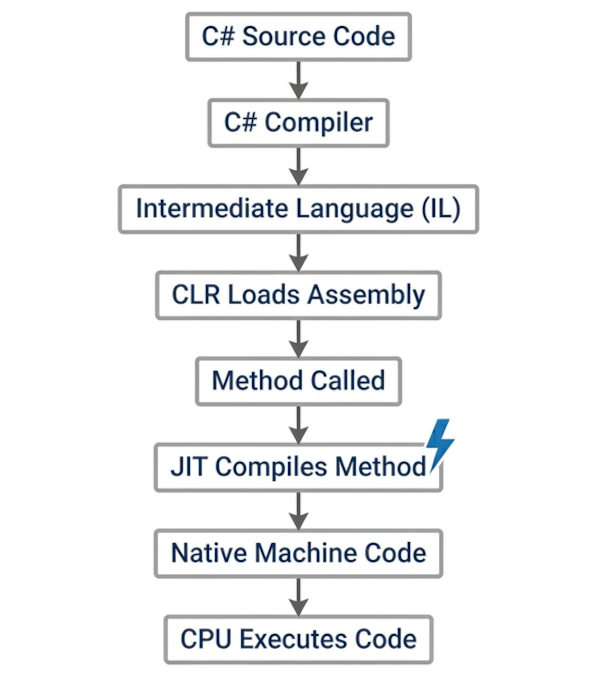
The important detail is that methods are compiled only when needed.
If a method is never called, it is never JIT compiled.
Example of JIT Compilation
Consider the following code:
public class Calculator
{
public int Add(int a, int b)
{
return a + b;
}
}
At build time:
C# compiler converts the method into IL
At runtime:
• CLR loads the assembly
• First call to Add() triggers JIT compilation
• Native machine code is generated
• Future calls reuse compiled machine code
This avoids recompiling the method repeatedly.
Intermediate Language (IL)
IL is a CPU-independent instruction set used by .NET runtimes.
Example IL representation:
IL_0001: ldarg.1
IL_0002: ldarg.2
IL_0003: add
IL_0004: ret
These instructions are generic and not tied to a specific processor architecture.
The JIT compiler converts them into:
• x64 instructions
• ARM instructions
• ARM64 instructions
• Other architecture-specific machine code
depending on the runtime environment.
RyuJIT
RyuJIT is the modern JIT compiler used by .NET Core and modern .NET versions.
RyuJIT provides:
• Faster compilation
• Better CPU optimizations
• SIMD support
• Reduced memory usage
• Better inlining decisions
• Improved register allocation
It replaced older JIT implementations used in the .NET Framework.
RyuJIT is heavily optimized for cloud-native and server-side workloads.
Tiered Compilation
Modern .NET uses Tiered Compilation to improve startup speed and runtime performance simultaneously.
Instead of heavily optimizing every method immediately, the runtime uses multiple optimization levels.
The process works like this:
• Method initially compiled quickly
• Runtime monitors frequently used methods
• Hot methods get recompiled with advanced optimizations
This reduces startup overhead while still maximizing long-term performance.
Example of Tiered Compilation
Suppose an ASP.NET Core API receives millions of requests.
A method handling authentication may initially compile quickly with minimal optimization. Once the runtime detects heavy usage, it recompiles the method with aggressive optimizations such as:
• Inlining
• Loop optimization
• Register optimization
• Branch prediction improvements
This balances startup performance and throughput.
JIT Optimizations
JIT performs many runtime optimizations automatically.
Method Inlining
Small methods may be inserted directly into calling methods to reduce function call overhead.
Example:
public int Square(int x)
{
return x * x;
}
JIT may inline this method instead of performing a normal method call.
Dead Code Elimination
Unused code paths may be removed during compilation.
Example:
if (false)
{
Console.WriteLine("Never executed");
}
JIT can eliminate unreachable code completely.
Loop Optimizations
Loops may be optimized for:
• Reduced bounds checks
• Better CPU cache usage
• Vectorization
• Faster iteration
This is important in numerical and data-processing applications.
SIMD Optimizations
JIT can utilize SIMD (Single Instruction Multiple Data) CPU instructions automatically.
Example:
using System.Numerics;
Vector a = new Vector(1);
Vector b = new Vector(2);
var result = a + b;
JIT may generate optimized CPU vector instructions for better performance.
ReadyToRun (R2R)
ReadyToRun reduces startup delays by precompiling parts of the application ahead of execution.
Normally: JIT compilation occurs during runtime
With ReadyToRun: Some native code is generated during publishing
Example publish command:
dotnet publish -c Release -p:PublishReadyToRun=true
Benefits:
• Faster startup
• Reduced runtime compilation
Tradeoff:
• Larger binaries
• Sometimes slightly reduced optimization flexibility
Native AOT
Native AOT (Ahead-of-Time Compilation) fully compiles applications into native machine code before execution.
Example:
dotnet publish -c Release -p:PublishAot=true
Benefits:
• Extremely fast startup
• Lower memory usage
• No runtime JIT overhead
Disadvantages:
• Reduced reflection support
• Larger publish complexity
• Less dynamic runtime behavior
Native AOT is especially useful for:
• Microservices
• Serverless functions
• CLI tools
• Containerized applications
JIT and Garbage Collection Relationship
JIT and GC work closely together.
JIT helps GC by:
• Tracking object lifetimes
• Identifying stack references
• Generating GC-safe execution points
The runtime uses this information during garbage collection to determine which objects remain reachable.
Efficient JIT-generated metadata improves memory management accuracy.
JIT Warmup Problem
Applications sometimes experience slow initial requests because methods are being JIT compiled for the first time.
This is called cold startup or JIT warmup.
Example:
An ASP.NET Core API may respond slowly to the first request after deployment because:
• Controllers are loaded
• Methods are compiled
• Dependencies initialize
Subsequent requests become much faster.
Best Use Cases for JIT
ASP.NET Core Applications
Web applications benefit heavily from JIT because runtime optimizations improve throughput under sustained traffic.
Long-running APIs especially benefit from tiered compilation because frequently executed endpoints become highly optimized over time.
Cloud-Native Services
Containerized services often need a balance between startup speed and runtime efficiency.
JIT combined with ReadyToRun provides a practical compromise for scalable cloud environments.
High-Performance Backend Systems
Financial systems, recommendation engines, and data-processing services benefit from JIT optimizations because hot code paths become increasingly optimized during execution.
This allows managed applications to approach native performance in many workloads.
Scientific and Numerical Applications
SIMD optimizations and loop optimizations improve mathematical and vectorized operations significantly.
Applications involving matrix calculations or large data processing pipelines often benefit from JIT-generated vector instructions.
Advantages of JIT
Platform Independence
Applications remain portable because IL is CPU-independent until runtime.
The same compiled assembly can run on:
• Windows
• Linux
• macOS
• ARM systems
• x64 systems
without recompilation.
Runtime Optimizations
JIT can optimize using real runtime information that is unavailable during build time.
This allows more intelligent optimization decisions.
Efficient Memory Usage
Only executed methods are compiled.
Unused code paths do not consume compilation resources.
Adaptive Optimization
Tiered compilation allows hot methods to receive aggressive optimization while minimizing startup delays.
This improves both responsiveness and throughput.
Disadvantages of JIT
Startup Overhead
First-time method execution triggers runtime compilation.
This can increase application startup latency.
Increased CPU Usage During Startup
JIT compilation itself consumes CPU resources.
Applications with many methods may experience temporary CPU spikes during startup.
Runtime Complexity
JIT introduces additional runtime layers compared to fully native applications.
Debugging low-level performance issues may become harder.
Inconsistent Benchmark Results
Benchmarks may become misleading if JIT warmup is ignored.
First execution is often slower than later executions.
Common Mistakes When Working with JIT
Benchmarking Without Warmup
A common mistake is measuring performance before methods are fully JIT compiled.
Incorrect benchmark:
var sw = Stopwatch.StartNew();
Calculate();
Console.WriteLine(sw.ElapsedMilliseconds);
The result includes JIT compilation overhead.
Benchmark libraries such as BenchmarkDotNet handle warmup automatically.
Overusing Reflection
Heavy reflection usage can reduce JIT optimization opportunities because runtime behavior becomes less predictable.
Reflection-heavy systems may lose some inlining and optimization benefits.
Creating Excessive Generic Instantiations
Each generic type combination may trigger additional JIT compilation.
Example:
List<int>
List<string>
List<double>
Too many generic combinations can increase memory and startup overhead.
Ignoring Startup Performance
Developers sometimes optimize throughput while ignoring startup costs.
This becomes problematic in:
• Serverless environments
• Short-lived containers
• CLI tools
Startup optimization matters heavily in these scenarios.
Alternatives to JIT
Ahead-of-Time Compilation (AOT)
AOT compiles applications fully before execution.
Advantages:
• Faster startup
• Lower runtime overhead
• Reduced memory usage
Disadvantages:
• Less runtime flexibility
• More limited reflection support
• Native C++ Compilation
C++ compilers generate native machine code directly during build time.
This removes runtime compilation overhead entirely but sacrifices managed runtime features such as garbage collection and runtime safety.
JVM HotSpot Compiler
Java uses a similar runtime compilation model with HotSpot.
Both JVM and CLR:
• Use managed runtimes
• Support runtime optimization
• Perform adaptive compilation
However, implementation details differ significantly.
Comparison of JIT and AOT
| Feature | JIT | AOT |
|---|---|---|
| Compilation Time | Runtime | Build Time |
| Startup Speed | Slower | Faster |
| Runtime Optimization | Advanced | Limited |
| Platform Flexibility | High | Lower |
| Reflection Support | Excellent | Sometimes Limited |
Conclusion
JIT is one of the most important performance components inside the .NET runtime. It converts IL into optimized native machine code during execution while enabling platform independence and adaptive runtime optimization.
Modern JIT technologies such as RyuJIT and Tiered Compilation allow .NET applications to achieve excellent throughput and scalability in cloud-native and enterprise workloads. Features such as method inlining, SIMD optimization, and adaptive recompilation significantly improve runtime efficiency.
Understanding how JIT works helps developers optimize startup performance, benchmark applications correctly, reduce allocation overhead, and build high-performance .NET applications more effectively.