Kafka vs RabbitMQ vs Azure Service Bus: Architecture, Use Cases, Pros & Cons
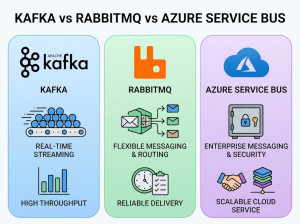
Modern distributed systems rely heavily on messaging and event streaming technologies to enable asynchronous communication, scalability, reliability, and decoupled architectures. Apache Kafka, RabbitMQ, and Azure Service Bus are among the most widely adopted messaging platforms, but each one is designed for different architectural goals and operational requirements.
Apache Kafka
Apache Kafka is a distributed event streaming platform designed for high-throughput, fault-tolerant, and real-time data pipelines.
Kafka is optimized for processing massive streams of events with high scalability and durability. It stores messages persistently in partitions and allows multiple consumers to independently read the same event streams. Kafka is commonly used for event-driven architectures, real-time analytics, log aggregation, stream processing, and microservices communication. Unlike traditional message brokers, Kafka behaves more like a distributed append-only log system where consumers track their own offsets and replay historical events when needed.
Why We Use Kafka?
Organizations use Kafka when they need:
• Extremely high throughput
• Real-time streaming
• Event sourcing
• Scalable distributed systems
• Durable event retention
• Stream processing capabilities
Strong Points of Kafka
• Very high throughput and scalability
• Excellent horizontal scaling
• Durable message retention
• Replay capability for historical events
• Strong ecosystem for stream processing
• Suitable for real-time analytics and big data workloads
• Supports millions of messages per second
Weak Points of Kafka
• More operational complexity
• Higher infrastructure requirements
• Steeper learning curve
• Not ideal for simple task queues
• Ordering guaranteed only within partitions
• Requires careful partition planning
RabbitMQ
RabbitMQ is a traditional message broker focused on reliable message delivery, routing flexibility, and asynchronous task processing.
RabbitMQ implements broker-based messaging using queues and exchanges, making it highly flexible for enterprise messaging scenarios. It supports multiple routing patterns such as direct, topic, fanout, and headers exchanges. RabbitMQ is commonly used for background jobs, task queues, transactional systems, request/reply communication, and service orchestration. Compared to Kafka, RabbitMQ prioritizes message delivery guarantees and routing sophistication over raw throughput.
Why We Use RabbitMQ?
Organizations use RabbitMQ when they need:
• Reliable task queues
• Complex routing logic
• Request-response messaging
• Lightweight asynchronous communication
• Simpler operational management
• Flexible message patterns
Strong Points of RabbitMQ
• Easy to set up and manage
• Flexible routing capabilities
• Excellent message acknowledgment support
• Strong reliability guarantees
• Good for transactional workloads
• Supports multiple protocols
• Lower operational complexity than Kafka
Weak Points of RabbitMQ
• Lower throughput compared to Kafka
• Less suitable for event replay
• Queue bottlenecks may occur at scale
• Limited long-term event retention
• Horizontal scaling is more challenging
Azure Service Bus
Azure Service Bus (ASB) is a fully managed enterprise messaging service in Microsoft Azure designed for secure and reliable cloud-based communication.
Azure Service Bus provides managed queues and publish-subscribe messaging without requiring infrastructure management. It supports advanced enterprise features such as sessions, dead-letter queues, duplicate detection, transactions, and scheduled delivery. The service integrates deeply with Azure ecosystems, making it ideal for enterprise cloud applications and hybrid architectures. Unlike Kafka or RabbitMQ, Azure Service Bus focuses heavily on managed reliability, enterprise integration, and operational simplicity.
Why We Use Azure Service Bus?
Organizations use Azure Service Bus when they need:
• Managed cloud messaging
• Enterprise-grade reliability
• Tight Azure integration
• Reduced infrastructure maintenance
• Secure cloud-native communication
• Hybrid application integration
Strong Points of ASB
• Fully managed service
• Minimal operational overhead
• Strong Azure ecosystem integration
• Enterprise security features
• Built-in dead-letter queues
• Message sessions and transactions
• High reliability and availability
Weak Points of ASB
• Vendor lock-in to Azure
• Higher cloud costs at scale
• Lower throughput than Kafka
• Less flexibility than self-hosted platforms
• Limited portability across cloud providers
When to Choose Which One?
Choose Kafka When
• You need real-time event streaming
• You process huge volumes of data
• Event replay is important
• You build event-driven microservices
• You need stream processing or analytics
• Scalability is a top priority
Typical use cases:
• Fraud detection
• Clickstream analytics
• IoT pipelines
• Log aggregation
• Real-time recommendation systems
Choose RabbitMQ When
• You need reliable task distribution
• Complex routing patterns are required
• Workloads are transactional
• You need request/reply communication
• Simplicity and flexibility matter more than throughput
Typical use cases:
• Background job processing
• Order processing
• Workflow orchestration
• Notification systems
• Internal service communication
Choose Azure Service Bus When
• You are heavily invested in Azure
• You prefer managed infrastructure
• Enterprise messaging reliability is required
• You need hybrid cloud integration
• Security and governance are major concerns
Typical use cases:
• Enterprise integrations
• Financial systems
• Corporate workflows
• Cloud-native business applications
• SaaS platform messaging
Comparison of Kafka, RabbitMQ and Azure Service Bus
| Feature | Apache Kafka | RabbitMQ | Azure Service Bus |
|---|---|---|---|
| Primary Purpose | Event streaming | Message brokering | Managed enterprise messaging |
| Architecture | Distributed log | Broker and queues | Managed cloud broker |
| Throughput | Very high | Medium | Medium |
| Message Retention | Long-term | Short-term | Configurable |
| Replay Support | Excellent | Limited | Limited |
| Routing Flexibility | Basic | Advanced | Moderate |
| Operational Complexity | High | Low | Very low |
| Cloud Managed | Optional | Optional | Yes |
| Best Use Case | Streaming and analytics | Task queues and routing | Enterprise cloud messaging |
Alternative Technologies
Apache Pulsar
Apache Pulsar combines messaging and event streaming with multi-tenant architecture and segment-based storage.
Best For:
• Multi-tenant systems
• Large-scale cloud-native streaming
• Geo-replication
Redpanda
Redpanda is a Kafka-compatible streaming platform designed for lower operational complexity and high performance.
Best For:
• Kafka-compatible deployments
• Simplified operations
• High-performance streaming
Amazon SQS
Amazon SQS is AWS’s fully managed queue service for scalable cloud messaging.
Best For:
• AWS-native applications
• Simple queue workloads
• Serverless architectures
Amazon Kinesis
Amazon Kinesis is a managed streaming platform for real-time analytics and event processing within AWS ecosystems.
Best For:
• AWS streaming pipelines
• Real-time analytics
• Managed event ingestion
NATS
NATS is a lightweight messaging platform optimized for low latency and microservices communication.
Best For:
• Lightweight messaging
• Edge computing
• Cloud-native systems
ActiveMQ
Apache ActiveMQ is a mature enterprise message broker supporting JMS and multiple messaging protocols.
Best For:
• Traditional enterprise systems
• Java ecosystems
• JMS-based architectures