Producer Consumer Problem in C# with Threading, BlockingCollection, and Channels
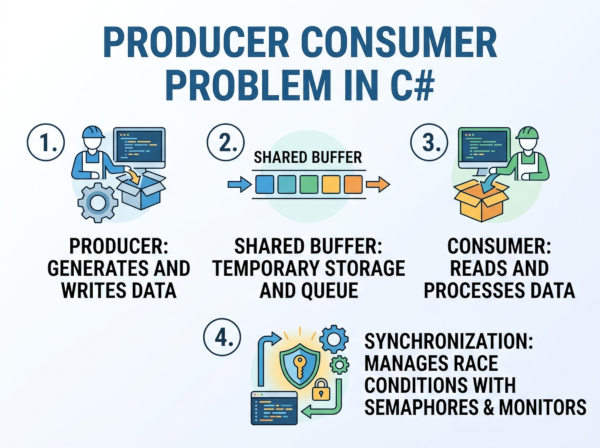
The Producer-Consumer problem is a multithreading synchronization pattern where producer threads generate data and consumer threads process that data using a shared resource such as a queue.
The Producer-Consumer problem is one of the most common concurrency problems in computer science. It models situations where one or more threads create work items while other threads consume or process those items.
The challenge is coordinating access to shared data safely and efficiently. Producers should not overwrite data while consumers are reading it, and consumers should not attempt to read data that does not yet exist.
In most implementations, producers place items into a queue, and consumers remove items from that queue. Synchronization mechanisms ensure both sides work correctly without race conditions or deadlocks.
Real-World Analogy for Producer Consumer Problem
Imagine a restaurant kitchen.
• Waiters place food orders into a shared order queue
• Chefs pick orders from the queue and prepare meals
The waiters are producers because they create work. The chefs are consumers because they process work.
If too many orders arrive at once, the queue grows. If chefs work faster than waiters, the queue becomes empty and chefs wait for new work.
This is exactly how producer-consumer systems behave in software applications.
Why We Use Producer-Consumer Pattern?
The producer-consumer model helps applications process work asynchronously and efficiently.
Without this pattern, applications often block while waiting for slow operations such as:
• database writes
• API calls
• file processing
• background jobs
• message handling
Instead of performing everything immediately, producers can enqueue work while consumers process tasks independently in the background.
This improves:
• responsiveness
• scalability
• throughput
• CPU utilization
Common Use Cases
Background Job Processing
Web applications frequently use producer-consumer systems for background tasks such as sending emails, generating reports, or resizing images.
For example, when a user uploads a file, the web request should finish quickly. Instead of processing the file immediately, the application pushes a job into a queue and a background consumer handles the expensive work later.
Logging Systems
Logging frameworks often use producer-consumer architecture internally.
Application threads produce log messages rapidly, while separate consumer threads write those logs to files or databases. This prevents application threads from slowing down because of disk I/O operations.
Message Queue Systems
Systems such as RabbitMQ, Kafka, and Azure Service Bus are essentially advanced producer-consumer systems.
Applications produce messages into queues, and independent services consume those messages asynchronously. This decouples systems and improves reliability in distributed architectures.
Video or Audio Streaming
Streaming applications continuously produce media chunks while playback systems consume them.
The buffer between production and consumption prevents interruptions caused by network fluctuations or processing delays.
Real-Time Analytics
Analytics pipelines often ingest events from millions of users. Producers generate event data while consumers aggregate, transform, and store it.
This architecture allows systems to scale horizontally under heavy traffic.
Core Challenges in Producer-Consumer Systems
Race Conditions
Multiple threads accessing the same queue simultaneously can corrupt data if synchronization is missing.
For example, two consumers may try to remove the same item at the same time.
Deadlocks
Improper locking strategies may cause threads to wait forever.
Deadlocks usually happen when threads hold locks while waiting for resources controlled by other threads.
Busy Waiting
A consumer continuously checking whether the queue has data wastes CPU resources.
Efficient systems use signaling mechanisms so consumers sleep until new items arrive.
Memory Growth
If producers generate items faster than consumers process them, the queue may grow indefinitely.
Bounded queues help prevent uncontrolled memory usage.
Basic Producer-Consumer Example in C#
Using Queue + lock
using System;
using System.Collections.Generic;
using System.Threading;
class Program
{
private static Queue<int> queue = new Queue<int>();
private static object lockObject = new object();
static void Main()
{
Thread producer = new Thread(Produce);
Thread consumer = new Thread(Consume);
producer.Start();
consumer.Start();
producer.Join();
consumer.Join();
}
static void Produce()
{
for (int i = 1; i <= 10; i++)
{
lock (lockObject)
{
queue.Enqueue(i);
Console.WriteLine($"Produced: {i}");
}
Thread.Sleep(500);
}
}
static void Consume()
{
while (true)
{
lock (lockObject)
{
if (queue.Count > 0)
{
int item = queue.Dequeue();
Console.WriteLine($"Consumed: {item}");
}
}
Thread.Sleep(300);
}
}
}
Problem with This Implementation
Although the example works, it has several weaknesses.
The consumer continuously loops and checks the queue even when no items exist. This wastes CPU cycles and is called busy waiting.
It also lacks proper termination handling and queue capacity management.
Real applications need more advanced synchronization mechanisms.
Better Solution Using Monitor
Monitor.Wait() and Monitor.Pulse() allow threads to sleep efficiently until data becomes available.
Producer-Consumer with Monitor
using System;
using System.Collections.Generic;
using System.Threading;
class Program
{
private static Queue<int> queue = new Queue<int>();
private static object lockObject = new object();
static void Main()
{
Thread producer = new Thread(Produce);
Thread consumer = new Thread(Consume);
producer.Start();
consumer.Start();
producer.Join();
consumer.Join();
}
static void Produce()
{
for (int i = 1; i <= 10; i++)
{
lock (lockObject)
{
queue.Enqueue(i);
Console.WriteLine($"Produced: {i}");
Monitor.Pulse(lockObject);
}
Thread.Sleep(500);
}
}
static void Consume()
{
while (true)
{
lock (lockObject)
{
while (queue.Count == 0)
{
Monitor.Wait(lockObject);
}
int item = queue.Dequeue();
Console.WriteLine($"Consumed: {item}");
}
}
}
}
How Monitor Works?
Monitor.Wait():
• releases the lock
• puts the thread into waiting state
• resumes only when another thread signals
Monitor.Pulse():
• wakes one waiting thread
This avoids unnecessary CPU usage because consumers sleep until producers add data.
Best Modern Solution in C#
BlockingCollection
BlockingCollection<T> is the preferred producer-consumer abstraction in modern .NET applications.
It automatically handles:
• thread synchronization
• blocking
• signaling
• bounded capacity
• concurrent access
BlockingCollection Example
using System;
using System.Collections.Concurrent;
using System.Threading;
using System.Threading.Tasks;
class Program
{
static BlockingCollection<int> queue =
new BlockingCollection<int>(5);
static void Main()
{
Task producer = Task.Run(() =>
{
for (int i = 1; i <= 10; i++)
{
queue.Add(i);
Console.WriteLine($"Produced: {i}");
Thread.Sleep(500);
}
queue.CompleteAdding();
});
Task consumer = Task.Run(() =>
{
foreach (var item in queue.GetConsumingEnumerable())
{
Console.WriteLine($"Consumed: {item}");
Thread.Sleep(1000);
}
});
Task.WaitAll(producer, consumer);
}
}
Why BlockingCollection Is Better?
BlockingCollection removes most manual synchronization complexity.
If the queue becomes full:
• producers automatically wait
If the queue becomes empty:
• consumers automatically wait
This dramatically simplifies concurrent programming.
Bounded vs Unbounded Queues
Unbounded Queue
An unbounded queue has no size limit.
This is simple but dangerous because producers may generate data faster than consumers can process it, eventually causing memory exhaustion.
Bounded Queue
A bounded queue has a maximum capacity.
When full: producers block until consumers free space
Bounded queues provide backpressure and prevent memory explosions in high-load systems.
Advanced Producer-Consumer with Channels
Modern .NET applications increasingly use System.Threading.Channels.
Channels are:
• lightweight
• asynchronous
• high-performance
• ideal for async/await workflows
Channel Example
using System;
using System.Threading.Channels;
using System.Threading.Tasks;
class Program
{
static async Task Main()
{
var channel = Channel.CreateBounded<int>(5);
var producer = Task.Run(async () =>
{
for (int i = 1; i <= 10; i++)
{
await channel.Writer.WriteAsync(i);
Console.WriteLine($"Produced: {i}");
}
channel.Writer.Complete();
});
var consumer = Task.Run(async () =>
{
await foreach (var item in
channel.Reader.ReadAllAsync())
{
Console.WriteLine($"Consumed: {item}");
}
});
await Task.WhenAll(producer, consumer);
}
}
Advantages of Producer-Consumer Pattern
Better Application Responsiveness
Applications can respond quickly while background workers process expensive operations separately.
This is especially important in web applications where users should not wait for long-running tasks.
Improved Scalability
Multiple consumer threads can process work in parallel.
As workload increases, systems can scale horizontally by adding more consumers.
Decoupled Architecture
Producers and consumers operate independently.
This makes systems more modular, flexible, and easier to maintain.
Efficient Resource Usage
Threads spend less time blocked and more time performing useful work.
Proper synchronization also reduces unnecessary CPU consumption.
Disadvantages of Producer Consumer Pattern
Increased Complexity
Multithreaded systems are harder to design and debug than single-threaded systems.
Issues such as race conditions and deadlocks can be difficult to reproduce.
Synchronization Overhead
Locks and signaling mechanisms introduce overhead.
In highly optimized systems, excessive locking can reduce throughput.
Queue Backpressure Problems
If consumers cannot keep up, queues may become bottlenecks.
Applications need strategies for handling overload situations.
Common Mistakes about Producer Consumer Problem
Forgetting Thread Safety
Using a normal Queue<T> without synchronization causes data corruption under concurrent access.
All shared resources must be protected properly.
Infinite Queue Growth
Many beginners create unbounded queues without monitoring capacity.
Under heavy load, memory usage can grow until the application crashes.
Holding Locks Too Long
Expensive operations inside lock blocks reduce concurrency.
Locks should protect only the minimal critical section.
Busy Waiting
Repeatedly checking queue state wastes CPU cycles.
Efficient systems use blocking synchronization primitives instead.
Alternatives to Producer-Consumer Pattern
Actor Model
Actor systems such as Akka.NET use message-passing instead of shared-memory synchronization.
This reduces locking complexity and improves scalability in distributed systems.
Reactive Programming
Reactive systems process streams of events asynchronously.
Libraries such as Rx.NET are useful for event-driven architectures and real-time pipelines.
Dataflow Blocks
TPL Dataflow provides higher-level concurrent processing pipelines.
It simplifies complex workflows involving batching, throttling, retries, and parallel execution.
Producer-Consumer Complexity
| Operation | Typical Complexity |
|---|---|
| Enqueue | O(1) |
| Dequeue | O(1) |
| Blocking Wait | O(1) |
| Synchronization | Depends on contention |
When You Should Use Producer-Consumer?
Use producer-consumer architecture when:
• work arrives asynchronously
• tasks are expensive
• throughput matters
• background processing is needed
• systems must scale independently
It is one of the foundational patterns in modern backend systems, cloud services, and distributed architectures.