Kafka Exactly Once Delivery Explained with C# Examples
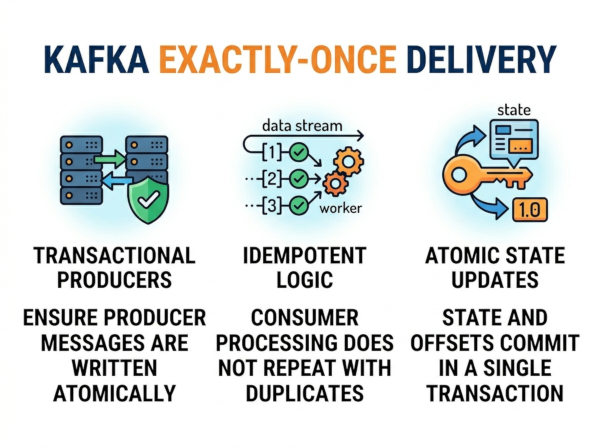
Kafka exactly once delivery, also called Kafka Exactly Once Semantics (EOS), is a mechanism that ensures a message is processed only one time, even if failures, retries, or network interruptions occur.
In distributed systems, duplicate messages are a common problem. For example, imagine a payment system where a producer sends a transaction event to Kafka. If the producer crashes before receiving an acknowledgment, it may retry sending the same message again. Without proper protection, the payment could be processed twice.
Kafka exactly once delivery solves this problem by combining idempotent producers, transactional messaging, and offset coordination. This allows applications to avoid duplicate processing while maintaining reliability.
Why Exactly Once Delivery Is Important?
Exactly once delivery is critical for systems where duplicate processing can cause serious business problems. Applications such as banking, order processing, inventory management, and financial reporting often require strict consistency.
For example, in an e-commerce platform, processing the same order twice could charge the customer multiple times or reduce inventory incorrectly. In analytics systems, duplicate events may produce inaccurate reports and misleading business decisions.
Kafka’s exactly once semantics help developers build reliable event-driven systems without implementing complex duplicate-detection logic manually.
Kafka Message Delivery Guarantees
Kafka supports three delivery models:
At Most Once
Messages may be lost, but duplicates are avoided. If a consumer fails before processing a message, the message might disappear permanently.
This model is useful for low-priority systems such as metrics collection where occasional data loss is acceptable.
At Least Once
Messages are never lost, but duplicates may occur. If failures happen during processing, Kafka may redeliver messages.
This is the most common Kafka delivery model because it provides strong durability while remaining relatively simple.
Exactly Once
Messages are processed exactly one time without duplication or loss.
This model is ideal for transactional systems where consistency and accuracy are critical.
How Kafka Exactly Once Delivery Works?
Kafka exactly once semantics rely on multiple components working together.
Idempotent Producers
An idempotent producer ensures Kafka stores each produced message only once, even if the producer retries sending it multiple times.
Kafka assigns sequence numbers internally to detect duplicate write attempts.
Transactions
Kafka transactions allow multiple operations to succeed or fail together atomically.
For example, a consumer can read messages, process them, produce new messages, and commit offsets inside a single transaction. If any step fails, Kafka rolls back the entire transaction.
Offset Coordination
Kafka coordinates consumer offsets with transactional writes. This prevents situations where messages are processed but offsets are not committed correctly.
As a result, applications avoid both duplicate processing and data loss.
Key Components of Kafka Exactly Once Delivery
Transactional Producer
A transactional producer can send messages atomically using Kafka transactions.
If the transaction succeeds, all messages become visible together. If it fails, none of them are committed.
Idempotence
Idempotence prevents duplicate writes caused by retries or network issues.
This feature is enabled automatically when transactions are configured correctly.
Transaction Coordinator
Kafka includes an internal transaction coordinator responsible for managing transaction states.
The coordinator tracks active transactions and ensures consistency across brokers.
Consumer Isolation Level
Consumers can choose whether to read committed transactional messages only.
Using read_committed prevents consumers from reading incomplete or aborted transactions.
How Kafka Exactly Once Delivery Works Internally?
Suppose a producer sends a payment event:
Payment #5001
A network failure occurs before the acknowledgment reaches the producer. The producer retries sending the same message.
Without idempotence:
Payment #5001
Payment #5001
The consumer receives duplicate messages.
With Kafka exactly once delivery enabled, Kafka detects the duplicate retry and stores only one message.
How to Enable Kafka Exactly Once Delivery?
Producer Configuration
Kafka producers must enable idempotence and transactions.
Required settings:
enable.idempotence=true
acks=all
transactional.id=my-transaction-id
These settings ensure reliable transactional writes.
Consumer Configuration
Consumers should use committed transaction isolation:
isolation.level=read_committed
This prevents reading incomplete transactions.
Kafka Exactly Once Delivery C# Producer Example
Install Kafka Library
dotnet add package Confluent.Kafka
Transactional Producer Example
using Confluent.Kafka;
var config = new ProducerConfig
{
BootstrapServers = "localhost:9092",
EnableIdempotence = true,
Acks = Acks.All,
TransactionalId = "payment-transaction-producer"
};
using var producer =
new ProducerBuilder<string, string>(config).Build();
producer.InitTransactions(TimeSpan.FromSeconds(10));
try
{
producer.BeginTransaction();
await producer.ProduceAsync(
"payment-events",
new Message<string, string>
{
Key = "payment-1001",
Value = "Payment Approved"
});
producer.CommitTransaction();
Console.WriteLine("Transaction committed.");
}
catch (Exception ex)
{
producer.AbortTransaction();
Console.WriteLine($"Transaction aborted: {ex.Message}");
}
This producer guarantees transactional message delivery and avoids duplicate writes.
Kafka Exactly Once Delivery Consumer Example in C#
using Confluent.Kafka;
var config = new ConsumerConfig
{
BootstrapServers = "localhost:9092",
GroupId = "payment-processing-group",
AutoOffsetReset = AutoOffsetReset.Earliest,
IsolationLevel = IsolationLevel.ReadCommitted
};
using var consumer =
new ConsumerBuilder<string, string>(config).Build();
consumer.Subscribe("payment-events");
while (true)
{
var result = consumer.Consume();
Console.WriteLine(
$"Message: {result.Message.Value}");
}
This consumer reads only committed transactional messages.
Best Use Cases for Kafka Exactly Once Delivery
Payment Processing Systems
Financial systems cannot tolerate duplicate transactions. Exactly once delivery ensures payments are processed correctly even if failures occur during communication.
This helps prevent double charges, inconsistent balances, and financial reconciliation issues.
Order Management Platforms
E-commerce systems process large volumes of orders continuously. Duplicate order processing may create shipment errors, inventory inconsistencies, and customer dissatisfaction.
Kafka exactly once semantics reduce the risk of duplicate order execution.
Inventory Tracking Systems
Warehouse and inventory applications must maintain accurate stock counts. Duplicate inventory events can create incorrect inventory calculations.
Exactly once delivery helps preserve inventory consistency across distributed systems.
Banking and Accounting Applications
Accounting systems require strict transactional integrity. Duplicate ledger entries may lead to incorrect financial reporting and auditing problems.
Kafka transactions help maintain accurate event processing in these environments.
Real-Time Analytics Pipelines
Analytics systems often aggregate millions of events. Duplicate events can distort reports, dashboards, and machine learning outputs.
Exactly once semantics improve data quality and reporting accuracy.
Advantages of Kafka Exactly Once Delivery
Prevents Duplicate Processing
The primary advantage is protection against duplicate message processing.
This is especially important in transactional and financial applications where duplicates can cause expensive errors.
Improves Data Consistency
Kafka transactions ensure related operations succeed or fail together.
This helps maintain reliable and consistent distributed systems.
Simplifies Application Logic
Without exactly once semantics, developers often need custom duplicate-detection logic.
Kafka reduces this complexity by handling reliability internally.
Better Reliability in Distributed Systems
Distributed systems commonly experience retries, temporary failures, and network interruptions.
Kafka exactly once semantics improve resilience under these conditions.
Disadvantages of Kafka Exactly Once Delivery
Increased Complexity
Exactly once delivery introduces additional configuration and transactional logic.
Developers must understand producer transactions, offset coordination, and consumer isolation settings carefully.
Performance Overhead
Transactions and idempotence add additional processing overhead.
Applications requiring maximum throughput may experience slightly reduced performance.
More Resource Usage
Transactional state management increases broker resource consumption.
Large-scale systems using heavy transactional workloads may require additional infrastructure capacity.
Limited External Guarantees
Kafka guarantees exactly once delivery only inside Kafka workflows.
If external systems such as databases are involved, developers may still need idempotent application logic.
Kafka Exactly Once vs At Least Once
| Feature | Exactly Once | At Least Once |
|---|---|---|
| Duplicate Messages | Prevented | Possible |
| Performance | Slightly slower | Usually faster |
| Complexity | Higher | Lower |
| Best For | Financial and transactional systems | General event processing |
| Reliability | Very high | High |
Best Practices for Kafka Exactly Once Delivery
Use Stable Transactional IDs
Transactional IDs should remain stable across producer restarts.
Changing transactional IDs frequently may break transaction recovery mechanisms.
Keep Transactions Short
Long-running transactions increase broker overhead and resource usage.
Applications should commit transactions quickly whenever possible.
Monitor Transaction Failures
Transaction metrics and logs should be monitored carefully.
Frequent transaction failures may indicate infrastructure or configuration problems.
Combine with Idempotent Consumers
Even with Kafka EOS, external systems may still require duplicate protection.
Database writes and API calls should remain idempotent whenever possible.
Alternatives to Kafka Exactly Once Delivery
Application-Level Deduplication
Applications can store processed message IDs and ignore duplicates manually.
This approach works but increases application complexity significantly.
Database Transactions
Some systems rely on database transactions instead of Kafka transactions.
This may simplify smaller architectures but can become difficult in distributed systems.
RabbitMQ Acknowledgment Mechanisms
RabbitMQ supports acknowledgments and retry handling but does not provide Kafka-style distributed transaction semantics natively.
It is often better suited for task queues rather than event-stream consistency guarantees.
Apache Pulsar Transactions
Apache Pulsar also supports transactional messaging and exactly once processing features.
Some organizations consider Pulsar when evaluating alternatives to Kafka.
Conclusion
Kafka exactly once delivery provides strong guarantees that messages are processed only one time, even during failures and retries. By combining idempotent producers, transactions, and offset coordination, Kafka enables reliable distributed event processing for mission-critical systems.
Exactly once semantics are especially valuable in financial systems, inventory management, analytics pipelines, and transactional applications where duplicate processing can create major business problems. Although this feature introduces additional complexity and overhead, it significantly improves reliability and consistency in distributed architectures.
For C# developers, libraries such as Confluent.Kafka make it possible to implement Kafka transactional producers and consumers with relatively simple configuration, allowing modern applications to benefit from Kafka’s advanced reliability guarantees.