ZeroMq (ØMQ)

ZeroMQ (ØMQ) is a high-performance, asynchronous messaging library used for building distributed and concurrent systems. Unlike traditional message brokers, it is not a standalone server but a lightweight messaging layer embedded directly into applications.
It provides a message queue, but unlike message-oriented middleware, a ØMQ system can run without a dedicated message broker. The library is designed to have a familiar socket-style API.
Key Features of ZeroMQ
• Brokerless architecture (no central server required)
• High-performance messaging (low latency, high throughput)
• Supports multiple messaging patterns (pub/sub, request/reply, push/pull)
• Works over TCP, inter-process, and in-process communication
• Lightweight library with minimal dependencies
• Built-in support for asynchronous and concurrent communication
• Language bindings for C, C++, Python, Java, C#, and more
Distributed Computing Made Simple
• The socket library that acts as a concurrency framework.
• Carries messages across inproc, IPC, TCP, and multicast.
• Connect N-to-N via fanout, pubsub, pipeline, request-reply.
• Async I/O for scalable multicore message-passing apps.
• Large and active open source community.
• 40+ languages including C, C++, Java, .NET, Python.
• Most OSes including Linux, Windows, OS X.
• Free software with full commercial support.
Messaging Patterns in ZeroMQ
ZeroMQ is designed around communication patterns rather than queues.
1. Request–Reply (REQ–REP)
• Client sends request
• Server responds
Used in: RPC systems, Simple service calls
2. Publish–Subscribe (PUB–SUB)
• Publisher sends messages
• Multiple subscribers receive them
Used in: Event broadcasting, Live data feeds (e.g., stock prices)
3. Push–Pull (Pipeline)
• Tasks pushed into a queue
• Workers pull and process them
Used in: Load balancing, Parallel job processing
4. Dealer–Router
• Advanced routing and load distribution
• Used in complex distributed systems
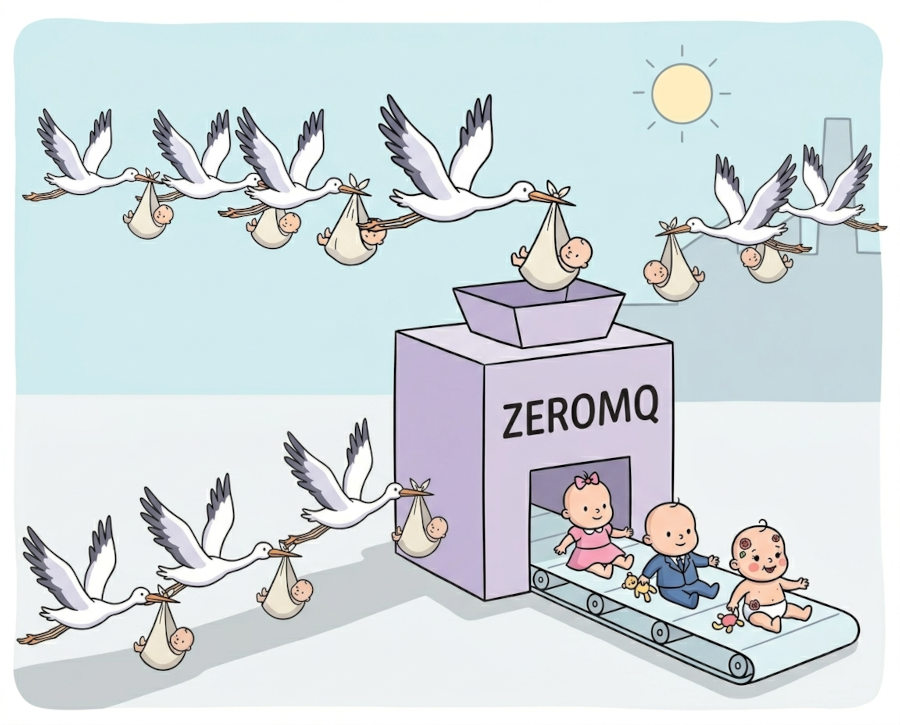
How ZeroMQ Works (Conceptually)
Unlike traditional messaging systems like message brokers, ZeroMQ:
• Does not store messages persistently
• Does not require a broker process
• Directly connects sockets between applications
It acts as a smart networking layer rather than a server.
Advantages and Limitations
Advantages
• Extremely fast and lightweight
• No central broker required
• Scales well for distributed systems
• Flexible messaging patterns
• Works in many programming languages
• Suitable for real-time systems
Limitations
• No built-in message persistence (messages can be lost)
• No native monitoring or management UI
• More complex reliability logic must be implemented manually
• Not ideal for enterprise queue management out of the box
• Requires careful design for fault tolerance