Prompt engineering in LLM

If fine-tuning is changing the model, prompt engineering is about getting better results without changing the model at all.
Prompt engineering is the practice of designing inputs (prompts) so a language model produces the desired output.
A “prompt” isn’t just a question—it can include:
• Instructions
• Examples
• Constraints
• Formatting rules
• Context
Weak prompt example: Explain AI
Engineered prompt: Explain artificial intelligence in simple terms for a 12-year-old. Use 3 short paragraphs and a real-world analogy.
Same model but very different output.
Why do we use prompt engineering?
Because LLMs are highly sensitive to input phrasing.
Prompt engineering helps you:
• Get more accurate answers
• Control tone and structure
• Reduce ambiguity
• Avoid unnecessary tokens (cost)
• Improve reliability without retraining
It’s often the fastest and cheapest way to improve results.
Who uses prompt engineering?
Everyone using LLMs seriously
• Developers
• Product teams
• Analysts
• Writers
• AI engineers building tools and agents
• Non-technical users refining outputs in daily workflows
It’s one of the rare AI skills that’s both:
• beginner-friendly
• and deeply sophisticated at scale
Core techniques of Prompt engineering
1. Clear instructions
Be explicit about what you want: Summarize this in 3 bullet points.
2. Role prompting
Assign a role: You are a senior software engineer. Review this code.
3. Few-shot prompting
Provide examples:
Input: 2+2 → Output: 4
Input: 3+5 → Output: 8
Input: 7+6 → Output:
4. Chain-of-thought prompting
Encourage step-by-step reasoning: Explain your reasoning step by step.
5. Output constraints
Control format: Return the answer as valid JSON.
Real-life analogy of Prompt engineering
1. Giving instructions to a human
• Vague: “Do this report”
• Clear: “Write a 1-page summary with 3 key insights and a conclusion”
Better instructions produce better results.
2. Google search (but smarter)
• Bad query produces irrelevant results
• Well-phrased query produces exactly what you need
Prompting is like talking to a very literal, very powerful assistant.
Relationship of Prompt engineering to other concepts
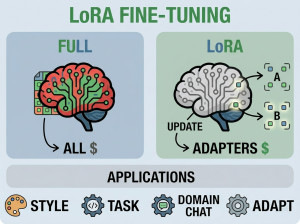
Fine-tuning
Prompt engineering = no training, instant
Fine-tuning = training required, more consistent
Prompting is usually tried first
Tokenization
Prompts are turned into tokens
Small wording changes → different token splits → different outputs
Attention mechanism
Your prompt influences what the model “pays attention” to
Alternatives / complements of Prompt engineering
Prompt engineering is often combined with:
1. RAG (Retrieval-Augmented Generation)
Add external knowledge dynamically
2. System prompts
Set global behavior (tone, rules)
3. Fine-tuning
When prompting alone isn’t enough
Downsides / Disadvantages of Prompt engineering
• Not always reliable (can vary across runs)
• Trial-and-error heavy
• Model-dependent (what works on one model may not on another)
• Limited control compared to training