Fine Tuning in LLM

Fine-tuning is the process of taking a pretrained model (trained on massive, general data) and training it further on a smaller, targeted dataset.
Instead of starting from scratch, you “nudge” the model to behave in a certain way.
Example:
• Base model → knows general language
• Fine-tuned model → writes legal contracts or answers medical questions in a specific style
Why do we use fine tuning?
Pretrained models are:
• Broad
• General-purpose
• Not aligned to specific needs
Fine-tuning helps:
• Specialize behavior (e.g., customer support tone)
• Inject domain knowledge (legal, finance, medicine)
• Control outputs (format, style, safety)
• Adapt to internal/company data
Without fine-tuning, you’d rely only on prompting, which has limits.
Who uses fine tuning?
• AI companies (OpenAI, Google, Meta) → align base models
• Enterprises → adapt models to internal workflows
• Startups → build niche tools (legal AI, coding assistants, etc.)
• Researchers → experiment with new capabilities
Developers often use tools like:
• PyTorch
• TensorFlow
• Hugging Face Transformers
Types of fine-tuning
1. Supervised fine-tuning (SFT)
Train on input → ideal output pairs
Example:
• User: Explain black holes simply
• Assistant: (high-quality explanation)
Teaches the model “this is what a good answer looks like”
2. Reinforcement Learning from Human Feedback
• Humans rank outputs
• Model learns preferences (helpful, safe, polite)
This is how models become more aligned with human expectations
3. Instruction tuning
Special case of SFT
Focused on following instructions well
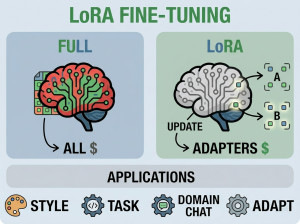
4. Parameter-efficient fine-tuning (PEFT)
Only adjust small parts of the model (e.g., LoRA)
Much cheaper than full retraining
Real-life analogy of Fine Tuning
1. University → job training
Pretraining = getting a general education
Fine-tuning = learning your specific job
2. Hiring a chef
Base model = chef who knows all cuisines
Fine-tuning = training them to cook your restaurant’s menu
Alternatives of Fine Tuning
Fine-tuning isn’t the only way to adapt models:
1. Prompt engineering
Give better instructions instead of retraining
Fast, cheap, but less consistent
2. Retrieval-Augmented Generation (RAG)
Feed external data at runtime instead of training
Great for up-to-date or private data
3. System prompts / context injection
Control behavior via initial instructions
Lightweight but limited depth
When fine-tuning is better?
Use it when you need:
• Consistent tone/style
• Domain-specific expertise
• Structured outputs (e.g., JSON, legal format)
• Behavior that prompting alone can’t reliably enforce
Downsides / Disadvantages of Fine Tuning
• Costly (compute + data preparation)
• Risk of overfitting (too narrow behavior)
• Maintenance (needs updates as data changes)
• Catastrophic forgetting (can lose general knowledge if done poorly)